

When a question matters deeply, it is natural to want an answer you can trust. If intuition, tarot or spiritual reflection has a place in your life, you may turn to it for perspective while wondering what to do next.
Clarity does not have to arrive as a complete picture of your future. Sometimes it is quieter: naming what you need, finding the question nobody has answered yet, or choosing a next step that respects your limits. You can welcome spiritual meaning and still check the practical details.
Seven Steps for Finding Clear Answers
Use these steps at your own pace. Not every question needs a long exercise, and a real deadline or urgent safety concern comes before waiting for the right feeling.
1. Choose one question, not your whole future
Start with the decision in front of you. “What should I do with my life?” can hold many different needs. “What do I need to know before accepting this role?” is easier to work with.
Give yourself a little room to think: silence non-essential alerts, take a comfortable walk or jot down a sentence. A familiar prayer or quiet ritual can belong here if you enjoy it. You do not need a special object, a vivid meditation or a perfectly calm mind.
Try this: Finish “The question I need to work on today is…” If several questions appear, choose the one with the nearest real deadline or the greatest practical importance.
2. Ask what can actually be answered
The NHS problem-solving guide distinguishes problems you can act on from hypothetical worries about things outside your control. You can ask about a job’s responsibilities; you cannot guarantee that every day in it will be satisfying.
Open questions help you explore meaning. Direct yes-or-no questions help establish details. You may need both. These hypothetical reframes show the difference between wanting a future verdict and finding a question you can use:
- “Will this move make me happy?”
- “What would change about my costs, daily routine and access to people I care about?”
- “Does this sign mean we should reconnect?”
- “What would need to be different, and is contact safe, welcome and consistent with the other person’s boundaries?”
- “Am I meant to follow this new interest?”
- “What small way could I explore it without neglecting my existing commitments?”
Try this: Identify one answer that could genuinely change your decision. Then name where you could get it: a written agreement, a relevant professional or a respectful conversation.
3. Listen to intuition without making it carry every answer
You may experience intuition as a quiet nudge, a feeling in your body or a sudden sense that something deserves attention. You can respect that experience without turning it into a verdict about another person or the future.
If a possible move feels wrong, ask what the feeling brings into focus. Perhaps being far from friends matters more than you first admitted. Perhaps there is a lease term you have not understood. If you cannot identify a reason, you can leave the feeling unresolved rather than inventing one.
Enthusiasm deserves the same care. Feeling encouraged by a reading can be meaningful, but it is not a reason to skip checking costs, consent or an important condition. If a prediction is involved, our guide to psychic predictions explains how to keep the original claim separate from what you later associate with it.
Try this: Write “I feel…” and “I can check…” on separate lines. Neither line has to cancel the other.
4. Ask for the kind of guidance you need
A friend may help you find words for a concern. Someone doing a job may describe its everyday demands. An appropriate qualified professional can help with a medical, legal or financial question within their field. Choose the person for the question, not simply for how confidently they answer.
Ask about relevant credentials, fees, scope and any interest in what they recommend. “What is this advice based on, and what remains uncertain?” is a reasonable question. You are allowed to ask for an explanation you understand.
If your concern is persistent distress rather than an optional spiritual question, our guide to psychic readings and therapy explains why those conversations have different roles. A reading should not decide treatment or replace professional care.
Try this: Name the help you want before looking for an adviser: information, specialist advice, emotional support or spiritual reflection.
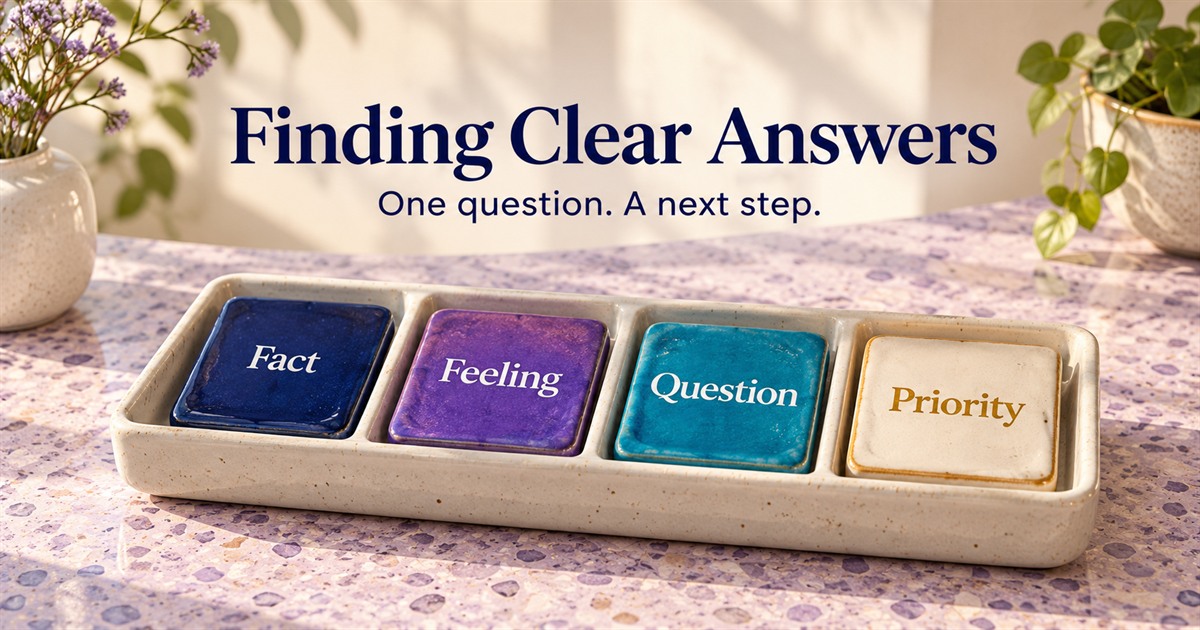
5. Give facts, feelings, unknowns and priorities separate places
A note becomes more useful when it shows which kind of information you are recording. Here is a hypothetical job-offer example, not a recommendation to accept or reject a role:
Verified fact
“The written offer states the salary and start date.” This is information you can point to, while still checking what the agreement includes.
Feeling or impression
“I feel excited and uneasy.” That describes your experience; it does not establish whether the workplace will suit you.
Unanswered question
“How often would I be expected to work late?” A missing answer is something to investigate, not automatically a warning sign.
Personal priority
“Predictable evenings matter because of my family commitments.” A priority can guide a choice without being a fact about the employer.
The next step might be to ask about overtime and request the answer in writing. Notice how the note turns a vague uneasy feeling into a specific question without dismissing the feeling or pretending it proves something.
Try this: Label each important note. If a sentence mixes two categories, split it. Do not let a long list of minor benefits hide a non-negotiable requirement.
6. Try a small step with a clear limit
Where possible, explore an option before making a larger commitment. A conversation with someone in a field, an introductory lesson or a visit to a possible neighborhood may answer a limited question. None can reproduce every part of the future.
Decide what you want to learn, how much time or money you can use, and what would make you stop. “Temporary” does not automatically mean low-risk: living arrangements and contracts can create real obligations. Do not test an unsafe situation or involve another person without their freely given agreement.
Try this: Complete “This step will help me learn… It will not establish… My limit is…”
7. Set a time to decide or review
If waiting is possible, give it a purpose and an ending. “I will ask two questions before Friday, then review the options” creates a plan. Waiting indefinitely for a sign can leave the same decision untouched.
Include the cost of waiting: an offer might expire or someone may need your response. At the review point, you might choose, decline, ask for more time or seek specialist help. Material new information can justify changing your mind; the return of an uncomfortable feeling does not always require restarting the whole process.
Try this: Choose a realistic review time and name what, if anything, you need to learn before it arrives.
If You Bring the Question to a Psychic Reading
A spiritual reading can give a concern a different language: a card about transition, an image of a doorway or a theme you want to explore. Ask how the interpretation relates to your question rather than feeling obliged to make every detail fit.
Choose your time and spending limit before the session. You can finish with an unanswered question, disagree with an interpretation or decide against another booking. Our reading preparation guide helps shape a focused session; the quality-reading checklist covers the service standards you can expect.
If you find yourself seeking another reading before every ordinary choice, pause and consider what would help outside the session. Our guide to grounding and spiritual escapism offers a way to reflect without making your beliefs the problem.
A Short Decision Note You Can Reuse
Copy these prompts into a private note and date it. Share only the details needed when asking for help; you do not need to give an adviser your whole personal history.
- My decision
- What exactly am I deciding, and by when?
- My priorities
- What matters most, and what would make an option unacceptable?
- What I know
- Which details have I verified, and which are feelings or assumptions?
- What I need to ask
- Which missing answer could change my choice, and who can provide it?
- My next step
- What can I do within my time, cost, safety and energy limits?
- My review point
- When will I reconsider, and what new information would justify a change?
You Can Move Forward Without Knowing Everything
A clear answer may be “yes,” “no,” “not yet” or “I need a different kind of help.” It can also be a small next step while part of the question stays open. Let spiritual reflection support your judgment, not become a test you must pass before you are allowed to choose.
If distress is persisting or interfering with everyday life, speak with a qualified healthcare professional. NIMH’s mental-health guidance explains when to seek help and how a primary care provider can help you find appropriate support. Urgent health or safety concerns should not wait for a reading or a sign.
*rolls eyes* So we’re supposed to sit around meditating while our lives fall apart? Sounds fantastic! If only clarity came with a side of pizza! Maybe next time include actionable tips that work in real life?
This article is so refreshing! I love the emphasis on mindfulness and self-reflection. It’s like a gentle reminder to slow down and truly connect with ourselves. Thanks for sharing these valuable strategies for clarity!
Honestly, this post feels overly simplistic. Life isn’t just about asking the right questions or meditating. Sometimes, we need hard facts and concrete steps rather than vague advice. Not impressed.
‘Finding clear answers’ sounds like something you’d hear from a fortune cookie! But hey, if journaling makes you feel better about life decisions, then who am I to judge? Pass me that cookie!
‘Life is full of questions’—and cookies! Who knew clarity could be so delicious? Maybe I should journal about my favorite snacks instead!
‘If only clarity was as easy as a snack!’ But seriously, don’t underestimate the power of writing down thoughts—it can really help organize chaotic minds!
The article brings up some interesting points about intuition and journaling, which are often overlooked in decision-making processes. However, it’s crucial to balance these insights with practical data-driven approaches for optimal results.
‘Be patient’? Sure, but let’s not forget that sometimes you need to act fast! We can’t always wait for ‘clarity’ when deadlines are looming; sometimes you just have to make the best choice available.
While I appreciate the focus on introspection, I argue that relying solely on intuition can lead to poor decision-making. A thorough analysis of all options should be prioritized over feelings alone in serious matters.
This article is like a breath of fresh air! The idea of taking small steps really resonates with me—life is too short for rash decisions. Thanks for inspiring us to embrace the journey!