

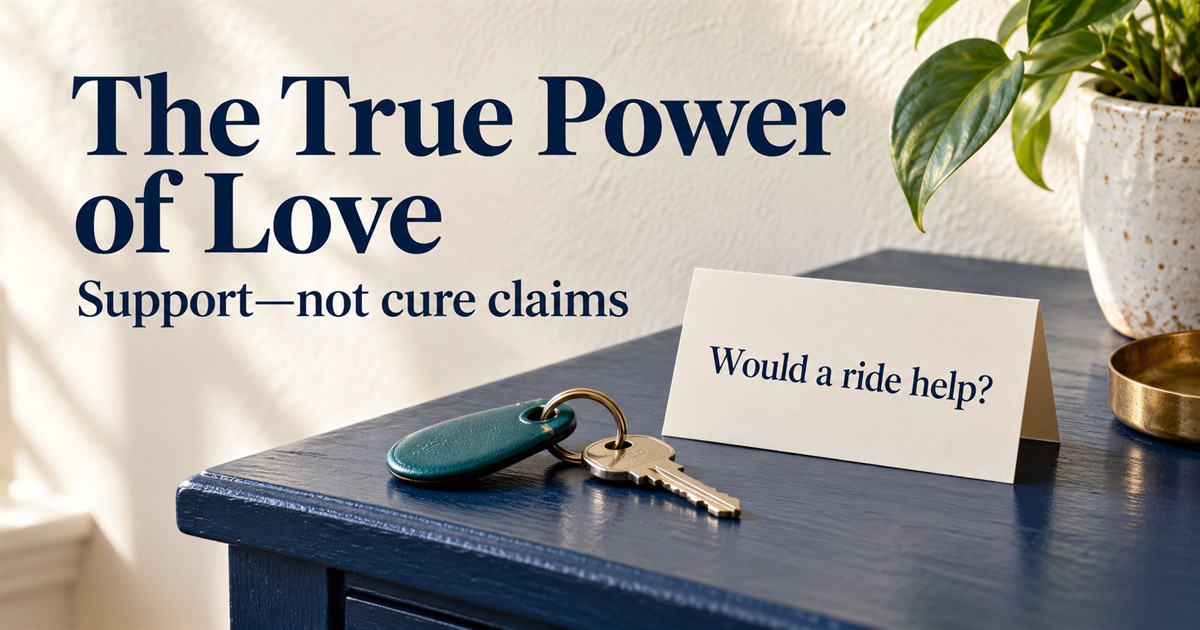
Sometimes love looks less like a grand declaration and more like staying to listen, asking before a hug or following through on one small offer. If you experience love as a spiritual connection, you can honor that meaning while paying attention to the other person’s real needs. Its everyday value does not depend on promising a cure.
If you are frightened, grieving or unwell, you do not have to become perfectly positive to deserve care. Having a difficult emotion is not a failure to love yourself, and another person’s health outcome is not a test of how much love you gave them.
Support is valuable; it is not a medical promise
CDC guidance on social connection describes the value of stable, supportive relationships for coping with stressful challenges. It includes emotional support and practical help, such as transport to an appointment. Those are concrete ways that connection can matter.
That does not mean romantic love can diagnose, prevent or cure a particular illness. Nor does it show that someone became ill because they avoided their spiritual self, felt afraid or received “negative messages.” Claims about love’s frequency or the heart’s magnetic field do not establish a treatment.
For cancer specifically, the National Cancer Institute’s explanation of common cancer myths says there is no convincing evidence that a positive or negative attitude determines the risk of developing or dying from cancer. Emotional support may help with coping; it should not become a demand to suppress sadness or a reason to blame a patient.
Keep symptoms, medication and treatment decisions with appropriate health professionals. Compassion can accompany care, but a spiritual interpretation should not replace it. Our guide to spiritual healing and its limits makes the same distinction between personal meaning and medical claims.
Love can leave room for fear, anger and grief
You can care about someone and still feel worried, frustrated or uncertain. A loving relationship does not require the absence of every uncomfortable feeling. What matters is how you respond, including whether you respect the other person’s dignity and choices.
“Everything happens for a reason” or “you just need to love yourself” may feel reassuring to the speaker but unwelcome to someone in pain. Ask rather than deciding what interpretation they need. A more open response might be, “I do not know how to make this easier. Would you like company, practical help or some space?”
There is no need to argue a person out of their feelings. You can acknowledge what they say without predicting their future, agreeing with every belief or promising that the situation will improve. Listening and honest uncertainty can exist together.
Offer help the other person actually wants
Care becomes more useful when an offer is specific and the recipient has a genuine choice. The following is a simple conversation sequence, not a therapy technique:
- Ask what would help. “Would you like me to listen, help with a task or leave this conversation for another time?”
- Make a realistic offer. Name what you can do, such as bringing an agreed meal or helping organize a question for an appointment. Do not promise more time, money or responsibility than you can give.
- Respect the answer. A declined offer is not rejection of your worth. Ask before touch, sharing personal details, inviting visitors or involving other people.
- Check before repeating it. Needs can change. Agree on whether a later message or visit would be welcome rather than assuming constant contact is helpful.
Offering support also does not make you responsible for rescuing someone or ensuring a particular outcome. You can be caring while saying, “I can help with this part, but I cannot take over the whole situation.”
Respect matters more than a declaration of love
Love is respect describes healthy relationships in terms of communication, boundaries, mutual respect and support, including room for privacy and space. A declaration of love does not cancel those needs.
Consider behavior alongside feelings. Can you say no without punishment? Can you keep appropriate privacy, see supportive people and make your own choices? Is an apology followed by a change, or only another demand that you accept harm as proof of devotion?
For U.S. dating-relationship support, love is respect offers help at 866-331-9474 or by texting LOVEIS to 22522. If someone may monitor your activity, consider safer ways to seek support; private browsing cannot guarantee privacy. Call 911 for immediate danger; outside the U.S., use local services.
Our guide to compatibility and healthy relationship choices looks at practical fit rather than treating a strong connection as evidence that a relationship must continue.
Self-compassion does not require feeling wonderful
A modest starting point is to describe a problem without attacking your character. “I am finding this task difficult” leaves room to ask for help; “I am broken and deserve this” closes that room. You do not have to replace every critical thought with a grand affirmation.
Choose one action consistent with your needs: rest, ask for clarification, arrange appropriate care or set a limit on what you can take on. Our flexible self-care and boundaries guide offers adaptable wording and a small plan.
Self-compassion is not a promise that pain will vanish. If you are struggling, support can come from a trusted person or a qualified professional. You can accept help without first proving that you have mastered your emotions.
A practical meaning for love’s power
Some people interpret love as a spiritual source of meaning or wholeness. That is a personal belief, not evidence that illness comes from disconnection or that affection repairs the body.
A grounded expression of love makes room for reality: the person’s feelings, their consent, your limits and the care they may need. It may not solve the whole problem, but it can make a particular moment more respectful, less lonely or more manageable—without promising an outcome neither of you can control.
Touch should be welcome to everyone involved.
This article beautifully articulates the profound connection between love and healing. It’s inspiring to see how the power of love can be the key to our wellness. Let’s spread more love in our lives!
The concepts discussed here align closely with modern psychology and holistic health practices. Research supports the idea that emotional well-being directly influences physical health, making this an essential read for anyone interested in self-care.
‘Love is the best medicine’—if only my doctor accepted hugs as payment! Seriously though, I appreciate the message but I’m still going to need my antibiotics for that nasty cold!
“This post raises some thought-provoking ideas about self-love and healing. It’s crucial that we address our mental state to improve our overall health. The mind-body connection is real, and acknowledging it can bring transformative changes.”
“Absolutely! The more we embrace love and positivity in our lives, the better equipped we are to handle life’s challenges. It’s all about perspective and nurturing our inner selves.”
“But what if someone’s mental state is affected by something beyond their control? Isn’t it naive to think all illness can be cured through positive thinking alone? We must also consider external factors.”
“Healing through love? Does that mean I can just binge-watch rom-coms instead of going to therapy? If laughter truly is the best medicine, then sign me up for a comedy marathon right now!”
‘Just love it away!’ Great advice! Next time I have a broken leg, I’ll just hug it until it feels better! This article seems to overlook practical solutions and offers more of a feel-good mantra.
‘Love heals all?’ Really? What about medical science? We can’t just ignore established treatments because they don’t fit into this fluffy narrative. Love is important, but let’s not dismiss the role of medicine.
While I appreciate the intention behind this piece, it feels overly simplistic. Love is not a magical cure-all for every ailment. There are many complex factors involved in healing that aren’t addressed here.