

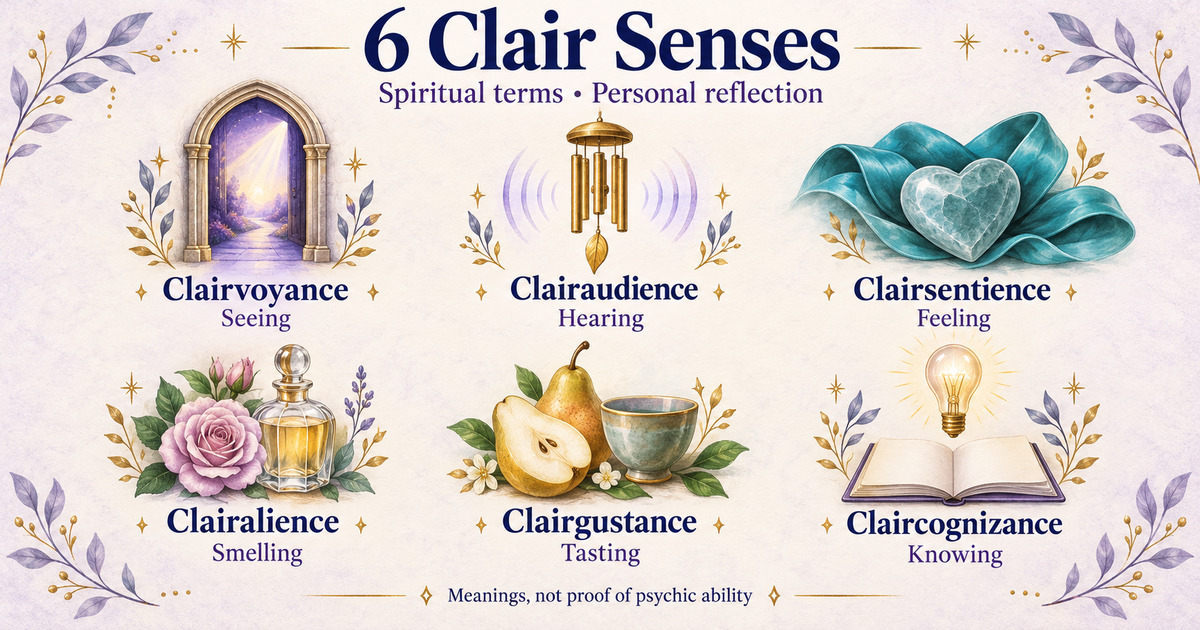
The six “clair senses” are terms used in some psychic and spiritual discussions to describe experiences associated with seeing, hearing, feeling, smelling, tasting and knowing. They are a vocabulary for interpreting impressions—not a checklist that proves psychic ability or a medical explanation for unusual sensations.
You may find this language meaningful without treating every dream, mood or sensory change as a message. Learning the terms does not require you to identify a dominant gift, connect with spirits or make your experiences more intense.
Open the full-size illustrated six-term guide. Each term’s meaning and limits are explained in accessible text below.
What the six clair-sense terms describe
The explanations below describe spiritual usage. They do not establish that an experience came from another dimension, a deceased person or someone else’s private thoughts.
1. Clairvoyance: seeing
Clairvoyance is commonly described as “clear seeing.” In this context, people may use it for mental images, symbolic pictures or experiences they interpret as visions. A picture in your imagination can be useful for reflection without being a verified view of an event.
If you imagine a doorway while considering a change, you might explore what “a new opening” means to you. That association does not show what will happen next. Being artistic or enjoying visual ideas is not proof of clairvoyance.
2. Clairaudience: hearing
Clairaudience means “clear hearing” in this spiritual vocabulary. It may refer to an internally imagined word, remembered sound or experience interpreted as a message. Remembering a song and hearing an unexplained sound as though it were present are different experiences.
Musical interests do not establish a psychic gift. Do not try to intensify unexplained voices or ringing to obtain guidance; the health guidance below matters.
3. Clairsentience: feeling
Clairsentience is described as “clear feeling,” often linked to emotional or bodily impressions. Feeling tense around someone does not prove that you are reading their emotions or absorbing their energy.
Separate your experience from your interpretation: “I feel uneasy” is something you can report; “I know you are angry” needs clarification. Ask how the person feels, and leave room for their answer to differ from your impression.
4. Clairalience: smelling
Clairalience is the spiritual term associated with “clear smelling.” Someone might interpret a familiar fragrance as a reminder of a loved one. The emotional meaning of that association is different from evidence that the person is present.
A smell without an identifiable source should not automatically be assigned a spiritual cause. Check ordinary surroundings safely and seek assessment for unexplained changes rather than assuming a message.
5. Clairgustance: tasting
Clairgustance is described as “clear tasting.” In spiritual accounts, a taste may be associated with a memory or an interpretation involving someone who has died. Imagining a favorite food is not the same as having a persistent unusual taste in your mouth.
Enjoying cooking or noticing flavors does not identify a psychic gift. New or lingering taste changes deserve appropriate healthcare attention, not a demand to develop them.
6. Claircognizance: knowing
Claircognizance means “clear knowing” in this framework: a strong impression that something is true without a readily explained reason. Certainty alone does not verify the impression.
This label should not be presented as demonstrated mind-reading or reliable future prediction. Before acting on a belief about someone, check observable information and respect their privacy. Our guide to the meaning behind intuition offers evidence-checking questions.
What “developing” these senses can safely mean
A grounded approach is to explore imagination, attention and personal meaning—not to promise paranormal results. Choose an ordinary, low-pressure activity if you enjoy it:
- Visual reflection: look at an object, then describe or sketch what you noticed. Distinguish what was visible from details you added in imagination.
- Sound reflection: listen to familiar music at a comfortable volume and note the memories or feelings it brings up. You are reflecting on a real sound, not trying to hear a spirit.
- Emotional reflection: name your feeling, note the situation and identify a question or boundary that would help. Do not assign your feeling to another person without asking.
You can stop at any point. Do not use sleep deprivation, substances, prolonged isolation or forced sensory experiences to produce a “sign.” You do not need to smell, taste or see something unusual for a reflection practice to count.
A fictional memory-and-meaning example
If you keep notes, separate what happened from what you think it means. Imagine looking at an old family photograph:
- The experience
- “I remembered my grandmother’s perfume while looking at the photograph.” This describes a memory, not a new smell in the room.
- The meaning I considered
- “I felt close to her, and I wondered whether the memory was a message.” You can hold that as a personal spiritual interpretation.
- What remains unverified
- The comforting association does not establish who or what caused it. You do not need to turn the memory into proof or dismiss the comfort it brings.
This is a made-up example, not a reported client experience. If you are actually noticing an unexplained or persistent sensory change, use the care guidance below rather than treating the exercise as a way to identify its cause.
When sensory changes need healthcare attention
Spiritual terminology should not delay checking symptoms:
- Ringing, buzzing or similar unexplained sounds: NIDCD describes tinnitus as perceived sound without an external source. It recommends starting with a primary care doctor for assessment. Ringing is not evidence of clairaudience.
- Unexplained or changed smells: NIDCD’s smell-disorder guidance describes phantosmia as sensing an odor that is not there. Smell changes have several possible causes; discuss them with a healthcare professional.
- Persistent unusual tastes: NIDCD’s taste-disorder guidance describes phantom taste perception and other changes. Medical and dental assessment can help identify the cause. Do not stop prescribed medicines on your own.
- Unexplained voices or visions: the NHS advises medical help for hallucinations. Seek prompt assessment rather than assuming spiritual contact.
Seek emergency help if voices tell you to harm yourself or someone else, symptoms rapidly worsen or sudden confusion develops. In the United States, call 911; do not drive yourself to emergency care. MedlinePlus also explains when prompt assessment and emergency help are needed.
This is not a way to diagnose yourself from a list. Tell a healthcare professional what you experienced, when it started and whether it affects daily life. You can discuss beliefs that matter to you while still investigating possible health causes.
Keep interpretation separate from authority over others
A clair-sense label does not authorize someone to reveal another person’s “hidden” motives, diagnose illness or override consent. If a reader says they know what you think before you speak, you can correct them or decline the reading. An interpretation is not more important than your own account of your experience.
You also do not owe anyone a demonstration of a gift. There is no need to compare yourself with performers or buy repeated services to fix an alleged failure. Practices should remain voluntary and within your chosen budget.
If you choose a reflective reading
Ask a present-focused question, such as “What does this symbol bring up for me?” A reader’s answer is an interpretation you may consider, not authority over your health, relationships or private memories. Agree on the fee and spending limit beforehand, keep sensitive details private and decline pressure to pay for an urgent “repair.” Our quality reading checklist offers useful questions about costs and respectful limits.
For ways to stay connected to ordinary life, explore grounding versus spiritual escapism. The most useful outcome of learning these six terms may simply be clearer language: what you noticed, what it means to you and what remains uncertain.
“Learning your giftings” sounds poetic, but isn’t it also somewhat vague? How do we differentiate between genuine intuition and mere coincidence? There’s room for exploration here, but let’s not romanticize every gut feeling.
@_Philosopher_33 That’s an intriguing point! Yet many spiritual practices thrive on subjective experiences which can’t always be rationalized. It’s worth exploring these feelings rather than dismissing them outright.
I think you both raise important points! Yet, isn’t it limiting to box people’s experiences into strict categories? Maybe there’s merit in allowing individuals their unique interpretations of intuition and instinct.
“Clairgustance” sounds like something I’d expect from a cooking show! Imagine tasting your grandma’s lasagna from beyond! If only I could clairvoyantly order pizza instead!
If my gut feeling tells me to eat dessert first, am I clairgustant or just hungry? Maybe I should start taking notes on my snacks; who knew my cravings might be linked to spiritual insights!
@WhimsicalWillow Haha! But seriously, isn’t food often tied to memory and emotion? Perhaps you’re onto something profound about connecting taste with our spiritual journeys!
Or maybe you’re just craving sugar… Let’s not turn every whim into a metaphysical experience! Sometimes dessert is just dessert!
While I see the appeal of these ideas, we must consider the psychological implications behind them. Isn’t it possible that what some call ‘clair gifts’ is just heightened perception or intuition? Let’s not jump to supernatural conclusions too quickly.
But isn’t that what makes these experiences so unique? Just because they aren’t scientifically proven doesn’t mean they lack value. Many personal experiences can’t be quantified but are still very real to those who experience them.
“Listening to spirits like tuning into a radio?” Really? Next, they’ll tell us we need Wi-Fi to connect with our ancestors! This whole thing feels more like a sitcom than actual advice.
The descriptions of each clair gift are quite interesting. I appreciate the thorough explanation of clairsentience and claircognizance, particularly how they relate to emotional intelligence and intuition in everyday life.
I found this article incredibly insightful! The way it breaks down the different clair gifts is so helpful for anyone looking to understand their own abilities. It’s like a guide to unlocking our hidden potential!
Honestly, this just sounds like a bunch of new-age nonsense. How can someone claim to have special gifts without any scientific evidence? It seems like a way for people to feel special about nothing.