

Flower symbolism / your own meaning
A flower can hold a memory before you have words for it: a familiar garden, a colour you love or a shape that invites a closer look. If nature belongs in your intuitive or spiritual practice, a flower picture can give that reflection a gentle place to begin.
You do not need a rare bloom, a special purchase or a perfectly quiet mind. A photograph, drawing or printed picture is enough. Let it open a question about your own life, while leaving room for information you can check and choices that remain yours.
Start with a picture, not a preparation
Using flower imagery is different from using a plant on or in your body. This guide is about looking, imagining and writing—not teas, tinctures, sprays, baths, burning plants or taking supplements. Flower symbolism does not establish psychic ability, predict events or guarantee protection or healing.
You can also choose an image that has no spiritual association at all. A flower does not have to be “right” for you, and not feeling anything special is not a failure of intuition.
Six flower pictures, six questions to explore
These are optional creative associations, not universal meanings or rules shared by every tradition. Choose the picture that interests you and change the question if another one fits better. The small action is an invitation, not an instruction.
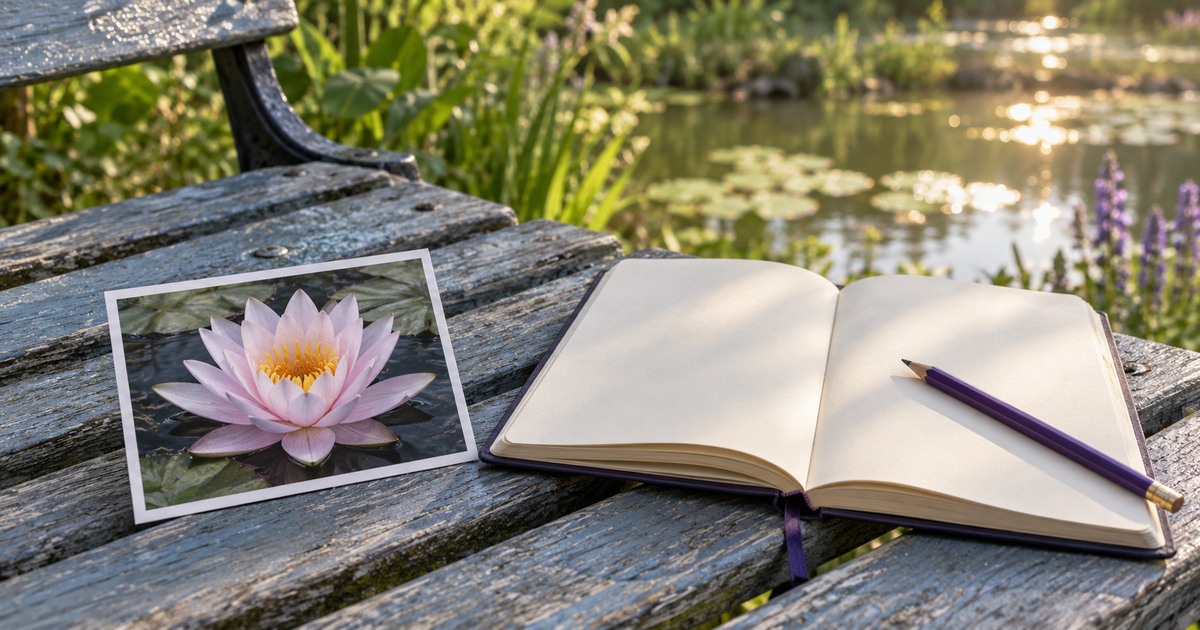
Water lily: a pause
Let an image of a bloom on water stand for a little space between an impression and a response.
“What have I actually noticed, and what am I adding to it?”
A small action: Write one observation and one interpretation on separate lines before deciding what to do.
Violet: quiet strengths
If a small flower reminds you of overlooked qualities, use it to acknowledge something you already bring to your life.
“Which strength have I used recently without giving myself credit?”
A small action: Name a specific example, such as asking a clear question or keeping a boundary.
A night-blooming flower: dreams
A picture with a nighttime theme can become a heading for a dream note. You do not need to identify or obtain a plant called “queen of the night.”
“What feeling stayed with me, and does it connect with anything in waking life?”
A small action: Record what you remember and label any meaning as your interpretation, not a prediction.
Blue poppy: curiosity
An unfamiliar colour or shape can invite a second look without requiring a supernatural explanation.
“What detail or possible explanation have I not considered?”
A small action: Write one question you could answer through ordinary information, observation or conversation.
Red clover: priorities
Use the picture as a reminder to consider how your time is shared between demands, care and rest.
“What deserves a little more room, and what could be made smaller?”
A small action: Adjust one optional commitment if you can. No herbal product is needed for this exercise.
Orchid: your own pace
Let a distinctive flower image remind you that a meaningful choice does not have to follow someone else’s timetable.
“What would a manageable next step look like in my actual circumstances?”
A small action: Choose a step you can adapt, including rest or asking for help. Our guide to making changes without self-blame offers more examples.
Try a short picture-and-journal practice
Use a picture you already have or your own sketch. There is no required length, special arrangement or result to achieve. You can simply look at the image and stop there.
-
Notice before interpreting
Describe a few visible details: pale petals, an uneven edge, a dark background. If you are using an imagined flower instead, note that you are working with an image in your mind.
-
Give your impression a name
Write a feeling, memory or association in your own words. “This reminds me of waiting” describes your response; it does not establish what another person feels or what will happen.
-
Ask one open question
Try “What matters to me here?” or choose a prompt above. Avoid turning the picture into a yes-or-no command about health, money, safety or another person’s consent.
-
Choose what comes afterward
Keep one useful question, check one fact, rest or speak with someone supportive. Put the image away when you want to finish; you do not need another sign before you can end the practice.
If reflection becomes repeated checking or pressure to feel certain, pause. Our guide to grounding and spiritual reflection explores how to leave room for ordinary care. You can skip journaling if it adds pressure rather than helping you express yourself.
A worked example: from a flower image to a clear question
Suppose a water-lily picture brings up a sense of distance while you are thinking about a friendship. You can respect the impression without assuming it reveals your friend’s private thoughts. A hypothetical note might read:
- What I notice
- “The flower is separate from the other shapes in the picture. I feel a little lonely looking at it.”
- What it means to me
- “I may be missing a sense of connection. That does not tell me why my friend has been quiet.”
- What I can check
- “We have not arranged a catch-up recently. I can decide whether to ask if they would like one, without assuming they owe a reply.”
- My next choice
- “If contact is safe and welcome, I could send one low-pressure invitation. I can also seek company elsewhere or choose not to contact them.”
The useful outcome is a question you understand better, not proof that the flower delivered a message. Another person’s words, boundaries and consent still matter. If the situation is unsafe, choose appropriate support instead of using a symbol as a reason to reconnect.
Keep plant safety separate from spiritual meaning
Check the species and safety before bringing real plants into your home, including risks to children and pets. California Poison Control explains that common names can cover different species. An article illustration is not a plant-identification method.
Nor is a flower prompt a reason to begin an herbal product. NCCIH’s red clover guidance says supplements may be unsafe during pregnancy or breastfeeding and advises speaking with a healthcare provider before using herbal products when taking medicines. Enjoying a clover picture and taking an extract are different choices.
Keep the meaning—and the choices—your own
You may experience a flower image as a spiritual reminder, a comforting memory or simply something beautiful. None of those responses needs to become a test of your gifts. A quiet or difficult day is not evidence of blocked energy, and you do not need to buy a reading or cleansing to make the exercise count.
If you want to bring the reflection into a psychic reading, take a question rather than a conclusion: “This image brought up a concern about connection; could we explore what I need?” Our reading-preparation guide can help you choose a topic, boundaries and a spending limit.
A meaningful symbol can sit alongside practical information and qualified care. Keep what helps, leave what does not fit and let the picture be a starting point—not the authority over your life.
‘Angel’s Trumpet’—I mean, who wouldn’t want a flower that sounds like it’s straight out of a fantasy novel? Let’s just hope it doesn’t call angels on us when we forget to water it!
While the claims about flowers enhancing psychic abilities may sound far-fetched, it’s interesting to consider the historical uses of plants in spiritual practices across cultures. Many have used nature for healing and insight.
‘Historical uses’ or not, I’d rather stick to science than play around with flowers thinking they can change my life. What’s next, talking to trees?
Exactly! Plants have been used for centuries in various cultures for their metaphysical properties. It’s worth looking into how they connect with our mental and spiritual well-being.
‘Queen of the Night’ sounds like a beautiful flower! I’m curious about its dream interpretation abilities—maybe I’ll try it out and see if I finally understand my dreams better!
‘Water Lilies can protect your psychic gifts’? Wow, next you’ll tell me that daisies can solve world hunger! Sounds like a flower power fairytale if you ask me.
The variety of flowers listed is quite intriguing! Each seems to offer unique benefits that could potentially aid those on a spiritual journey. It’s fascinating how people might find meaning in connecting with nature.
I absolutely loved this article! It’s fascinating how flowers can enhance our psychic gifts. I’ve always believed in the power of nature, and now I have new plants to explore. Thank you for sharing this knowledge!
This post is a load of nonsense. How can flowers possibly help with psychic abilities? It sounds like pseudoscience to me. People need to be more critical and not fall for these ridiculous claims.
So you’re telling me all I need is some Himalayan Blue Poppy and I’ll be the next psychic sensation? Where do I sign up? Guess it’s time to hit up the local garden center!