

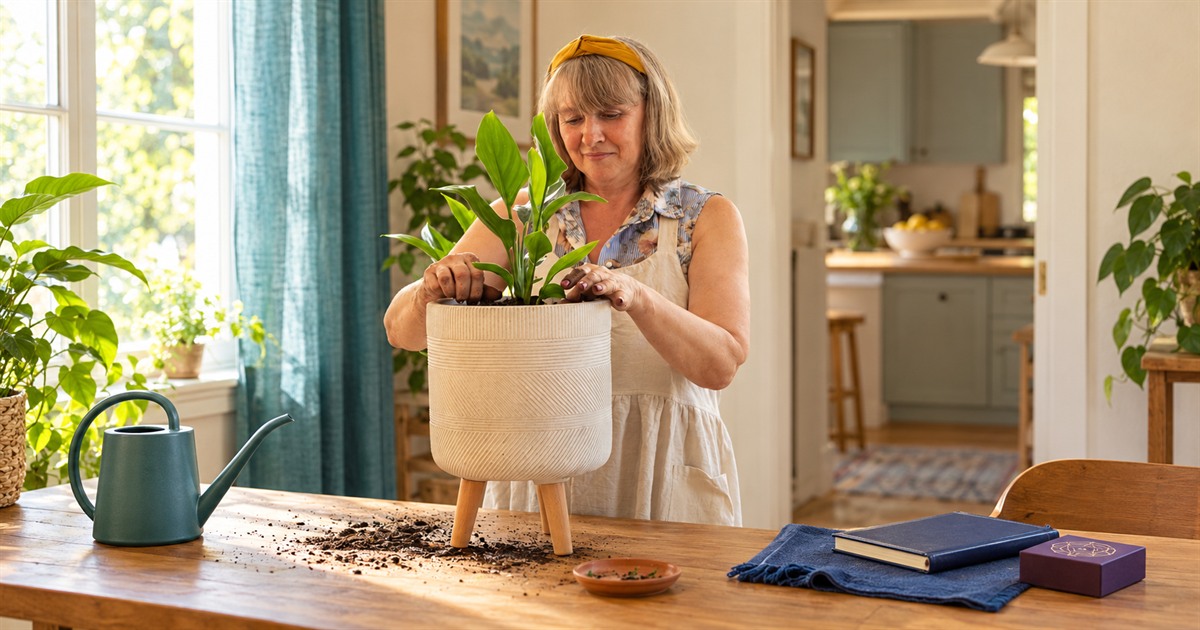
Spiritual reflection / room for real life
A spiritual practice can be a place to pause without becoming a place to hide. Prayer, tarot, meditation or a quiet moment by a window may help you hear yourself more clearly. The useful question is what the practice makes room for afterward.
You do not have to give up your beliefs to notice a pattern of avoidance. Nor do you have to turn every reflective moment into a task. Grounding is about reconnecting with the life you are actually living, including its need for rest, care and uncertainty.
Look at the pattern, not the spiritual tool
The same deck of cards can prompt a useful question or become part of a long search for reassurance. The same meditation can offer a welcome break or keep pushing an important decision into tomorrow. The tool itself does not tell you which is happening.
Grounding brings you back
You become more aware of where you are, what you feel and what is within your choice. You may still be sad or uncertain, but you can finish the practice and respond to a present need.
Escapism keeps moving the return
Relief becomes tied to another sign, spread or session before you can face the same safe issue. Over time, the issue is repeatedly deferred and the practice leaves less room for the rest of your life.
Here, spiritual escapism is a description of that pattern, not a diagnosis or a judgement about your faith. One postponed chore or one evening of comfort does not establish it. Look for repetition, increasing cost or time, and what is becoming harder to attend to.
Rest and safety are not failures to act
Resting, pacing around disability or illness, declining unsafe contact and asking for help can all be appropriate next steps. You do not need to prove that a practice is worthwhile by becoming productive immediately. A boundary does not stop being valid because someone calls it avoidance.
What the difference can look like in everyday life
These are hypothetical examples, not accounts of clients. Use them to recognise a direction, not to score yourself as a good or bad spiritual person.
A relationship question
- Reflection with a return
- A reading helps you name a need for clearer communication. You consider whether contact is safe, then decide what you want to ask or what boundary you need.
- A pattern to pause
- You keep buying readings about what someone secretly feels while setting aside their actual words, consent or lack of contact.
A work or money concern
- Reflection with a return
- A short prayer or journal entry gives you space to name your fear. You then locate the bill, prepare a question or ask someone to help you review the options.
- A pattern to pause
- You wait for a perfect sign before looking at a deadline, or buy another prediction instead of checking the information already available.
Grief or a difficult feeling
- Reflection with a return
- A familiar ritual gives the feeling a place. You allow sadness to remain and choose companionship, rest or another kind of support.
- A pattern to pause
- You feel you must be spiritually positive before anyone can hear how much you are hurting, so you keep your need for support hidden.
A pleasant distraction can be a reasonable break. The concern is not that you felt relief; it is that relief keeps becoming a condition for dealing with the same need. In its specific discussion of trauma, the VA National Center for PTSD explains that relying on avoidance can worsen PTSD symptoms. That does not mean you should confront trauma or unsafe situations on your own.
A gentle check after a practice
Instead of asking whether you feel perfectly calm, try these questions:
- Present: Can I notice something about my surroundings and what I need right now?
- Honest: Can I name the feeling or uncertainty without forcing it to disappear?
- Free to finish: Can I put the tool away, or does it feel as though another round is required?
- Supported: Is there a safe next step, a helpful person or a genuine need for rest that I can acknowledge?
There is no pass mark. If an answer is difficult, it is information about what you may need, not evidence that your intuition or faith has failed. A short note over a few occasions may be more useful than checking your state over and over in the same sitting.
Try a sensory option if it suits you
In spiritual language, grounding may mean feeling rooted in the earth or settled in your energy. In mental-health resources, it usually means bringing attention to present sensations and surroundings. A meaningful spiritual image does not establish an electrical, aura-related or guaranteed medical effect.
NHS inform describes a five-senses grounding sequence. If it feels suitable, sit or stand comfortably and notice what is already around you. You do not need to close your eyes or force a deep breath.
-
Five things you can see
Notice ordinary details: the edge of a curtain, the shape of a leaf or the colour of a cup.
-
Four things you can feel
Notice comfortable contact, such as clothing, the chair or a surface supporting you. Do not seek an unpleasant sensation.
-
Three things you can hear
Listen for sounds already present. You do not have to create noise or identify every source.
-
Two things you can smell
Notice a familiar, comfortable scent if one is there. Skip this part if it is unavailable or unpleasant.
-
One thing you can taste
Notice a taste already present, if comfortable. You do not need to eat, drink or find a special object to finish.
The numbers are prompts, not requirements. Use accessible senses, change the count or stop. Afterward, choose whether to return to an ordinary activity, rest or contact someone supportive. If you prefer a shorter format, the VA’s grounding activity menu offers other ways to focus on the present.
Change course if a practice makes things worse
If inward attention or a breathing exercise increases distress, you can stop rather than push through. Try a neutral external detail only if it is comfortable, or ask for support. Repeated panic, disconnection or difficulty returning to daily life deserves a conversation with a qualified clinician.
NCCIH notes that meditation can have unwanted effects and should not replace conventional care. Do not postpone assessment of a medical problem while trying to find the right spiritual exercise.
Keep intuition meaningful without making it a verdict
You may experience intuition as a spiritual nudge, a bodily feeling or a quiet inner impression. You can explore what it means to you while leaving room for error. Feeling calm does not prove that an impression is true, just as feeling anxious does not automatically make a concern false.
Separate three things: what you noticed, the meaning you gave it, and the information you can check. For example, “I felt uneasy after that conversation” describes your experience. “That person intends to harm me” is a further claim, not something the feeling alone establishes. If there is a concrete safety concern, respond to the facts and seek appropriate help.
If protection language is part of your practice, our guide to psychic protection, grounding and boundaries offers ways to pair a personal ritual with practical limits. Another person’s words, choices and consent still matter, whatever an interpretation suggests.
Give a paid reading a clear ending
A reading can be a place for reflection without becoming the place where every decision must be authorised. Before booking, choose a subject you want to explore and what you do not want discussed. Our reading preparation guide can help you shape those questions.
Set the time and spending limit separately from how reassured you hope to feel. Use the reading cost guide to understand how a minute rate becomes a total. You can finish a session with an unanswered question; you do not owe another payment because uncertainty remains.
Notice whether the reader respects your limits, welcomes questions and leaves your choices with you. The quality-reading checklist offers practical standards for that experience. A comforting interpretation and a respectful service are worth considering separately from any prediction.
Give the insight a small practical home
Before you put the notebook or cards away, try three lines. This is an optional reflection note, not a treatment plan:
- What came up?
- Name a feeling, concern or useful question without turning it into a certainty.
- What is mine?
- Identify a choice within your control, such as asking, checking, resting or arranging support.
- What comes next?
- Choose one small step and a realistic time, with room to adapt to safety and capacity.
A worked reflection example
What came up: “I am afraid to open a message about an appointment.” What is mine: “I can choose when to read it and ask someone to sit with me.” What comes next: “After lunch, I will open it with support and note whether it needs a reply.”
This example is not a command to act before you are ready. If the step is too large, make it smaller. If it is unsafe, choose a safer route. If the need is rest or care, let that be the next step.
For concerns about whether a service is encouraging reflection or dependency, our guide to reviewing psychic services explains the difference between personal meaning, conduct you can observe and factual claims that need checking.
Know when a different kind of support is needed
Spiritual companionship and professional care can belong in the same life. Seek qualified help if distress persists, worsens or affects sleep, relationships, safety or everyday functioning. You do not need to abandon your beliefs to describe what is happening honestly to a healthcare professional.
If there is immediate danger or you may harm yourself or someone else, use local emergency or crisis support now. Do not wait for a reading, a sign or a grounding exercise to decide whether help is allowed.
You can keep the meaning and loosen the pressure. Let a practice offer a pause, an honest question or a sense of connection. Then leave enough room for ordinary care, independent choices and a life that continues even while some answers remain unknown.
15 questions about grounding and spiritual escapism
1. What is the difference between grounding and spiritual escapism?
Grounding helps you reconnect with the present and choose a workable next step. Spiritual escapism describes repeatedly using a practice to put off a safe issue, feeling or source of support. Look at the pattern and its consequences, not whether you use cards, prayer or meditation.
2. Can meditation become a way of avoiding something?
Yes, but taking a meditation break is not automatically avoidance. Notice whether you can finish the practice and return to your needs, or whether the same concern keeps being postponed while the practice grows longer. Adjusting the routine is an option, not a failure of faith.
3. Is resting instead of acting spiritual escapism?
Not by itself. Sleep, recovery, disability pacing and quiet time can be appropriate needs. A next step may be resting, asking for an accommodation or arranging help. This is not a productivity test, and you do not need to earn rest by completing a task.
4. Do I have to contact someone to prove I am not avoiding them?
No. Refusing unsafe contact or keeping a protective boundary is not something you have to reverse. If a conversation is appropriate but difficult, you can plan its timing or ask for support. Do not use this checklist to pressure yourself into contact that puts you at risk.
5. What if I keep pulling tarot cards about the same question?
Choose a stopping point before you begin, such as one spread and a short note. Write down what remains uncertain, then put the cards away. If another draw mainly promises a feeling of certainty, consider taking a break and identifying what information or support you actually need.
6. How can I keep paid readings from becoming repeated reassurance?
Decide your purpose, spending cap and stopping point before booking. Do not let a new worry automatically become another purchase. Pause if you are repeatedly buying answers to the same unchanged question or spending money needed elsewhere; a reading does not have to settle every uncertainty.
7. Is spiritual grounding the same as a mental-health grounding exercise?
Not exactly. Spiritual grounding may describe feeling rooted, connected to the earth or settled in your energy. Mental-health grounding exercises direct attention toward present surroundings and sensations. You can value both, but a meaningful image is not proof of a medical effect or a substitute for care.
8. Do I have to complete all five senses in a grounding exercise?
No. Use senses that are accessible and comfortable for you, and skip anything unpleasant or unavailable. You do not need to search for a scent, eat something or reach a perfect count. If an exercise increases distress or disorientation, stop and seek support rather than force it.
9. What if paying attention to my breathing feels uncomfortable?
You do not need to use a breath-focused exercise. Try noticing a neutral object or a familiar sound instead, or stop the exercise. If panic, trauma symptoms or disconnection keep recurring, ask a qualified clinician to help you find an approach suited to your needs.
10. Have I failed at grounding if I still feel sad or worried?
No. You can remain upset and still know where you are, recognise what you need and choose a next step. The aim here is not to erase emotion or reach a particular spiritual state. If the exercise makes things worse, change course rather than judge yourself.
11. Does a calm intuitive impression prove that it is true?
No. A quiet or meaningful impression can be a prompt for reflection without establishing another person’s thoughts or predicting an outcome. Keep what it brings up separate from information you can check. Use appropriate evidence and professional advice for consequential decisions.
12. What if I am not ready for the practical step?
Make it smaller, change its timing or ask someone to help. You might draft a question without sending it, locate a document or arrange a conversation for another day. Rest or a safety plan can also be a next step; do not force yourself into danger or overwhelm.
13. How can I tell a helpful ritual from endless checking?
Notice whether it has an ending and leaves room for ordinary life. A useful ritual can be put away even when some uncertainty remains. If you feel driven to repeat it until you feel perfectly safe or certain, pause and consider support instead of adding more rules.
14. When should I seek professional help rather than another spiritual practice?
Seek qualified support if distress persists, worsens or disrupts sleep, relationships, safety or daily life. Meditation and grounding should not postpone medical or mental-health care. If there is immediate danger, use local emergency help rather than waiting for a ritual or reading to resolve it.
15. What can I ask a psychic reader to keep the session grounded?
Ask which parts are interpretations, what information you can check and which decisions remain yours. State topics you do not want discussed and the time or cost limit. You can decline a suggestion or end the session without needing the reader to agree with your boundary.