

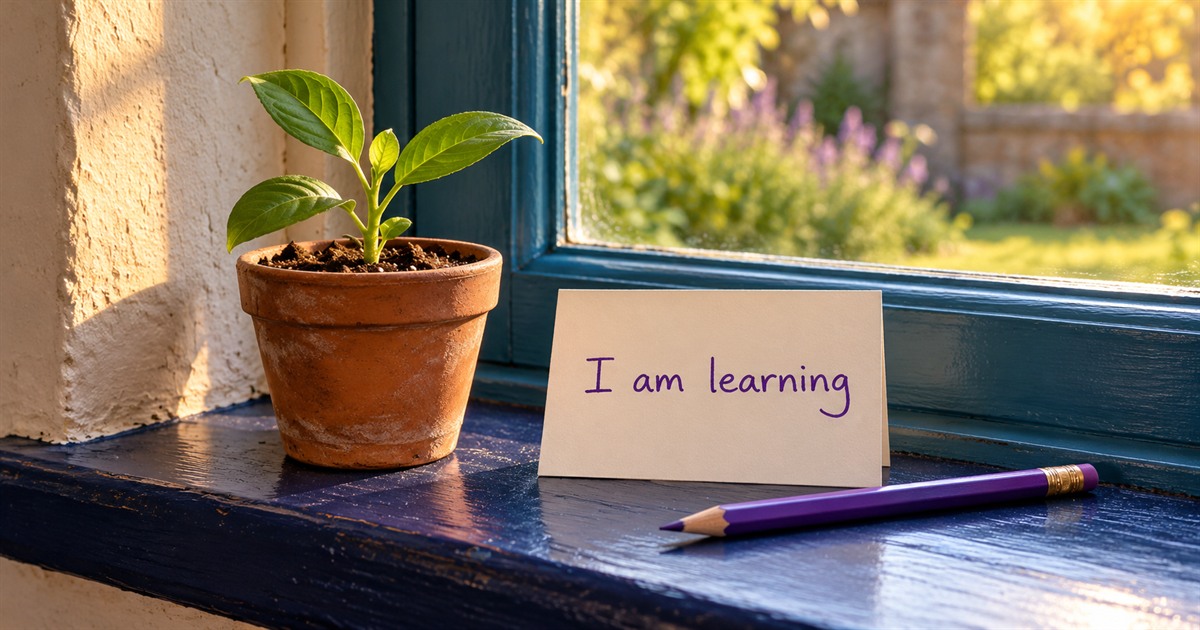
Changing your life for the better does not have to begin with a dramatic declaration. It can begin with noticing one thing you want to handle differently and choosing a manageable next step. An “I am” statement can serve as a reminder of that intention, if the wording feels useful to you.
Some people give these statements a spiritual meaning, using them during prayer or personal reflection. Others treat them as ordinary self-talk. Neither approach guarantees a particular outcome. Words cannot instantly remove practical obstacles, change another person’s choices or make you responsible for everything that happens.
What an “I am” statement can—and cannot—do
An “I am” statement describes a quality, value or direction you want to keep in mind: “I am learning to ask for help,” for example. You can use it as a cue to pause and consider your options. You do not need special wording, capitalization or a paid spiritual service to try it.
If language such as “I am a being of light” fits your beliefs, it can express personal spiritual meaning. It is not proof of a measurable energy change or a promise that circumstances will improve. You can also skip affirmations entirely and work directly with a practical plan.
There is no need to declare yourself fearless, perfectly confident or in control of every situation. A useful intention leaves room for uncertainty, ordinary emotions and other people’s independence.
Choose wording you can reasonably believe
Start with the difference between encouragement and contradiction. If “I am completely happy” clashes sharply with how you feel, repeating it may be frustrating. Try “I am allowed to have a difficult day and still take care of myself,” or “I am learning one step at a time.”
A 2009 study of positive self-statements found that, in two experiments, some participants with low self-esteem felt worse after repeating a positive statement. Benefits for participants with high self-esteem were limited. That does not mean every affirmation is harmful; it does mean forcing an uplifting phrase is not automatically helpful.
- For a difficult conversation: “I am allowed to pause before responding.” Follow it by asking for time to think.
- For learning something new: “I am practicing, not proving my worth.” Choose one short practice task.
- For asking for support: “I am allowed to ask a clear question.” Write down what help you need.
- For boundaries: “I am responsible for my choices, not everyone’s feelings.” Consider an honest, respectful limit.
These are examples to adapt, not rules or guarantees. Avoid statements that promise another person will love you, obey you or stop behaving badly. For more on balancing care with limits, see mutual care without losing yourself.
Turn one intention into a small action
Keep the process specific enough that you can tell whether you followed through. Rather than “My whole life will change today,” choose one situation and one action within your control.
- Name the situation. What is happening, without turning it into a judgment of your entire character?
- Choose a believable statement. Use language that acknowledges your current position and the direction you want to take.
- Pick an action. Make it small, affordable and workable with your health, responsibilities and available time.
- Review what happened. Notice what you did, what got in the way and what you might adjust.
For example: “I have postponed a routine appointment. I am learning to handle tasks in smaller pieces. Today I will find the contact number; tomorrow I will ask about available appointments.” If you cannot reach the service, that is an obstacle to work around—not evidence that your thoughts failed.
The NHS guide to low self-esteem recommends noticing negative beliefs, considering evidence that challenges them, being kinder to yourself and setting achievable challenges. A grounded statement can fit alongside those practices; it does not replace them.
Use a routine that suits you
You might read your statement before a task, write it in a notebook or keep it somewhere private. Morning and bedtime are optional reminders, not uniquely powerful windows that guarantee access to your subconscious. Choose a time that does not interfere with sleep or add pressure.
You can imagine the next practical step if that helps: opening the application, asking the question or taking a break. You do not have to vividly feel a successful outcome or suppress sadness, fear or doubt. If a phrase makes you feel ashamed, tense or further from reality, change it or stop using it.
Notice progress without blaming yourself
After a few attempts, ask: Did this reminder help me choose an action? Was the action manageable? Do I need a different plan, more information or someone’s help? Look for observable changes rather than signs that the universe has approved your words.
Money, illness, discrimination, caregiving demands and other people’s behavior are not solved by positive language alone. Needing support is not a spiritual failure. If low self-esteem or distress persists or affects daily life, speak with a qualified healthcare professional; the NHS notes that talking therapies can help with low self-esteem.
Keep what is useful, adjust what is not and allow change to be gradual. The aim is not to perform perfect positivity. It is to treat yourself with dignity while taking the next realistic step.
I absolutely love this article! The idea of using I AM statements is so empowering and uplifting. It’s amazing how simple affirmations can lead to profound changes in our lives. Thank you for sharing this wisdom!
Yes, positivity is contagious! Let’s spread these affirmations everywhere.
I agree! It’s a breath of fresh air to see such positive content. I can’t wait to start my mornings with these powerful statements.
…The historical aspect mentioned about Gary Ballard is intriguing. It adds a layer of context that could enhance one’s understanding of why these statements might resonate with some people.
This article presents an interesting concept about the power of words and thoughts. It aligns with many psychological principles regarding self-affirmation and mindset shifts. I think there’s merit in exploring this further.
‘I AM the Perfect Poise!’? What if I just want to be ‘I AM eating pizza right now’? That sounds way more relatable! Life changes through fun too, right?
While I see the appeal of I AM statements, it sounds a bit too good to be true. Life doesn’t change overnight just because you repeat some phrases. Real change requires real effort and action.
‘Miracles’ from repeating some phrases? Sounds like wishful thinking to me! There’s no scientific backing for such claims, and it feels like empty promises aimed at those desperate for change.