

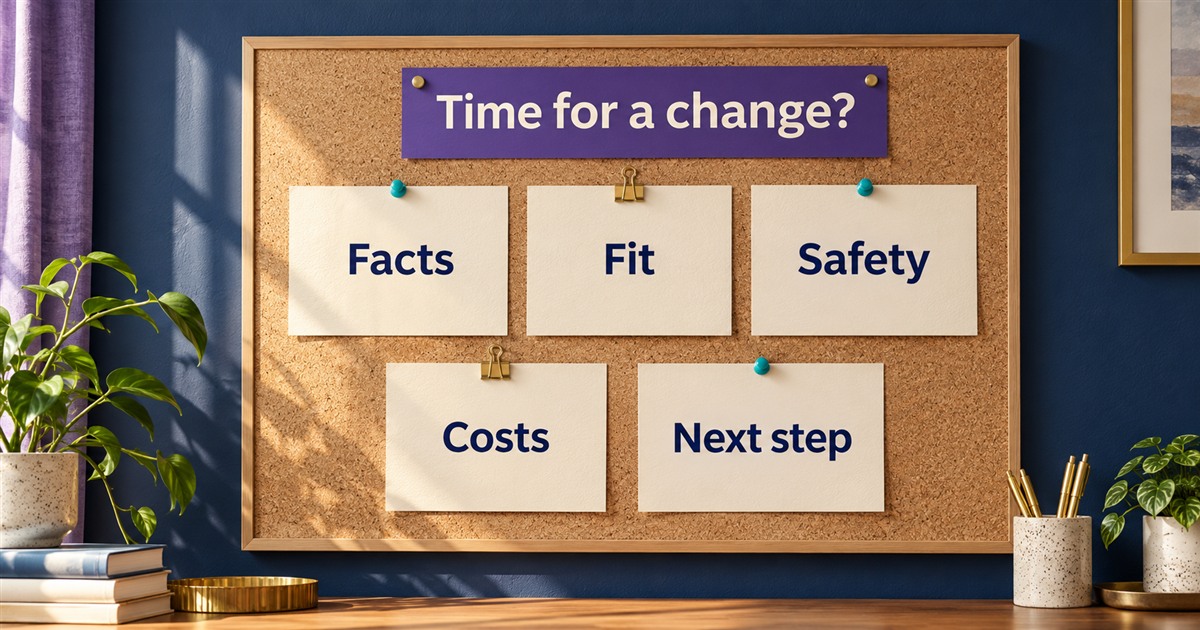
Wondering whether it is time to change your job, relationship or routine does not mean you have to make a dramatic decision today. Unease can be worth exploring, but it is not a complete explanation of what is wrong or proof that one particular choice will fix it.
You do not need a new year or a message from the universe to review your circumstances. If you interpret coincidences or intuition spiritually, treat that meaning as a personal reflection—not evidence that a particular outcome is guaranteed. These five questions can help turn a vague feeling into a practical next step.
1. What am I feeling, and what do I actually know?
Try separating an observation, a feeling and a conclusion. “I worked late four evenings this week” is an observation. “I feel depleted” describes your experience. “I must quit immediately” is one possible conclusion, not the only one.
The NHS guidance on reframing thoughts suggests checking evidence and considering alternatives. This does not mean pretending a genuine problem is positive or blaming yourself for someone else’s actions. A neutral thought might be: “My current hours are not working for me; I need to examine my options.”
Ask what has changed, how often the difficulty occurs and what information you still need. If a sense of emptiness or distress persists or affects everyday life, consider qualified health support as well as a review of your circumstances. A spiritual reading cannot diagnose its cause.
2. What no longer fits, and can it be adjusted?
The “tight shoe” idea can be a useful metaphor: something appealing at first may not suit your actual needs. It is not a syndrome or a test of whether you should leave. Nor does a poor fit mean you were foolish for choosing it; circumstances and priorities can change.
Name the mismatch as specifically as possible. Is it unpredictable working hours, an unmet need for rest, a repeated boundary problem or a goal you no longer want? Then consider whether a limited adjustment is realistic: asking about a schedule, reducing a commitment or discussing a specific concern where safe.
Watch what happens after an agreed change rather than relying only on promises. You may decide to stay, revise the arrangement or leave. Our guide to support without self-blame when you feel like giving up explores how changing direction can coexist with caring about a goal.
3. Is a conversation safe and useful?
In a relationship where you feel safe, a focused conversation may clarify a problem: “I feel disconnected when our plans keep changing. Can we agree on a way to check in?” Listen to the response and consider whether both people are willing to make specific, respectful changes. Honest communication does not guarantee compatibility.
You do not have to obtain a partner’s permission to end a relationship. Shared practical matters may require planning, but a prediction, promise or spiritual label does not obligate you to stay.
If you fear threats, retaliation or controlling behavior, do not treat a confrontation as the required first step. The National Domestic Violence Hotline describes safety planning for people experiencing abuse, preparing to leave or already separated. Seek tailored support using a safer device if your activity may be monitored. In immediate danger in the U.S., call 911; elsewhere, use local emergency services.
4. What would the transition require?
For an ordinary job transition, having another offer may reduce uncertainty, but it is not a universal rule that you must stay until one appears. Health, safety and other circumstances can affect your options. Review income, essential expenses, benefits, notice requirements and realistic alternatives; get qualified employment or financial advice for consequential questions.
Consumer.gov’s budgeting guide recommends listing income and expenses and reviewing actual spending. Use your own figures, including irregular costs, rather than assuming that optimism will cover a gap. Do not make borrowing or investment decisions based on a psychic prediction.
Keep a simple transition note: Option: apply for another role while exploring a schedule change. Possible benefit: more workable hours. Costs and unknowns: pay, benefits, commute and start date. Next check: confirm those details before committing. A plan can expose missing information without guaranteeing a result.
5. What is the smallest useful next step?
If there is no urgent safety issue, choose one action that gives you useful information: update your résumé, ask a factual question, review your budget or speak with an appropriately qualified adviser. Set a realistic point to review what you learned, allowing for genuine deadlines.
Our four practical decision checks can help you examine a choice without labeling yourself impulsive. You may also discover that rest, support or a smaller adjustment is more useful than an immediate overhaul.
The right next step is not necessarily the biggest one. Your feelings deserve attention, your constraints deserve respect, and your safety matters more than proving that you followed a sign. You can make a considered change without certainty about everything that comes afterward.
I absolutely loved this article! It resonates so well with me. The idea of subtle nudges from the Universe is something I’ve been feeling lately. It’s comforting to know I’m not alone in this journey of change.
‘Listening to your intuition’ is often easier said than done, especially when emotions cloud judgment. It’s essential that individuals take time for self-assessment before jumping into significant life changes.
‘Have a plan’—now that’s some groundbreaking advice! Who would’ve thought that changing jobs or relationships required actual planning? Next thing you know, they’ll tell us we should also save money before quitting!
The concept of internal versus external validation is fascinating. It’s true that we often project our issues onto others instead of recognizing our own role in our unhappiness. This insight could lead to profound self-reflection for many readers.
‘Walking across a bed of needles’? Sounds like my daily commute! If only all those little nudges would come with a map and guidebook on how to change my life effortlessly!
This article seems overly optimistic and lacks practical solutions. Just telling people to ‘listen to the Universe’ without offering concrete steps isn’t very helpful. Change requires real planning, not just wishful thinking.
‘Flogging a dead horse’? Really? That’s a bit extreme, don’t you think? Maybe some relationships just need more time and effort instead of being tossed aside at the first sign of struggle.
‘Tight shoe syndrome’? That’s a cute way to describe life choices! I guess we should all just return our ‘tight shoes’ then? Because who needs comfort when you can chase after every little sign from the Universe?
I find it ironic how the author suggests that leaving a job or relationship is always the answer. Sometimes, working through difficulties can lead to growth too! Is quitting really the best solution every time?