

Updated October 18, 2026.
You may enter a relationship with an idea of how often you will meet, what commitment means or how you will share responsibilities. Your partner may picture something different. A disappointing moment can be an invitation to clarify an assumption, but it is not automatically a sign that you expect too much.
Respecting someone’s individuality does not mean accepting mistreatment or abandoning what matters to you. You cannot make another person want the same relationship, and you can still decide what you are willing to participate in.
Start with one expectation you can name
Instead of “You never act like a proper partner,” identify the situation. Was it a cancelled plan, an unanswered question about exclusivity, or a household task you thought was shared? Describe the event without claiming to know why it happened.
Try a short private note: “I expected ____. We had/had not discussed ____. What matters to me is ____.” This is a reflection exercise, not a scorecard for deciding who is the better partner. It can help you choose one specific topic rather than arguing about the whole relationship at once.
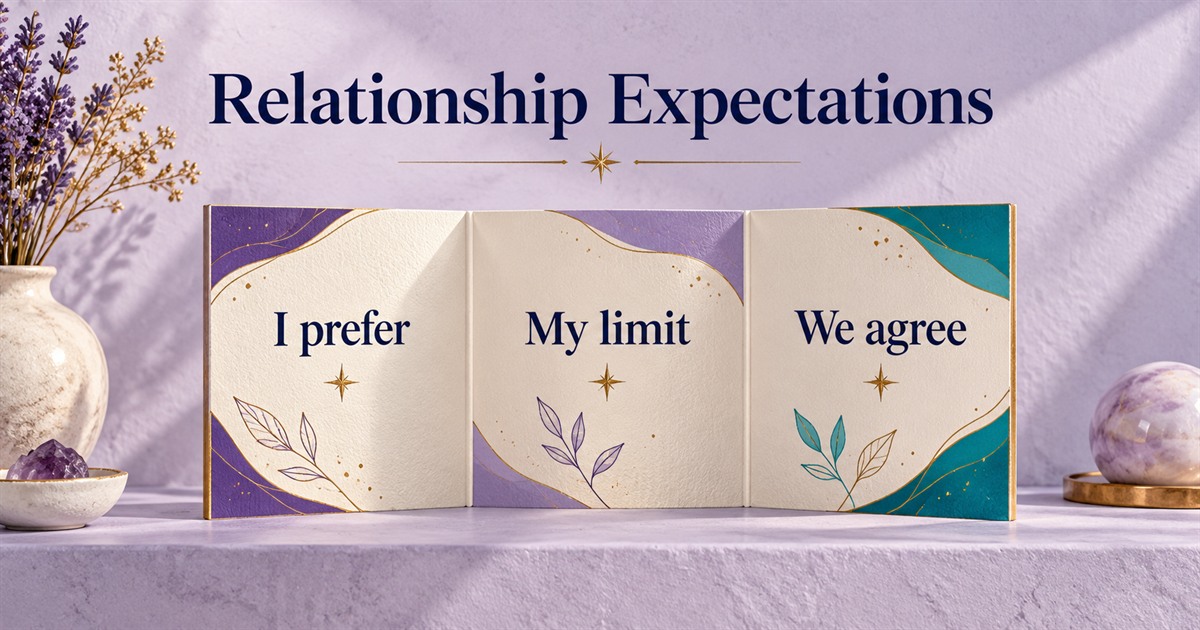
Separate a preference, a limit and a shared agreement
Love is respect’s guide to boundaries and expectations explains why unspoken assumptions can create conflict and why personal limits should be respected rather than pressured into changing. Its guidance also recognizes that incompatible needs can be a valid reason not to continue a relationship.
For a practical conversation, you might distinguish these three statements:
- A preference: “I enjoy making weekend plans in advance.” This invites discussion about what would suit both people.
- A personal limit: “I’m not comfortable sharing my account passwords.” You do not need to surrender privacy to prove affection.
- A shared agreement: “We both agreed to confirm our Saturday plan by Thursday.” This is something you can review together when circumstances change.
These examples are not a universal contract. Do not turn a preference into an unspoken rule or treat a partner’s refusal as permission to punish them. An agreement is meaningful only when both people understand and freely accept it.
Ask for something concrete and hear the answer
If it is safe to talk, choose a calm moment. You might say, “When our plan changed without a message, I didn’t know whether to wait. Can we agree to let each other know when a shared plan changes?” The request concerns a shared arrangement, not permission to track someone’s movements.
Give the other person room to explain practical limits or propose another option. A work shift, caring responsibility or accessibility need might affect what is feasible. “We should talk every evening” may need a different arrangement if one person cannot realistically commit to it.
Ask, “What can we each actually do?” Then summarize the plan in plain language. Our guide to speaking up and choosing when to pause offers additional wording for difficult discussions. No script can guarantee agreement.
Test outside advice against your own situation
A book, social-media post, family tradition or fictional romance can give you an idea without becoming a rule for your life. Ask whether the advice assumes a budget, schedule, culture, family structure or relationship goal that differs from yours.
For example, a weekly expensive date is not a necessary test of devotion. You could prefer a walk, a meal at home or another accessible way to spend time together. On the other hand, a wish for honesty is not merely an unrealistic fantasy you should discard to keep the relationship.
If money or responsibilities are the sticking point, our guide to managing money stress together includes questions about real costs and voluntary contributions. Avoid comparisons that require either person to spend more than they can afford.
Review actions without becoming a monitor
After an agreement, notice whether the chosen actions happen and whether both people can raise concerns. One mistake, repeated broken plans and a clear difference in relationship goals are not interchangeable. Ask what changed instead of assuming every disappointment proves indifference.
You can revise an arrangement you both want to revise. You can also decide that repeated unmet agreements or incompatible wishes no longer work for you. You do not need to inspect private messages, give endless chances or wait for someone’s personality to transform.
Keep safety and your own choice in view
If you fear retaliation, threats or coercion, a better communication technique is not the priority. The linked love is respect guide includes advocate contact options for exploring your situation. Our guide to relationship safety and decisions about leaving discusses support without requiring confrontation.
Spiritual interpretations can be meaningful to you, but they cannot establish a partner’s intentions or require you to stay. A workable relationship is not one where you have no expectations; it is one you freely choose with enough clarity to know what is and is not being offered.
Honestly, this post feels like a bunch of nonsense. Relationships require effort, and to just sit back and accept someone’s flaws? That’s not realistic! People need to work on themselves, not just be accepted as is.
‘Leaving the cap off the toothpaste isn’t worth fighting over?’ What kind of world are we living in?! I mean, if you can’t agree on toothpaste caps, are you really ready for a lifetime commitment?
‘Leave it to Beaver’ vs ‘Married with Children’? Now that’s a battle of the sitcoms! Imagine June Cleaver trying to have a heart-to-heart with Al Bundy – it would be pure comedy gold!
This article brings up some interesting points regarding the expectations we place on our partners. It’s crucial to remember that everyone comes with their own baggage. Maybe we should focus on better communication rather than relying on self-help books for guidance.
While I understand the author’s perspective, I think it’s too simplistic to say we shouldn’t try to change our partners at all. Some behaviors need correction for a relationship to thrive; otherwise, you’re just accepting toxic traits.
‘Happily ever after only comes in books’? Really? This whole notion sounds like an excuse for poor behavior in relationships. If we don’t strive for better, what’s the point of being in one?
I absolutely loved this article! It really resonated with me and reminded me that relationships are about understanding and acceptance. We should embrace each other’s imperfections instead of trying to change one another. Beautifully written!
“Mutual respect is paramount.” Well said! But come on, who has time for all this understanding? Just tell me how to fix everything in five easy steps instead of having feelings and stuff!