

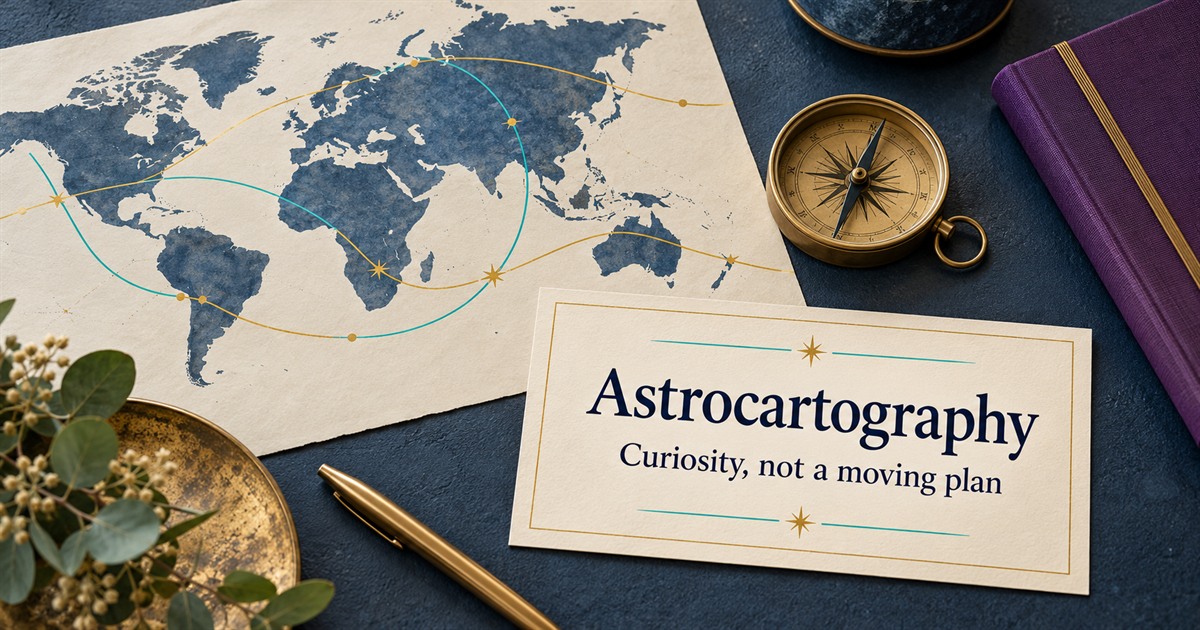
Astrocartography brings astrology and geography together by displaying birth-chart connections on a world map. People use it to explore symbolic associations with places they might visit or live. A line near a city is not evidence that the city will deliver a job, a relationship, healing or a particular future.
What an astrocartography map shows
Astrodienst’s AstroClick Travel introduction describes a map connecting birth data with the Sun, Moon, planets and four chart angles labeled AS, DS, MC and IC. Its interface lets users select lines, crossings or points to read interpretations.
Those interpretations belong to astrology. Words such as “supportive,” “challenging” or “transformative” describe that symbolic framework, not a verified forecast of your experience. A crossing is not a guarantee of a major event, and a supposedly difficult line does not establish that a location is unsafe.
A map calculation and a life prediction are different claims. Correctly plotting a chart does not establish that its interpretation can identify where you will thrive. Consider what the description prompts you to ask rather than treating it as an instruction.
Check the birth information—and label uncertainty
Before exploring a map, gather your birth date, birthplace and the most reliable birth time available to you. A record may be more useful than a remembered estimate, but do not assume every certificate includes a time. Avoid uploading an entire identity document when a tool only needs selected birth details.
Astrodienst’s birth-time FAQ asks for the most precise time available and explains that time uncertainty affects chart calculations. Its instructions use local clock time at birth and handle time-zone and daylight-saving adjustments. Follow the tool’s instructions rather than applying your own conversion a second time.
Do not treat “within half an hour” as a universal accuracy standard. If the time is approximate or unknown, say so. Do not invent a precise time to obtain a persuasive-looking map. Ask what parts of a tool’s output depend on the missing information, and treat precise location conclusions cautiously.
A simple way to explore without chasing certainty
- Choose a question: For example, “What kind of daily life would I want in this place?” Keep it open rather than asking the map to guarantee success.
- Use the provider’s current instructions: Enter only the information you are comfortable sharing. Check the date, birthplace and time assumptions before reading interpretations.
- Look at one or two places: Select relevant map points or lines and read the explanation. Record the theme as an astrological interpretation, not a fact about the destination.
- Translate the theme into an ordinary question: If a description brings up relationships, ask how you would actually meet people and maintain existing connections.
- Check independent information: Compare the idea with costs, work opportunities, housing, accessibility, safety and your responsibilities before taking action.
You do not need to keep opening interpretations until one gives the answer you hoped for. If the exercise becomes stressful or turns every destination into a warning, pause it. You can make a sound decision without resolving every symbol.
Separate a holiday idea from a relocation plan
A short visit and a permanent move involve different commitments. A pleasant holiday cannot show every aspect of working, renting or receiving care in a place. If a visit is feasible, treat it as a chance to observe daily conditions—not a test that will prove a planet’s influence.
- Resources: What are the upfront and ongoing costs, and what happens if income or plans change?
- Requirements: What entry, residence or work rules apply to your circumstances? Check the relevant government authorities rather than a chart interpretation.
- Daily life: What housing, transport, accessibility, health-care and communication needs must be met?
- Connections: What support would you retain, and who else would be affected by the decision?
For budgeting, consumer.gov’s guide starts with actual income and expenses. For international trips, U.S. travelers can use the State Department’s travel-planning guidance to check destination information, advisories, documents and personal needs. Travelers from other countries should consult their own government’s guidance too.
Turn curiosity into a reversible next step
Suppose a map description makes you curious about a city’s creative possibilities. The interpretation is “this place may feel creatively significant.” The practical question is “are there accessible classes, communities or work options there?” A next step could be checking local organizations and costs before considering a visit. That is exploration, not a promise of a creative breakthrough.
Our five practical questions about making a change can help you compare what you want with what is workable. Staying, postponing or choosing another place are valid outcomes—not evidence that you missed your destiny.
The most useful role for astrocartography is optional curiosity. Let it prompt questions if you enjoy it, then use real information, your priorities and appropriate professional advice for consequential decisions.
While the idea of Astrocartography might sound appealing, we must critically examine its validity. Is there any scientific basis for these claims? It’s essential to differentiate between belief systems and empirical evidence when discussing such topics.
‘This article resonates with me deeply! I’ve always felt a pull towards certain places, especially Paris. Now I’m convinced it’s more than just whimsy—it’s written in the stars! Time to explore my chart!’
‘Oh great, now I have to worry about which cities are good for my self-confidence too! Thanks for adding another layer of stress to travel planning—like figuring out what suitcase fits all my existential crises.’
Astrocartography is an intriguing subject that deserves more attention! The connection between geographic locations and personal energies is fascinating. I think it’s worth exploring how our environments can impact our personalities and life events.
‘Travel changes and heals us?’ Sounds like the perfect excuse for a midlife crisis road trip! If only moving around could actually solve all my problems – I’d be booking flights left and right!
‘So let me get this straight: I just need a birth certificate and a world map, and I can find out if I’m meant to live in Antarctica? Next thing you know, I’ll be telling my boss I’m relocating because of my Astrochart!’
I absolutely loved this article! It opened my eyes to the possibilities of how our birth charts can influence our lives in different locations. I’ve always felt drawn to certain places, and now I understand why. Can’t wait to create my own Astrocartography chart!
This is just another way for people to rationalize their wanderlust. Sure, astrology has its followers, but claiming that moving to a different city can magically change your life feels like pure fantasy to me. Real change comes from within, not a map.