

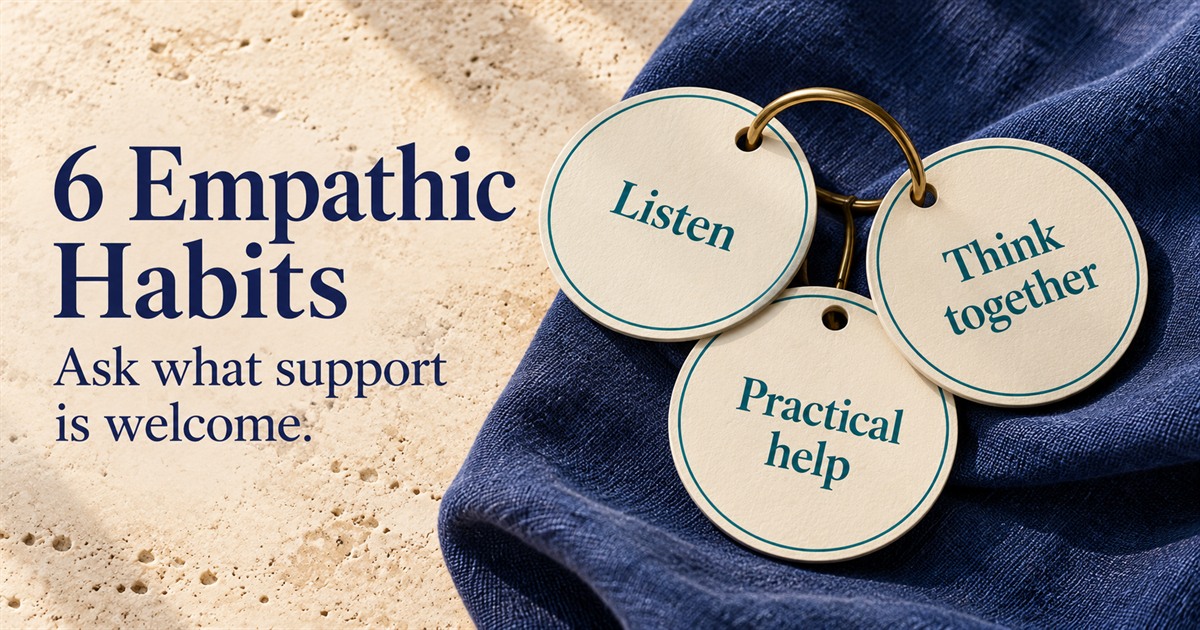
Illustration: imagined tags represent the three optional support choices below—not a real product, required tool, client record, proof of consent or promised response. View the full-size illustration.
Empathy means trying to understand another person’s experience rather than assuming your own perspective tells the whole story. You may feel moved by what they describe, but you cannot know exactly what they think or feel without asking. Empathic behavior is something you can practice in small, everyday ways.
These six habits are practical suggestions, not a test for whether you are a “true empath.” You can care about someone without sharing all their beliefs, absorbing their feelings or taking responsibility for solving their life.
1. Be curious without interrogating
Respectful curiosity makes room for another person’s story. Start with an open question such as “What has that been like for you?” Then let them decide how much to share. A stranger on a bus or someone at work does not owe you personal details.
Try one thoughtful question rather than a string of questions about sensitive experiences. Avoid treating someone’s identity, disability, finances or family circumstances as a topic they must explain.
2. Check assumptions before making a judgment
A label rarely explains an individual. Before deciding that someone is lazy, rude or uninterested, separate what you observed from the story you added.
A made-up messaging example: keep the observation, interpretation and possible question separate.
- What you observed
- “I have not received a reply today.” This describes what you know so far.
- The story you added
- “They do not care about me.” That is an interpretation, not something a missing reply establishes.
- What you could ask
- “Is there a better time to catch up?” An invitation to clarify leaves room for their own account.
Their explanation may change your understanding, or it may not. You cannot infer their private thoughts from silence alone. Empathy also does not mean ignoring a repeated pattern that matters to you.
No one needs to claim they are free of bias. A more useful habit is noticing assumptions, listening to corrections and being willing to revise an opinion.
3. Listen before offering advice
Give the person time to finish. Check your understanding in ordinary language: “It sounds like the uncertainty has been the hardest part. Have I understood that?” Leave room for them to disagree.
Ask, “Would you like me to listen, help think through options or do something practical?” Let their answer guide what you offer:
Listen
Stay with their account. Leave pauses, ask an open question when useful and check whether you understood.
Think together
If they want ideas, compare options without choosing their answer for them. They may decide differently from you.
Practical help
Agree on a specific task and timing before acting. An offer is still a choice they can decline.
In its guidance on supporting someone who is struggling, Samaritans describes a nonjudgmental presence and open questions rather than rushing into advice. Its guidance is about serious distress; the listening principles can also inform everyday conversations.
You do not have to reveal a private story of your own to prove you care. If you share an experience, keep it relevant and return attention to the other person rather than making their situation about you.
4. Imagine another perspective, then verify it
Perspective-taking can start with “What information or pressures might I be missing?” It should not end with “I know how they feel.” Imagining someone’s circumstances is a starting point for curiosity, not a substitute for their account.
For a simple example, a colleague who declines an evening event may have responsibilities you do not know about. You can offer a daytime option without demanding an explanation or deciding that you have discovered their real motive.
Read or listen to accounts people choose to share. If you volunteer, follow the organization’s actual needs and safeguarding rules. People facing hardship are not props for your personal growth, and briefly entering a setting does not mean you now understand everyone’s life there.
5. Turn care into specific, consent-based help
“Let me know if you need anything” can be difficult to answer. A specific offer may be easier: “Would it help if I brought dinner on Thursday?” or “Would you like company while you make that call?” Accept no without persuasion.
Do not contact someone’s relatives, tell their story publicly or arrange a service on their behalf without permission in an ordinary situation. Helpful intentions do not remove their right to choose.
At work or in a community, ask what change people affected actually want. Listening matters, but practical follow-through and accountability matter too. Empathy alone does not guarantee good leadership, end discrimination or resolve every conflict.
6. Keep boundaries and make repairs
Being caring does not require constant availability. You can say, “I can listen for twenty minutes, but I won’t be available later tonight.” Offer only what you can realistically provide.
Samaritans’ guidance on looking after yourself recognizes that supporting someone in serious distress can be difficult and that stepping back or widening their support network may be necessary. You do not have to become someone’s only source of help.
Understanding a person’s feelings does not oblige you to tolerate threats, abuse or unwanted contact. You can understand a viewpoint without agreeing with it, excusing harm or maintaining a relationship.
If you interrupt, guess incorrectly or give unwanted advice, repair it directly: “I made an assumption. I’m sorry. What did I miss?” A correction is useful information, not proof that you are bad at empathy.
Empathy is not the same as a spiritual empath identity
Some people use “empath” to describe strong emotional sensitivity or a spiritual sense of connection. That personal label does not establish psychic perception, accurate mind-reading or the ability to absorb another person’s energy.
Our guide to understanding the empath label explores the label with practical limits. If you feel drained after conversations, our guide to sensitivity and boundaries offers further reflection.
Start with one habit in your next conversation: ask, listen, check and respect the answer. You do not need to feel everything another person feels to treat them with care.
‘You have to be vulnerable…’ Yeah right! Just what I need—more reasons for people to see my soft side! I’ll pass on the radical listening; I’m more of a ‘nod-and-smile’ kind of person!
I absolutely loved this article! It beautifully highlights the importance of empathy in our lives. The way it explains how we can develop our empathic potential is both inspiring and practical. We really need more compassion in this world!
It’s fascinating how empathy can be nurtured over time. The connection between curiosity and understanding others really stood out to me. I’m intrigued by the idea that our brains can adapt in this way; it opens up avenues for further research and self-improvement.
‘Empathy can bring about social change.’ This aligns with many psychological studies I’ve read over the years. It’s crucial for societal progress; cultivating empathy can help bridge gaps between diverse communities and promote understanding.
‘Empathy is not just pity.’ Wow, groundbreaking stuff! Next, you’ll tell me that ‘not all heroes wear capes.’ I mean, sure, let’s all just be super empathetic beings—easy as pie! 😂
‘Being an empath means you have to get into other people’s lives.’ That sounds exhausting! Do I need a nap afterward? Maybe I’ll just stick to being a couch potato—much less emotional work involved! 😂
While I appreciate the sentiment of promoting empathy, I question whether it truly leads to social change as suggested. Sometimes empathy can lead to emotional burnout, and not everyone is equipped to carry others’ burdens without suffering themselves.
Honestly, this article feels like a lecture on common sense. Empathy is basic human decency, yet here we are, discussing it like it’s some revolutionary concept. Why do we need an article to remind us to care about others?