

When something feels different in your relationship, uncertainty can hurt before you know what has happened. You may want to trust your partner while also wanting to take your intuition seriously. You can listen to that uneasiness without turning it into an accusation or dismissing your need for clarity.
Changes in routine, appearance, affection or communication do not, on their own, prove cheating. Begin with what you actually noticed, the agreements you share and what you need now. A collection of hints is not the same as a confirmed breach of trust.
First, name the agreement you are concerned about
“Cheating” needs a clear context: what have you both agreed about sexual exclusivity, dating, romantic messages or contact with former partners? Separate an agreement you made from a rule you hoped was understood. An unstated expectation may need a direct conversation; it is not automatically a promise the other person knowingly broke.
This distinction does not require you to accept something that hurts you. You can say, “We have not discussed this, and I need us to be clear about it before I continue.” Clarifying an agreement is different from deciding that every boundary you want will be acceptable to both people.
Why familiar “signs of cheating” leave important gaps
- Less sex or affection: You may want to discuss the change, but it does not identify another partner. No one owes sex to demonstrate fidelity.
- New clothes, friends or routines: These tell you something has changed, not why it changed.
- A private phone or more time alone: Privacy is not proof of wrongdoing, and a relationship does not give either person automatic access to the other’s accounts.
- A payment you do not recognize: Ask about that transaction and the shared-spending agreement. Do not invent a recipient or purpose.
- An inconsistent account: Identify the particular detail that does not fit. An inconsistency can call for clarification without supplying the whole explanation.
Several uncertain observations do not become certainty simply because they appear on the same checklist. A defensive reply, tears or unusual eye contact cannot settle the question either. Our body-language and assumptions guide explains why gestures should not be treated as a lie detector.
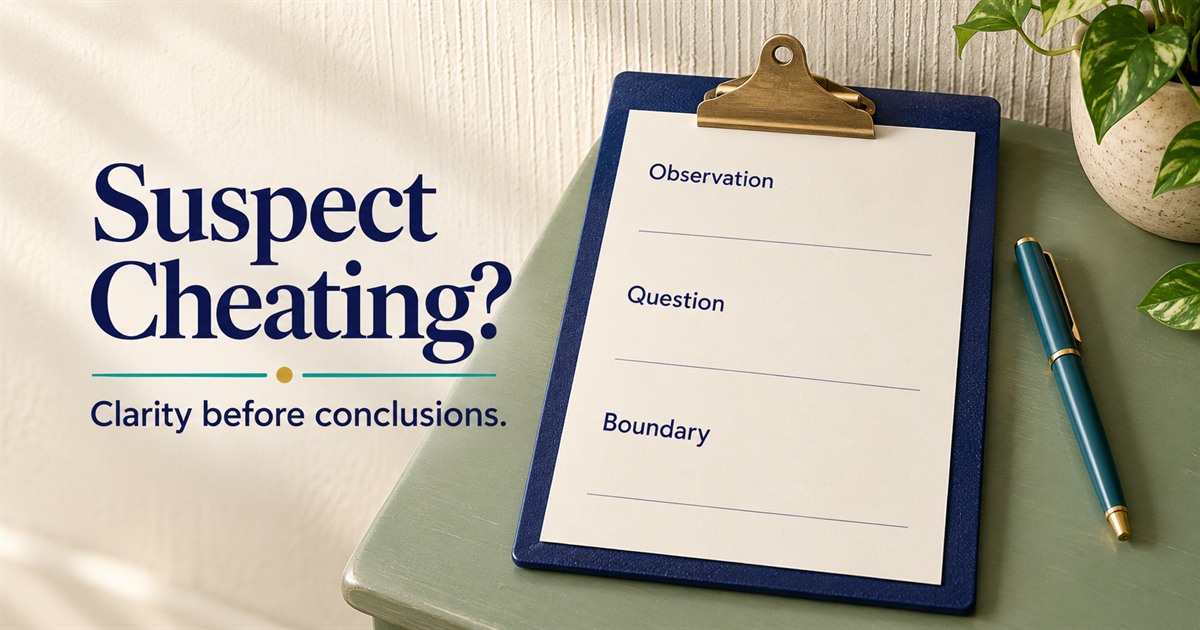
Make a three-part clarity note
If it is safe to keep a note, separate the event from your interpretation. You can also think through these questions without saving anything on a device another person may monitor.
- 1. Observation: what do I know?
- Describe one specific event without assigning a motive. Distinguish something you saw yourself from something another person told you, and mark what remains unknown.
- 2. Question: what needs an answer?
- Ask about that event or the relationship agreement. Keep the question answerable rather than asking someone to prove that nothing has ever happened.
- 3. Boundary: what will I choose?
- Name what you are willing to take part in while the issue is unresolved. A boundary can guide your decision; it is not a demand for a password, sex or unrestricted tracking.
Hypothetical example: You notice a charge on a statement you are entitled to view. The observation is “I do not recognize this payment,” not “You paid for a date.” The question is “What was this payment for?” A possible boundary is “I am not comfortable adding new shared spending until we have clarified this transaction and our spending agreement.” The payment alone does not establish an affair.
The guide to finding clear answers offers more ways to keep facts, assumptions and personal priorities separate. You do not need a perfect explanation of someone else’s motives to recognize what is important to you.
Have a direct conversation only if it is safe
If contact is safe and wanted, choose a time when you can discuss one concern without rushing. Ask for clarification instead of setting a trap, impersonating someone online or repeatedly testing a reaction.
A possible opening
“I have been feeling unsettled about this specific situation. I want to understand what happened and whether we are working from the same relationship agreement. Can we talk about that?”
You can follow with a specific question: “What do we each understand exclusivity to include?” or “How does this situation fit the agreement we made?” Listen to the answer, and distinguish a factual explanation from a promise about future conduct.
A denial is not automatically a lie; reassurance is not independent confirmation. If the answer leaves a gap, name the gap rather than demanding a more emotional performance. You may pause: “I need time to think about what you have said. I am not ready to decide what comes next.”
Do not secretly access private accounts, install monitoring software, use another person’s login or recruit friends to investigate. Use information you are legitimately entitled to see. If you are afraid of your partner’s reaction, skip the confrontation and go to the safety section.
Give intuition a role that supports your choices
A tarot spread, dream or intuitive impression may help you explore what trust, connection or uncertainty means to you. You do not have to reject that spiritual meaning to be careful about what it establishes. A psychic reading cannot verify that a partner has cheated, identify a supposed third person or diagnose an infection.
Questions for reflection or a reading:
- What am I afraid of losing, and what do I need in order to feel respected?
- Which part of my concern comes from an observed event, and which part is still an interpretation?
- What choice is mine to make even if I never learn every detail?
Keep any paid reading within a limit you freely choose. Do not treat a claim of “certain proof” or a demand for another paid session as a reason to accuse your partner. A spiritual interpretation should not replace their words, your consent, appropriate healthcare or your own judgment.
Treat sexual-health concerns as health questions
If you have symptoms, a possible exposure or concerns about an STI, contact a healthcare professional rather than waiting for a confession or a reading. The CDC’s STI testing guidance explains that infections often have no symptoms and that the tests you need depend on your circumstances.
Ask which tests are appropriate, when to have them and whether follow-up is needed. A result requires medical interpretation, not an automatic accusation: for example, a herpes blood test cannot identify who transmitted the infection or when it was acquired.
Follow the clinician’s advice about treatment, partner communication and when it is safe to have sex. You can decline sex while you seek advice; you do not need to use sex as a test of trust.
If the relationship feels unsafe, change the next step
Threats, intimidation or controlling behavior deserve attention whether or not infidelity occurred. You do not need evidence of an affair before asking for help. Our guide to destructive relationship behaviors and support can help you recognize a concern without turning this conversation into a test of courage.
If you fear retaliation, seek individual safety guidance rather than announcing a confrontation or a plan to leave. If your activity may be monitored, consider a safer device or way to reach help. The Hotline’s internet-safety guidance explains that private or incognito browsing does not guarantee that all traces disappear.
Choose a next step without promising the whole future
- If uncertainty remains: Decide what you need clarified and what you are willing to continue. You can ask for time, seek individual support or decide the relationship is not right for you without declaring an unproven allegation to be fact.
- If a breach is confirmed and you both want to continue: Discuss what conduct must stop, what accountability means and whether professional support would help. A difficult period in a relationship does not make one person responsible for the other’s choice to break an agreement. Trust need not return on a schedule or through unlimited surveillance.
- If you choose to leave: Consider practical responsibilities and support, with safety planning where needed. You do not owe immediate forgiveness, renewed intimacy or a chance to reconcile.
Your feelings deserve care, and your decisions can respect both intuition and information you can check. Return to the observation, question and boundary when you need a manageable starting point—not a perfect detective test.
‘Forgetfulness’ as a sign of cheating? If that’s the case, I must be dating a goldfish! Some people just forget things; it doesn’t mean they’re hiding an affair. Lighten up, folks!
‘Changing styles’? So if my partner buys new shoes, I should check for hidden lovers? Next time someone asks why I’m shopping, I’ll say it’s because I’m suspicious!
Honestly, this article just spreads paranoia. Not every change in behavior means cheating. It’s ridiculous to think that a partner can’t have personal changes without being accused of infidelity.
I have to disagree with the premise that these signs are definitive indicators of cheating. Many factors can affect behavior, and assuming the worst could lead to unnecessary conflict in relationships.
‘Strange smells or occurrences’? Really? Next, you’ll say they might have a secret cat! I love how dramatic this post is—it’s like a soap opera waiting to happen!
I found this article really enlightening! It’s amazing how many signs can be misinterpreted. Communication is definitely key in any relationship. Open dialogue could prevent so many misunderstandings!
This post provides a good overview of potential warning signs, but it’s crucial to approach each situation with nuance. Psychological studies suggest that communication issues are often misdiagnosed as infidelity indicators.
‘Healing After Cheating’? This section felt rushed. Healing takes time and varies for everyone; it should’ve been explored further. Relationships are complex and deserve more than just bullet points.
‘Not Communicating’ is on the list? Wow, groundbreaking! Maybe couples should just stop talking altogether—that would solve everything! This advice is about as helpful as a screen door on a submarine.