

An aura color can give you a language for something you have not quite put into words: a wish to speak more openly, make room for creativity or reconnect with what matters. You can explore that meaning without letting a color decide who you are.
In spiritual practice, an aura is often understood as a subtle presence or energy around a person. Some readers describe colors they associate with it; others use visualization or a camera-generated portrait. These are different experiences, and a color interpretation is not a measurement of your personality, health or worth.
Ten Aura Colors: Meanings to Explore, Not Labels to Wear
Notice the color you are drawn to, or one mentioned in a reading, and use its question as a starting point. You do not need to see an aura to try this exercise. The theme is an invitation to reflect, not evidence that you possess or lack a particular quality.
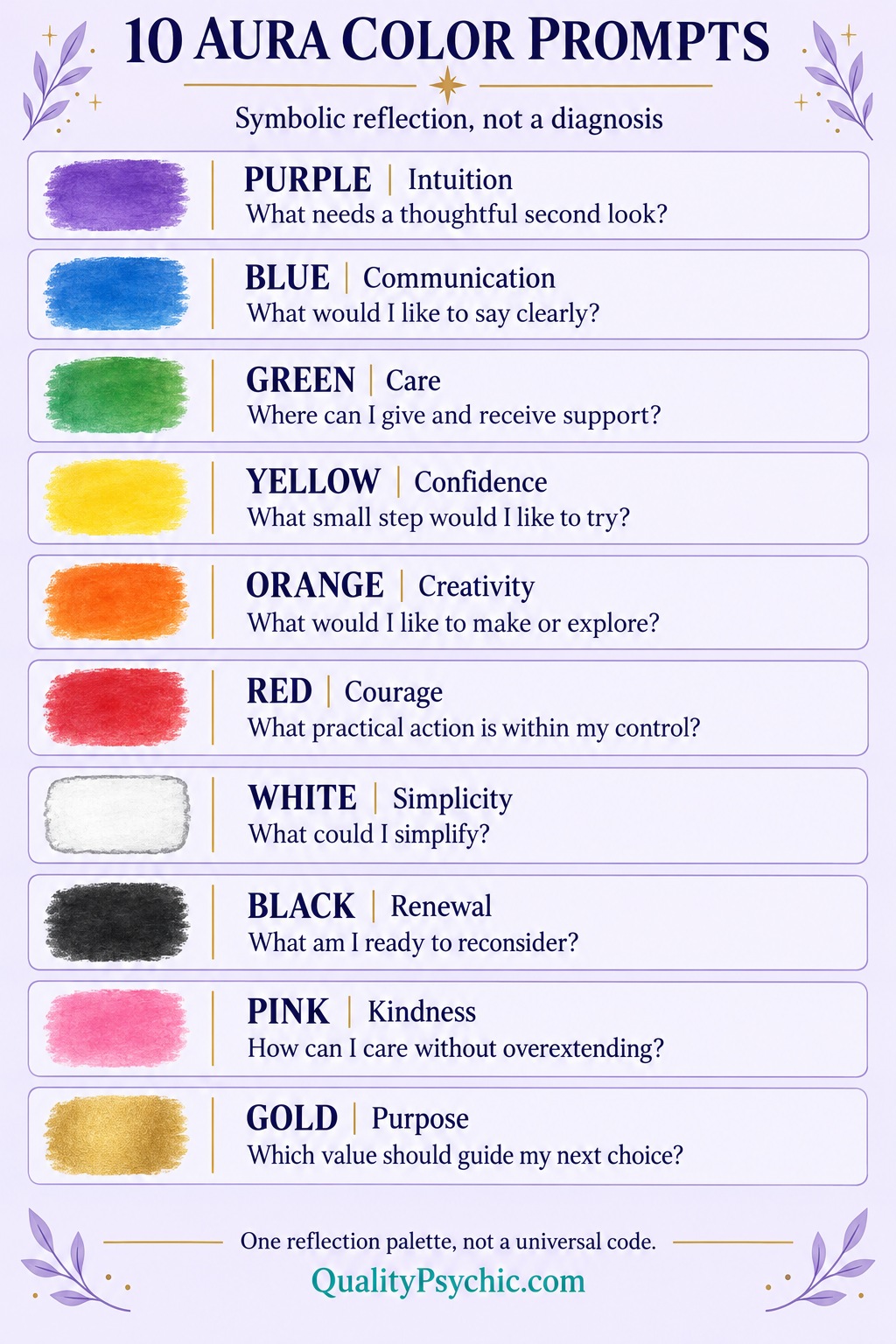
1. Purple: Intuition
Purple can stand for inward attention and a willingness to listen to your intuition. Give an impression room to develop, then consider what you know and what you are only assuming.
Ask yourself: What needs a thoughtful second look?
2. Blue: Communication
Blue offers a gentle prompt about expression and listening. Think about a conversation you would like to approach calmly, including what you want to say and what you need to hear.
Ask yourself: What would I like to say clearly?
3. Green: Care
Green can bring attention to care, connection and growth. Look at both sides of support: what you can offer comfortably and where you might welcome help yourself.
Ask yourself: Where can I give and receive support?
4. Yellow: Confidence
Yellow can be a reminder of curiosity, enjoyment and confidence that grows through doing. Choose a manageable experiment instead of expecting yourself to feel completely ready.
Ask yourself: What small step would I like to try?
5. Orange: Creativity
Orange invites play, expression and new approaches. Creativity need not mean making art: it might be changing a routine, cooking something different or finding another way to solve a problem.
Ask yourself: What would I like to make or explore?
6. Red: Courage
Red can symbolize energy and the courage to act. Keep the action proportionate to the situation; being brave can mean asking a question or setting a limit, not making a dramatic leap.
Ask yourself: What practical action is within my control?
7. White: Simplicity
White can serve as an image of space, peace and a fresh start. Rather than treating it as proof of purity, consider whether reducing one demand would make your day feel clearer.
Ask yourself: What could I simplify?
8. Black: Renewal
Black can make room for reflection, privacy and reconsidering an old pattern. A dark color is not a bad omen, a moral judgment or a reason to fear that something is wrong with you.
Ask yourself: What am I ready to reconsider?
9. Pink: Kindness
Pink can represent affection, gentleness and connection. Kindness includes your own needs: a caring response can have a boundary, and saying no does not make you less compassionate.
Ask yourself: How can I care without overextending?
10. Gold: Purpose
Gold offers a prompt about inspiration and values. It does not place anyone above another person spiritually. Focus on the value you want to express in an ordinary choice.
Ask yourself: Which value should guide my next choice?
Turn a Color Into One Useful Next Step
You can use the palette in a journal, after a spiritual reading or simply while taking a quiet moment. There is no need to force an image or find the “right” color.
- Choose one color. Pick the one that interests you today. If a reader suggested it, notice your own response before accepting their explanation.
- Answer its question in plain language. Write a sentence about a real situation. Separate a feeling or impression from facts you can check.
- Choose a small, ordinary action. Make it something within your control, then notice whether it helps. You are free to change your mind.
If reflection keeps turning into searching for hidden signs, pause and return to what is happening around you. Our guide to grounding versus spiritual escapism explores ways to keep a spiritual practice connected with everyday choices.
What an Aura Color Cannot Tell You
No color in this guide establishes that someone is healthy, unwell, truthful, dangerous, spiritually advanced or destined for a particular relationship. White and gold are not higher ranks; black is not evidence of evil, a curse or a need for cleansing.
A reading also cannot give you another person’s private thoughts or consent. If an interpretation concerns a relationship, use it to consider your own feelings and questions, not to decide what the other person secretly wants.
Spiritual accounts sometimes describe aura colors changing. You may also notice your own color preferences and associations changing. Neither is a reliable way to diagnose stress, trauma or a medical condition. Health concerns deserve qualified care, not a color-based conclusion.
A Reader’s Impression, Visualization and Camera Portrait Are Different
Spiritual interpretation
A reader may describe colors within their spiritual framework, sometimes linking them with chakra symbolism. Ask what the color means in their approach and how they arrived at it. You can appreciate an interpretation without treating it as a verified field around your body.
Personal visualization
Imagining a color is a reflective exercise, not a test you pass by seeing something vivid. If visualization does not appeal to you, choose a color on the chart and write instead. Nothing needs to be detected or proved for the question to be useful.
Aura photography
The manufacturer of the AuraCam 6000 describes hand sensors, a proprietary algorithm and a colored overlay combined with a portrait. It presents the imagery as symbolic and for entertainment. That process does not establish that the resulting colors photograph an independently verified aura. Other products may work differently, so ask the operator which device they use and what it actually records.
Reiki and health claims
If aura language comes up during Reiki, keep the spiritual interpretation separate from health claims. The National Center for Complementary and Integrative Health says Reiki has not been clearly shown effective for any health-related purpose and that there is no scientific evidence for the energy field thought to play a role in Reiki. This is guidance about Reiki, not a color chart for judging a person.
Five Questions Before Paying for an Aura Reading
A thoughtful experience leaves room for questions and disagreement. Before booking, ask:
- What am I receiving? Clarify whether it is a reader’s interpretation, a camera portrait, written notes or a combination.
- How are the colors produced? Ask about the reader’s method or the camera process, rather than assuming they are the same.
- What is the full cost? Check duration, billing units, extra images and any follow-up charges. Use our reading-cost guide to think through the total, not just the advertised starting rate.
- What happens to my information? Ask whether photos, contact details or session notes are saved, shared or used publicly, and how to request deletion.
- Can I decline an interpretation or an extra service? You should not need to buy urgent cleansing because someone calls a color dark or blocked.
Our psychic-reading preparation guide can help you choose a question and a comfortable boundary. For broader service standards, use the quality reading checklist before you commit.
Let the Meaning Support You, Not Define You
The most helpful color interpretation gives you something you can use: a clearer question, a kinder boundary, a creative idea or a conversation to prepare. It does not need to become a permanent identity. Let the symbol open a possibility, then keep the next choice your own.
This article is incredibly enlightening! I’ve always felt a connection to my aura but never understood it fully. The explanations of each color and their meanings helped me realize why I resonate with certain energies. Thank you for sharing this wisdom!
“Aura colors change based on emotions,” huh? Sounds suspiciously like my mood swings! Maybe next time I feel grumpy, I’ll just tell people my aura is ‘cloudy gray.’ Gotta love new age logic!
*chuckles* So now we’re supposed to meditate on our ‘auras’ while sipping green tea? What’s next, finding your inner unicorn? This whole aura thing sounds like something out of a fairy tale.
While I see the appeal in understanding auras, I think we need to critically assess these claims. Just because there’s a belief in energy fields doesn’t mean they exist in any tangible way. Isn’t it crucial to rely on empirical evidence?
Great job detailing the connection between chakras and aura colors! It’s fascinating how these energies interact with our emotions and overall well-being. I appreciate the insights into meditation and self-assessment techniques to find one’s aura.
‘Aura photography’? Seriously? This feels like one of those wild schemes where you charge people for blurry pictures claiming they capture their ‘energy field.’ Next, they’ll be selling ‘aura filters’ for social media! How ridiculous is that?
@WittyWillow Haha, right? Imagine putting on an Instagram filter that makes your aura look more vibrant. “Feeling blue today? Try our new Aura Boost filter!” Just wait until influencers start endorsing it!
“Your energy is your own, and you are unique!” That’s very true! I’ve found meditating has helped me connect with my inner self—regardless of whether or not you believe in auras, taking time for self-reflection is always beneficial.
Honestly, this seems like a bunch of nonsense to me. How can you quantify something as abstract as an aura? It feels like just another way to sell courses or books on spirituality without any real scientific backing.