

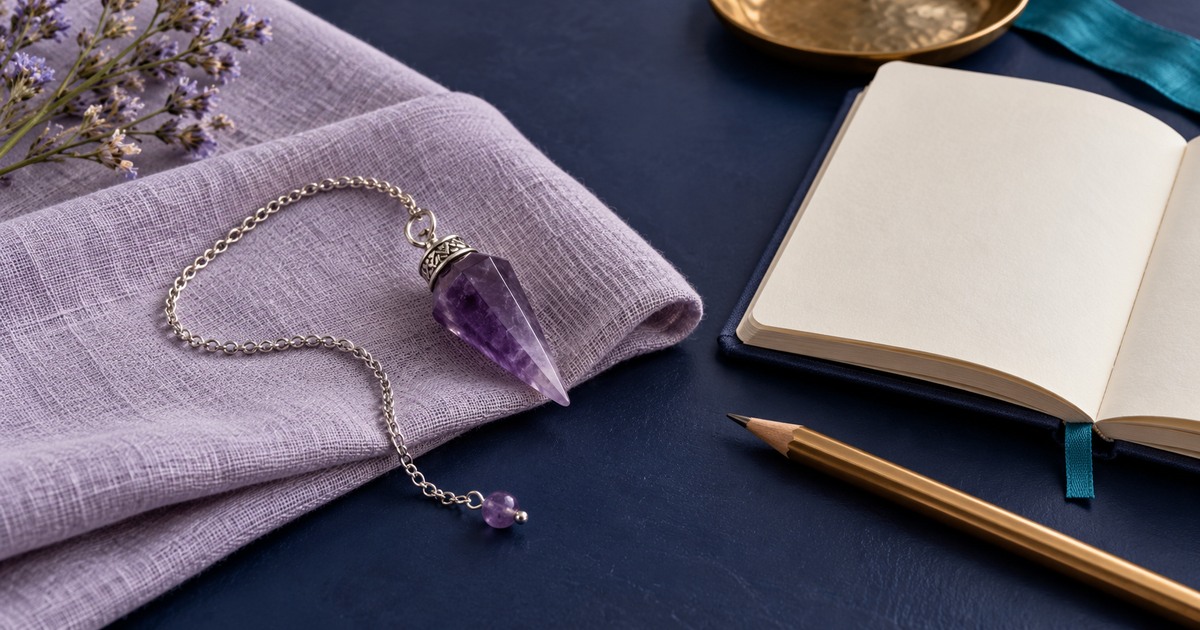
A quiet practice, with your choices intact
If you are drawn to pendulum work, you may enjoy the pause it creates: a small crystal, a question and a moment to listen inward. A crystal pendulum is a weighted stone hanging from a chain or cord. In divination, people give its movements symbolic meanings; you can explore that practice while keeping room for uncertainty.
This guide offers a gentle way to begin, understand the movement and turn your impressions into a next step. The pendulum is an optional companion to reflection, not an authority over your life.
A simple first pendulum practice
You do not need to feel a special sensation or produce a particular movement. Begin with a low-pressure topic, such as what you would like to make time for this week. If you prefer, do the writing part without a pendulum.
-
Settle into a comfortable position
Sit at a stable table. Check that the chain is securely attached, then hold its end lightly between your fingers with your forearm supported. Leave enough space for the weight to hang without touching the table, your body or nearby objects. Keep it away from your face, and stop if your hand or arm becomes uncomfortable.
-
Notice the starting movement
Let the weight settle and watch what it does before asking anything. It may stay almost still, sway or trace a circle. Note this starting movement rather than deciding that every motion is a message.
-
Name one intention
You might say, “I want to notice what matters to me about this choice.” Prayer or a quiet moment can be part of your practice if that fits your beliefs. There is no required phrase, crystal or cleansing ritual.
-
Notice the question and your reaction
Bring one topic to mind. Watch the movement, but also notice your own response: relief, disappointment, curiosity or a wish for a different answer. These are feelings to explore, not evidence that the pendulum knows an outside fact.
-
Put the pendulum down before deciding
Write what happened, what it meant to you and what you can check. Choose one ordinary action, or leave the matter open. You do not owe the ritual a decision.
Keep observation, meaning and action separate
A short record gives you something clearer to revisit than a remembered “yes.” Here is a hypothetical example about making time for a creative project:
A three-part pendulum note
- What I observed
- “The pendulum moved back and forth. I felt pleased when I imagined starting the project.”
- What it meant to me
- “I may want more space for creativity.” This is a personal interpretation, not a prediction that the project will succeed.
- What I will check or do
- “I will look at my calendar and see whether one short session fits without crowding out rest or other commitments.”
If nothing moves, your practice has not failed. You can still ask what you hoped to feel and what you need to know. Our guide to connecting intentions with practical actions offers another way to work with a meaningful object.
Why does a hand-held pendulum move?
A pendulum responds to movement where it is held. Tiny finger or arm movements can build into an obvious swing, even when you do not feel you are deliberately moving. This is commonly called the ideomotor effect.
A 2021 motion-capture study of hand-held pendulums recorded small movements producing larger oscillations. The length of the pendulum also affected participants’ ability to produce that effect. The study explains a physical way that a swing can develop; it does not validate divination answers.
You may still find the ritual spiritually meaningful. Meaning and factual accuracy are different questions. A movement that surprises you does not, by itself, establish contact with a guide, knowledge of the future or another person’s thoughts.
Some practitioners assign movements to “yes,” “no” and “unclear.” Those meanings vary; there is no universal direction key. If you use your own key, write it down beforehand and allow an unclear result to remain unclear. Naming a movement does not independently verify the answer.
Turn a verdict into a useful question
Questions about your own values and available choices leave you more room than attempts to uncover secrets or guarantee an outcome. These examples show how to keep the spiritual reflection connected to real life:
“Should I apply for this job?”
Reflect: What attracts me to the role, and what concerns me?
Check: Read the duties, qualifications and advertised pay. Write one question you would ask in an interview. A swing cannot establish whether you will be hired or whether the job will suit you.
“Does my friend secretly resent me?”
Reflect: What actually happened, and what am I assuming?
Check: If it is appropriate and safe, ask about the specific moment without claiming to know their feelings. Respect what they say and their choice about contact.
“Should I book another reading?”
Reflect: What would I like to explore that I have not already asked?
Check: Review the total cost, your budget and whether another session would add anything useful. Taking a break is a valid choice; repeated readings are not a requirement for spiritual progress.
For a fuller way to sort a decision, see finding clear answers. Write down what you know, what remains uncertain and the smallest step that could help you learn more.
Choose for comfort; care for the actual material
Choose a weight and chain you can hold comfortably, with a secure attachment and no loose or sharp parts. A color or shape may carry personal symbolism for you. It does not need to be expensive, and a simple non-crystal weight can serve the same reflective purpose.
- Check before cleaning. Identify the stone, metal and any treatments, and follow the maker’s care instructions. Do not assume the assembled pendulum tolerates soaking, salt, chemicals, heat or prolonged sunlight.
- Match care to the stone. For example, GIA’s amethyst care guide explains that abrupt temperature changes can fracture amethyst and prolonged intense light can fade some of its color. Advice for that stone is not a cleaning rule for every crystal or chain.
- Keep a symbolic reset gentle. If you like a fresh start, put the pendulum down and name a new intention. That is different from removing dirt. A water-free pause can honor your ritual without risking an unsuitable cleaning method.
- Store it thoughtfully. Protect the pointed end from knocks and keep small weights and cords out of reach of young children and pets. Check the attachment again before the next use.
When to put the pendulum down
Pause if you are asking the same question until you get the movement you want, feel frightened by an answer or feel unable to choose without checking again. Return to your notes, speak with someone you trust or simply leave the question unanswered for now. A spiritual tool does not need to become an obligation.
Chakra and energy readings are spiritual interpretations, not medical measurements. Do not use a pendulum to diagnose illness, locate a supposed health blockage, choose or change medication, or decide whether care is needed. Bring health concerns to an appropriate qualified professional.
A swing cannot establish faithfulness, private thoughts or consent. For money, safety and legal decisions, use verifiable information and appropriate qualified advice rather than a pendulum result.
Take one thing with you: let the ritual open a thoughtful question, then let your choices rest on your values, the facts you can check and the people actually involved.
I’ve been practicing meditation for years, and I’ve found using a crystal pendulum enhances my focus significantly. It’s remarkable how such simple tools can amplify our spiritual practices if used mindfully!
I find it perplexing that people trust pendulums for answers when they could just think logically about their choices instead. This reliance on mystical tools seems counterproductive in our age of information and science.
While I appreciate the enthusiasm, I can’t help but roll my eyes at the idea of using a pendulum for spiritual healing. It’s just a piece of rock on a string! Science should come first, not superstition.
This article provides some insightful information about crystal pendulums. It’s interesting how these tools can potentially aid in energy cleansing and chakra balancing. The historical context behind pendulums is also worth exploring further.
I absolutely loved this article! It opened my eyes to the world of crystal pendulums and their potential. I’ve been looking for ways to enhance my meditation practice, and this seems like a perfect fit. Thank you for sharing!
*sigh* Another article promoting new-age nonsense! What’s next? Using magic beans to grow your garden? At least make it entertaining instead of pretending this is a legitimate practice!
If only I had known that waving around some crystals could solve all my problems! Forget therapy or self-reflection; I’m just going to start asking my new best friend, Mr. Pendulum!
Next thing we know, people will start arguing about which crystal is the best therapist! Maybe we should put them all on reality TV—’The Real Crystals of Chakra County.’
Surely Mr. Pendulum will tell you that pizza is always the answer, right? Because every serious question deserves an equally serious response: “What toppings should I choose?!”
‘So you want clarity? Grab a rock on a string!’ Honestly, if I wanted advice from something that swings around, I’d just consult my grandfather’s old clock! But hey, whatever floats your boat.
‘Clarity’ with crystals—what’s next? ‘Deep thoughts’ with paperweights? Just remember not to ask it if you should have tacos for dinner; those decisions require more than swinging rocks!
‘Yes’ and ‘no’ answers from crystals—sounds like the ultimate life coach! Who needs therapy when you’ve got a fancy rock telling you what to do?