

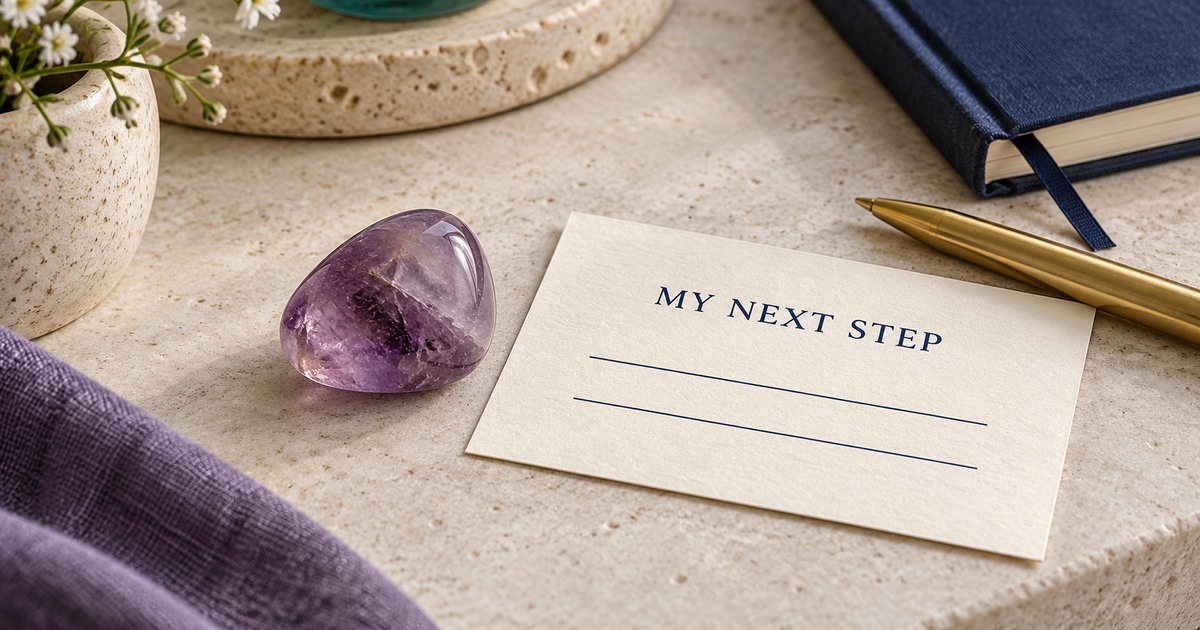
If crystals belong in your spiritual practice, you may enjoy choosing one for a fresh beginning, a quiet pause or a value you want to carry into the day. Its color, texture or personal story can give your intention a familiar place to return to. The practice can be simple: name what matters, choose an action and let the stone remind you.
Connect the intention to your own next step. “I want to show more care in my friendships” leaves you something to choose. “This person must contact me” asks a ritual to control someone else’s decision. A crystal is optional; consent and practical action are not.
Choose a reminder with meaning for you
Begin with a stone you already enjoy, if you have one. A gift, a color you love or a memory may matter more to you than a shopping list of supposed powers. You do not need an expensive crystal, a rare shape or a particular matching chart before you can reflect.
When a spiritual tradition or teacher gives a stone a meaning, you can consider that association within its own context. It is not a verified rule that one mineral must produce a particular life outcome. You can also give an object a personal meaning: “This reminds me to be patient,” rather than “This will make everyone treat me patiently.”
Pick something comfortable to handle, without sharp edges or loose pieces, or simply look at it on a stable surface. A drawing, keepsake or written note is an alternative. You do not have to hold a stone, put it on your body or feel a special sensation for the exercise to count.
A flexible four-step intention practice
Use these steps at your own pace. There is no required time of day, moon phase, number of repetitions or feeling you have to achieve.
-
1. Name a direction you can influence
Choose a value or activity: making room for creativity, speaking more honestly or caring for a friendship. Let the wording describe your choices rather than a guaranteed result or another person’s response.
-
2. Give it one practical next step
Ask, “What could I actually do, and when would it fit?” Keep it within your time, energy and resources. “After breakfast on Saturday, I will write one paragraph” is something you can attempt; “My work will become famous” is not an action plan.
-
3. Make a quiet connection
Set the stone beside your note, look at it or hold it if comfortable. You might say the intention aloud, offer a familiar prayer or sit quietly with your eyes open. You do not need to force calm, visualize clearly or interpret a physical sensation as proof.
-
4. Take the step and return to the note
Let noticing the reminder bring the action back to mind. Later, ask what you actually did and what needs adjusting. A missed step is information about the plan, not proof that your crystal rejected the intention.
If quiet exercises feel uncomfortable, stop or change the format. You can write a practical note and move on without meditation. Our guide to grounding and spiritual reflection explores ways to stay connected with everyday needs while keeping room for meaning.
An intention card with an action you can check
This hypothetical example uses a crystal as a reminder for friendship, not as a way to make someone reply:
My next step
- My intention
- I want to care for a friendship I value.
- My action
- On Wednesday afternoon, I will send one friendly message asking whether they would like to catch up.
- What remains theirs
- Whether they reply, what they share and whether they want to meet. I will respect a request for space.
- My review
- Did I send a message that felt kind and honest? I can acknowledge that choice without treating their answer as a test of my worth or my crystal.
You could adapt the same structure for a creative project or a household task. Choose an action you can reasonably attempt, not a commitment to force an outcome. If your goal is unclear, the guide to finding clear answers can help separate facts, hopes and unanswered questions.
Physical cleaning and symbolic cleansing are different
You may use “cleansing” as part of a spiritual fresh start. That meaning is separate from removing dirt, and it does not establish that an object has accumulated harmful energy. Taking physical care of the material comes first.
Physical care
Identify the material and any treatment before choosing a cleaning method. Water, salt, heat, chemicals and direct sunlight are not suitable for every stone. If you do not know what it is, ask a knowledgeable gem professional rather than guessing.
Symbolic reset
Put the object down, read your intention again and decide whether it still fits. You can begin again without smoke, flame, soaking or leaving the stone in sunlight. The reset need not physically alter the object.
The Gemological Institute of America’s care guidance explains that heat, strong light, chemicals and some cleaning methods can damage gems, with special care needed for treated materials. Its amethyst guide notes that prolonged intense light may fade color and abrupt temperature changes can cause fractures. A cleaning method suitable for amethyst is not automatically suitable for an unidentified stone.
Keep stones out of your mouth and drinking water. Store small or sharp pieces where children and pets cannot reach them. Use a stable place for the reminder rather than loose stones under a pillow. Do not rely on a feeling of “good energy” to establish physical safety.
Personal meaning is not the same as a health effect
A ritual may feel comforting or spiritually significant to you. That experience does not establish that a mineral treats anxiety, heals an illness or protects you from harm.
What the cited crystal study can tell us
A randomized study of 138 adults compared rose quartz with a visually matched placebo during a 14-day protocol. It found no anxiety benefit specific to the crystal. That is a finding about the tested intervention and outcomes—not a test of every person’s spiritual meaning or every possible ritual.
Keep medical treatment and mental-health support separate from this optional practice. Do not stop prescribed treatment, delay care or use a crystal interpretation to diagnose yourself or someone else. You do not have to buy a stone, pay to remove “negative energy” or maintain constant positivity to deserve support.
Review the action, then let the practice change
When you return to the note, ask what was useful and what was too demanding. You might keep the same intention, choose a smaller action or put the stone away for a while. Forgetting the ritual does not make a setback your fault.
- If you took the step: notice what you chose, without assuming that every later event was caused by the stone.
- If you did not: ask whether the timing, energy needed or task size was realistic. Change the plan rather than adding a compulsory ritual.
- If another person is involved: leave their choices with them. A meaningful coincidence is not permission to ignore a boundary.
The related guide to luck, symbols and practical choices offers another way to appreciate encouragement without making it a promise. If you want to start again, return to the four-step practice. Let the crystal support the intention—not become another thing you must get perfectly right.
“Cleanse your crystal?” Are we talking about a rock or my laundry here? If only my socks had such positive energy! I guess I should start meditating with my detergent next. Who knew laundry could be so spiritual?
“FunnyBunny73”, I get your humor, but honestly, if it helps someone feel more organized or motivated in their life, why not let them have their fun with crystals?
‘Listen to your intuition.’ Really? So if my intuition says binge-watching TV while eating chips counts as setting intentions, is that valid too? This whole concept seems overly simplistic.
@IntuitiveIrene_, fair point, but there has to be balance! Self-care shouldn’t become an excuse for avoiding responsibilities or real-life challenges.
@CynicalCathy88, sometimes simplicity is key! Intuition can guide us toward self-care practices too; it doesn’t always have to be about productivity!
I’m intrigued by the idea of using crystals for intention-setting! Although I’m skeptical about their powers, I can see how they might serve as a physical reminder of one’s goals and aspirations.
While the article promotes setting intentions with crystals, it’s essential to note that the efficacy of crystal healing lacks empirical support. Intentions can be beneficial in psychological terms, but relying solely on crystals may lead to disappointment.
This is all just wishful thinking, isn’t it? Crystals and intentions? It sounds nice, but there’s no scientific basis for any of this. We need real solutions, not magical thinking.
I absolutely love this article! The emphasis on setting intentions and using crystals is so inspiring. It’s a beautiful reminder that we can manifest our dreams by aligning our energies. Thank you for sharing such positive insights!
‘The energy you have in life should focus on what crystal you choose.’ This resonates with me deeply! It’s all about tuning into yourself and finding what vibes best match your journey. Let’s embrace the power of positivity!
I find it amusing how people will believe anything that sounds mystical. Setting intentions might help some people focus better, but attributing success to crystals is quite a stretch! Let’s not confuse correlation with causation.