

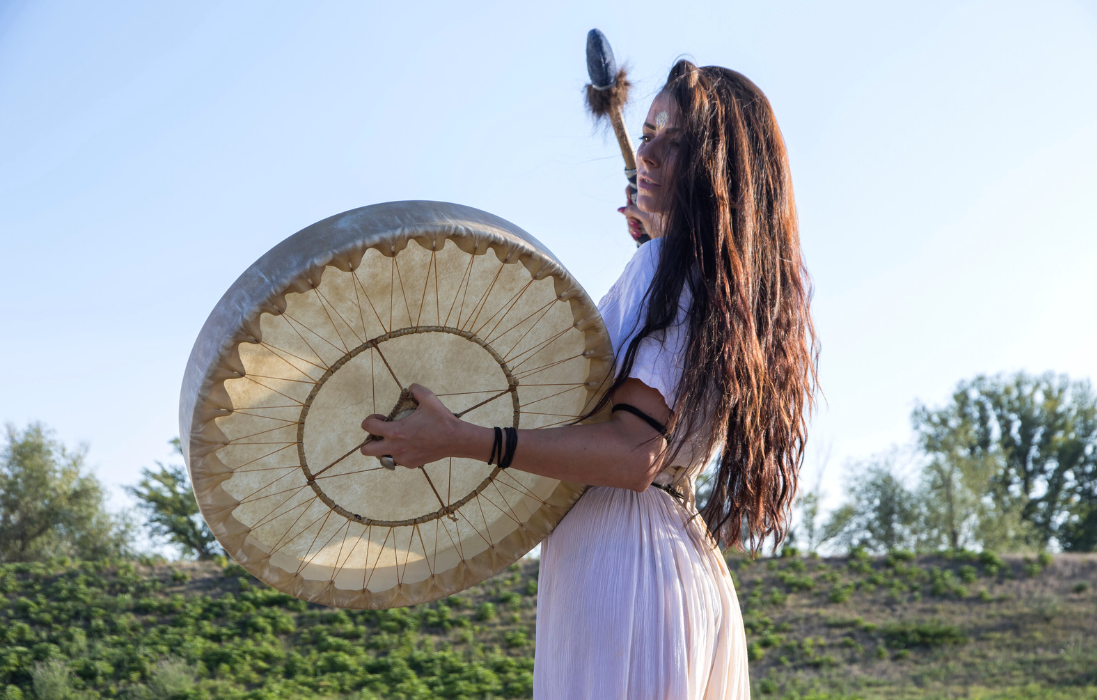
Spiritual drumming is the use of rhythm as part of reflection, prayer or a personally meaningful ritual. Someone might listen to a steady beat while meditating, play a drum to mark an intention, or join a group for music and connection. “Shamanic drumming” is a more specific label, but it is also used loosely in contemporary workshops. Before joining one, ask what tradition or practice the organizer actually means.
A rhythm can feel absorbing or emotionally powerful without proving contact with spirits, predicting events or curing an illness. You can appreciate that experience while keeping its interpretation open.
Spiritual drumming is not one universal tradition
Different communities have their own instruments, musical techniques, spiritual roles and rules about participation. West African drumming, Sámi ceremonial drums and a modern recreational drum circle should not be treated as interchangeable versions of the same practice.
For example, the Metropolitan Museum of Art’s account of the Malinke jembe places that instrument within the Mandé region of West Africa and describes its relationship with blacksmith traditions, ritual and ensemble performance. That is a particular musical and cultural history, not an origin story for all drumming.
The British Museum’s description of a Sámi drum identifies imagery connected with reindeer herding, fishing, the sun and the winter solstice. It also describes symbols associated with the spiritual journeys of a noaidi. These are interpretations within a named tradition, not evidence that any drum has supernatural powers.
If you want to learn about a particular community’s practice, seek teaching that community chooses to share. Ask who is teaching, how they learned and whether the event is open to visitors. Do not assume that buying a drum gives you a ceremonial role or permission to reproduce sacred designs, songs or rituals.
Which kind of drumming session are you considering?
A personal reflective practice
You choose a simple rhythm or recording as a focus for attention. Your intention might be enjoying music, reflecting on a question or taking a quiet break. You do not need to call yourself a shaman or claim a connection to a tradition you have not learned.
A community ceremony or spiritual workshop
The setting matters. A community-led ceremony may have specific participation rules; a commercial workshop may use a contemporary mixture of practices. Ask the organizer to explain that distinction clearly, including what is optional and what participants are expected to do.
Clinical music therapy
This is a health profession, not simply a spiritual event with drums. NCCIH explains that music therapy involves a therapeutic relationship and the practitioner’s education, training and credentials. If your goal is treatment, check professional qualifications and discuss appropriate options with your healthcare team.
What can you reasonably expect?
You might enjoy the rhythm, find it easier to focus, or feel a sense of connection with other participants. You might also feel bored, distracted or uncomfortable. None of those responses is a measure of spiritual worth, and you do not need to force an intense experience.
Some practitioners describe drumming as a journey, a connection with ancestors or a representation of the earth’s heartbeat. Treat those descriptions as spiritual beliefs or metaphors. An image, feeling or memory that arises is not automatically a message from someone else or reliable information about the future.
For reflection, it can help to separate three things: what you noticed, what meaning you gave it, and what ordinary action you want to take. “I felt calmer” is an observation. “The rhythm reminded me to slow down” is an interpretation. “I will protect an evening break” is a practical choice. Our guide to grounding versus spiritual escapism explores that distinction further.
Drumming and health: keep the limits clear
NCCIH notes potential benefits from some music-based interventions, but much of the research remains preliminary. Findings about a particular intervention do not establish that a spiritual drumming workshop treats arthritis, heart disease or another condition. Nor do they show that a drum’s “frequency” removes illness or guarantees emotional healing.
Use drumming as an optional interest alongside appropriate care, not as a reason to delay assessment, stop medication or replace treatment. Music can also evoke distressing memories, and prolonged instrument playing can cause pain or injury. If participation is uncomfortable, stop rather than accepting an explanation that discomfort proves the practice is working.
Questions to ask before joining a circle
- Purpose: Is this recreational music, spiritual reflection, a named ceremony or professional therapy?
- Teaching: What experience and, where relevant, community authorization or clinical credentials does the facilitator have?
- Choice: May you listen, keep your eyes open, decline touch or sharing, take a break and leave?
- Sound and access: How loud is it? Are hearing protection, seating, quieter space and adaptations available?
- Costs and claims: What is included in the price? Avoid promises of guaranteed cures, psychic powers or compulsory follow-up purchases.
- Privacy: Will anyone record or photograph you? Can you decline without pressure?
A clear answer is more useful than an impressive spiritual title. You should not have to reveal private health details or painful experiences to prove your willingness to participate.
A low-pressure way to explore rhythm
- Choose an ordinary intention. For example, “I want to enjoy a short musical break.” This is personal reflection, not a guide to recreating a ceremony.
- Get comfortable. Sit with support and use gentle tapping or quiet audio. Keep your hands relaxed and avoid movements that hurt.
- Keep it brief and optional. Try a short interval, pause and notice whether you want to continue. There is no required speed, duration or trance state.
- Finish with everyday awareness. Look around, notice your surroundings and write one observation if useful. You can stop without analyzing the experience.
Do not use absorbing exercises while driving or doing anything that requires full attention. If sound or inward attention increases distress, choose a quieter activity instead.
Protect your hearing
The National Institute on Deafness and Other Communication Disorders explains that sound can damage hearing when it is very loud, or loud for too long. Distance from the source also matters. Lower playback volume, shorten exposure, move away from loud drums and use appropriate hearing protection in loud settings. If you cannot make the setting safe, leave it.
Persistent ringing or concern about hearing deserves a hearing assessment, not a spiritual interpretation. A meaningful practice should leave room for your physical comfort, informed choice and right to stop.
#DrumLife! I never thought about drumming as spiritual or healing before. Next time I’m at a party, I’ll have to show off my mad skills while channeling my inner shaman! 😂🎶
If only my therapist used drums instead of talk therapy! Imagine beating out my issues on a big ol’ bongo—definitely sounds more fun than sitting on a couch discussing feelings. 😂🥁
I absolutely loved this article! It beautifully captures the essence of spiritual drumming and its profound impact on both mind and body. Drumming truly is a universal language that transcends cultures. Thank you for sharing this!
“You don’t have to be from any specific tribe to use a drum for healing.” Wow, so now anyone can just pick up some drumsticks and claim they’re healing? Seems like the latest trend in cultural tourism to me!
While I appreciate the history of shaman drumming presented here, I can’t help but feel it romanticizes a practice that is deeply cultural. It’s essential to respect the origins without appropriating them for personal gain.
I agree with you, CuriousCat_42. There’s a fine line between appreciation and appropriation, and this article seems to blur it quite a bit.
I think it’s important to highlight cultural practices like these, but yes, care must be taken in how we discuss them. It’s vital that we honor their true significance.
“Anyone can become a shaman?” That sounds more like an oversimplification than reality! Being a shaman takes years of learning and cultural understanding, not just picking up a drum! This article glosses over crucial aspects.
This post provides some basic information about spiritual drumming but lacks depth in certain areas such as its psychological effects or scientific studies supporting its benefits. More research would enhance understanding.
This article offers an informative insight into the world of drumming! I had no idea about the different types of drums or their historical significance in various cultures. Very enlightening read!