

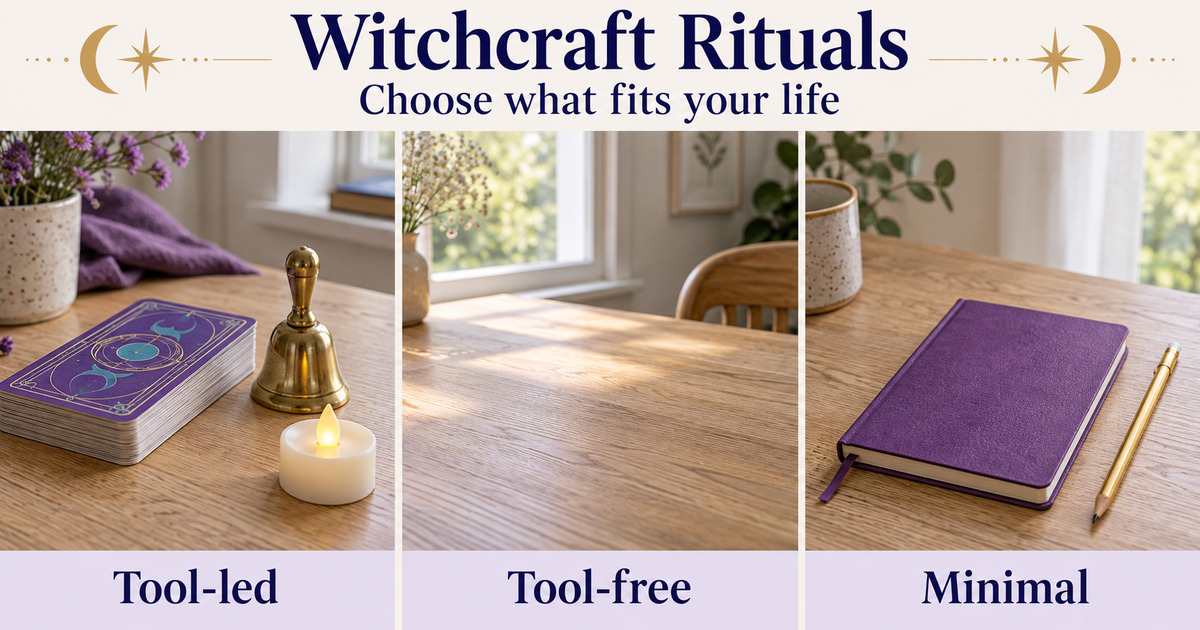
You do not need an expensive collection of objects to begin a personal witchcraft practice. Tools may help a ritual feel structured or meaningful; a tool-free approach may suit your budget, space or daily routine. Neither choice establishes that a spell can control events, cure illness or change another person’s feelings.
Here, “magic” refers to spiritual or symbolic practice rather than a guaranteed external result. The useful question is what a tool contributes to your experience—and whether you can use it safely, affordably and without pressure. You can keep the objects you enjoy, simplify what feels burdensome and change your approach later.
Open the full-size three-choice cover. The comparison and practical limits are explained in text below.
What a ritual tool can contribute
A candle, journal, deck of cards, bell or chosen object might provide a visible starting point for a practice. For some people, arranging a small space or handling a familiar item helps mark time for reflection. Others find the setup distracting or inconvenient. Your experience may differ.
Spiritual traditions can attach particular meanings or rules to their tools. If you are following a specific tradition, learn its context from appropriate teachers or community sources rather than assuming every practice is interchangeable. A personal symbolic substitution is not necessarily the same as performing a community’s established ritual.
Tools do not need to be treated as sources of verified healing energy. Enjoying a sound, color or texture does not demonstrate a therapeutic effect or make a prediction reliable. The cover compares illustrative setups; it does not show a spell producing a result.
Compare three ways to practice
A tool-led ritual
A repeatable arrangement of chosen objects may suit you if preparing the space is part of what you enjoy. Start with one item you already own, such as a journal, instead of assuming a kit is necessary.
Tradeoffs: purchase costs, replacement supplies, storage, maintenance and restrictions on flames or scents. An object’s price, rarity or appearance does not prove greater spiritual power.
A tool-free ritual
A quiet reflection, spoken intention or imagined symbol needs no dedicated ritual objects. It may be easier when traveling or sharing a home, and it avoids replacing ingredients.
Tradeoffs: you may miss a visible beginning or ending. Choose a suitable time, name your topic and finish with one practical next step. Stay aware of your surroundings; an ordinary feeling is not a failure.
A minimal or mixed approach
Use a notebook on some days and no objects on others. A battery-operated candle can offer atmosphere without an open flame. You can keep one meaningful item rather than an elaborate collection.
Tradeoffs: even a small setup needs to fit your space, budget and house rules. This is not a contest between authentic and inferior practice; you can change what you use.
A fictional example: an evening without flames
Imagine choosing a short reflection about making room for a hobby. The choices might look like this:
- The practical limit
- “My building prohibits candles, and I do not want scented products.” There is no need to work around a safety rule to make a ritual count.
- The setup
- “I already own a notebook, so I will use that alone.” A flameless light is optional, not another required purchase.
- The next action
- “I will put a short hobby session on my calendar, then put the notebook away.” The action is something to attempt, not a promise that a spell will change circumstances.
This is a made-up example, not a reported client experience or proof of a spell’s effect. A tool-free version could use the same intention and practical action without the notebook.
Four questions before buying another tool
- Purpose: what would this object add that I cannot already do with what I own?
- Total cost: can I afford the item, replacement supplies and any ongoing purchases without affecting essentials?
- Practical fit: can I store it securely and use it within my home’s rules and other people’s needs?
- Freedom to decline: can I say no without being told I will attract harm, lose protection or fail spiritually?
Pause if a seller uses fear or insists that only their expensive item can remove a curse or guarantee an outcome. You do not owe anyone a purchase to prove commitment. Set your budget before shopping, and remember that “not buying anything” is a valid decision.
Missing an ingredient is also a reason to reconsider the activity, not improvise with an unidentified plant, unsafe substance or unsuitable household product. You may postpone a ritual or choose a simpler reflection instead.
Keep physical safety separate from symbolism
A spiritual meaning does not remove a tool’s ordinary risks. Check the object, the setting and the people or animals who could encounter it.
- Candles: the U.S. Fire Administration recommends considering flameless candles. If you use a flame, use a stable holder, keep it at least 12 inches from anything that burns and extinguish it before leaving the room or going to sleep. Its guidance advises against lit candles in bedrooms, bathrooms and sleeping areas.
- Oils and scents: Poison Control warns that misused essential oils can cause serious poisoning. Follow product instructions, do not swallow ritual oils or use them as homemade medicines, and keep bottles securely away from children and pets. Skin reactions are a reason to stop using the product. A scent-free ritual is an option.
- Shared spaces: ask before using scents, sound or displays in a room others use. Respect a refusal. Do not assume another person’s discomfort means their energy is incompatible with yours.
- Found materials: choose items you can identify and use safely. Do not ingest an unknown plant or put a mineral in drinking water merely because a ritual suggests it.
Try a small practice and review it honestly
Choose an ordinary topic, such as making time for a hobby, rather than trying to influence another person’s consent or replace a consequential decision. You might try this optional structure:
- Choose your setup: one familiar object, a minimal arrangement or no tools.
- Name your intention: write or say what matters to you, without promising that circumstances will obey it.
- Choose an action: identify something within your control, such as setting aside time or asking a clear question.
- Review the experience: note whether the setup was enjoyable, distracting, costly or inconvenient, and whether you took the practical step.
Review the experience and choose again
After a small attempt, ask what the setup actually added: a useful beginning, an enjoyable moment, extra work or an expense you would rather avoid. You can keep one part, change it, stop or try without objects next time. This is a reflection prompt, not a test of magical ability.
A calmer feeling or a completed action can matter without proving supernatural causation. Do not treat a coincidence as a guaranteed result or blame yourself for outcomes beyond your control. Our guide to manifestation and practical action explores the distinction between intention and practical action.
If a practice becomes compulsory, frightening or disrupts sleep and daily responsibilities, you can stop and seek appropriate support. For another grounded perspective, see grounding versus spiritual escapism.
The best setup is not necessarily the most elaborate. Choose what has a clear purpose, fits your circumstances and leaves you free to change your mind. Tools can be meaningful without being mandatory.
I absolutely loved this article! It provided a balanced view on using tools in magic. I personally find that they enhance my practice and help me focus better. Thanks for sharing such valuable insights!
I completely agree with you, Bubbles123! Tools add a layer of excitement to the practice, and it’s nice to have something tangible to work with.
While I appreciate your enthusiasm, I think it’s important to realize that true magic can also stem from within, without any external tools.
‘Tools are great,’ they said! But have you seen the price tags? I’d rather save my money for pizza than waste it on overpriced crystals! Just saying… Priorities matter.
I feel you on this one! Why spend all that cash when you can just harness your inner magic with a good old wish?
The article presents an interesting dichotomy between using tools and relying solely on one’s energy. Historically, many cultures have used both approaches effectively, which suggests that personal preference plays a significant role.
From an analytical perspective, it’s crucial to weigh both arguments about tool usage in witchcraft against personal experiences and outcomes. Empirical evidence can help clarify which method might yield more effective results for individuals.
Great point MathWhiz7! It’s all about experimenting and finding what resonates best with each practitioner.
Honestly, this post seems to gloss over the fact that using tools can lead to dependency. Real magic should come from within, not from expensive trinkets that may not even work.
‘Tools or no tools?’ sounds like a magical game show! But seriously, it’s fascinating how both sides have their merits. Just remember: if your spell fails, blame it on the wand not being in the right mood!
Oh sure, let’s just go ahead and ignore centuries of tradition because ‘freedom’ sounds nice. Next thing we know people will be casting spells with just their thoughts—what are we? Wizards in a sci-fi movie?
While your sarcasm is amusing, there is merit in learning how to adapt practices based on individual circumstances.
Haha SnarkyNoodle! But who wouldn’t want to be a wizard? Sounds like fun!