

Automatic writing is a term some spiritual practitioners use for writing they experience as arriving with little deliberate planning, sometimes interpreted as a message from a spirit guide or a higher self. That interpretation is a belief, not something established by the words appearing on a page.
You can explore writing for creativity or personal reflection without entering a trance, closing your eyes or accepting every sentence as guidance. Keep the freedom to pause, edit, disagree with the writing or decide that it has no particular meaning.
Automatic writing, freewriting and journaling
Here is what each label describes, and where its claims stop:
- Spiritual automatic writing
- Some practitioners interpret spontaneous writing as channeling an outside presence. The interpretation is not established by the words themselves.
- Freewriting
- A writing technique: you put thoughts into words without stopping to perfect the grammar.
- Journaling
- A broader practice that may include deliberate reflection, lists or accounts of your day.
Dartmouth’s Writing Center describes freewriting as an informal way to develop ideas without focusing on syntax or grammar. It does not require a claim about spirits. You can borrow that practical approach even if you are curious about spiritual automatic writing.
The distinction matters when you reread your page. “This sentence brought up a concern I want to explore” is different from “An outside being has confirmed what I must do.” A writing exercise does not establish the second claim.
What writing can and cannot tell you
A page may give you material to consider: a recurring question, an image for a story, an emotion you want to name or a possible next step. It may also contain repetition, contradictions or nothing you wish to use. None of those outcomes measures your spiritual worth.
Writing something quickly or unexpectedly does not verify its source, prove a prediction or show that a past decision was correct. The exercise cannot diagnose an illness, establish another person’s private thoughts or substitute for qualified medical, legal or financial advice.
If a scene feels like a recovered memory, do not treat vividness as historical confirmation. Our guide to past life regression and memory explains why suggestive experiences need caution.
Prepare a comfortable, voluntary session
Use paper and a pen, a keyboard or another writing method that suits you. Pick a place where you can sit comfortably and stop easily. A quiet setting may be pleasant, but you do not need special music, binaural beats, candles, crystals or paid equipment.
Stay awake and oriented to your surroundings. Keep your eyes open so you can see what you are doing. Do not use sleep deprivation, intoxicants or forceful breathing to try to obtain a stronger experience. There is no requirement to reach a trance or surrender control of your body.
Choose an ordinary, low-stakes prompt. “What would make tomorrow more manageable?” gives you room to reflect. “Who is secretly betraying me?” encourages an unsupported accusation rather than a useful writing exercise.
A five-step reflective writing exercise
This is an optional freewriting-based exercise, not a method for verifying channeling. A few minutes is enough to try it; the duration is your choice.
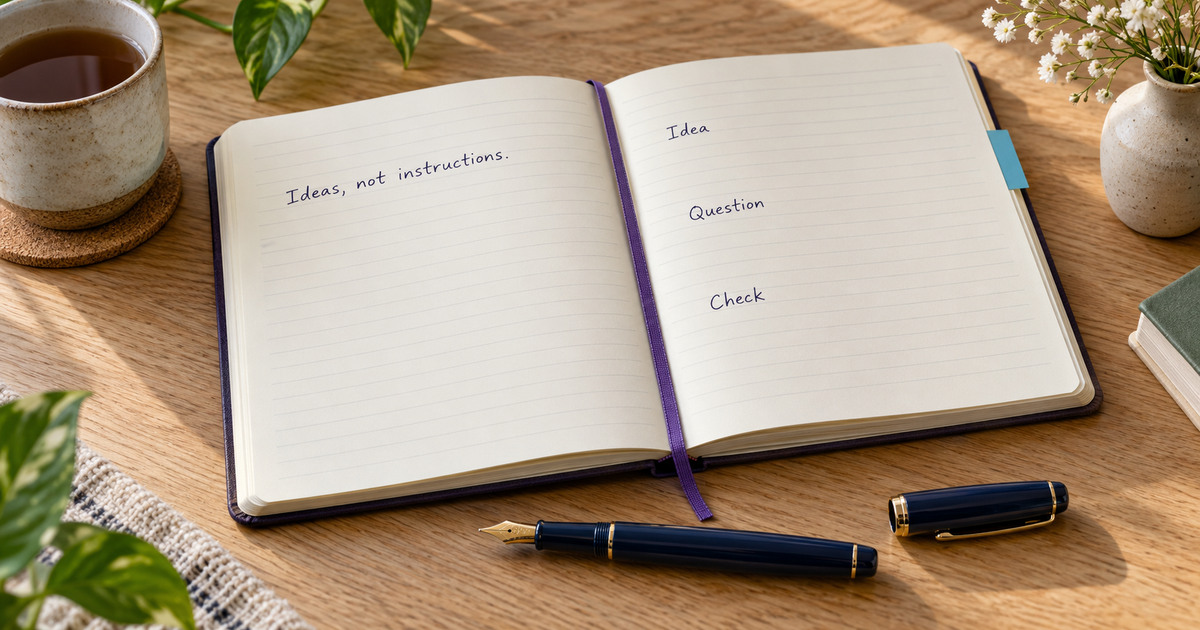
- Set a boundary. Write the date and a note such as “These are ideas, not instructions.” Decide when you intend to stop.
- Choose one prompt. Use a question about your own interests, needs or options, rather than predicting events or reading someone else’s mind.
- Write what comes to mind. Let sentences be imperfect. If nothing comes, describe an object nearby or end the session; do not force a message.
- Pause before interpreting. Put the pen down or stop typing. Notice your surroundings and take a break if you want one.
- Review deliberately. Mark questions, ideas and factual claims separately. Check a claim through an appropriate independent source before relying on it.
You can interrupt the exercise at any step. Choosing not to finish is not evidence of a blocked gift, a spirit’s displeasure or a failure to become enlightened.
Review the page without giving it authority
Ask what the words actually say, what you are adding to them and whether any action is needed. Keep interpretation separate from evidence. A sentence that sounds urgent, confident or unusually personal can still be a sentence you should question.
A made-up example: a sentence about work
- Words on the page
- “Leave your job now.” This is a hypothetical writing example, not a recommendation.
- A question to explore
- “I want to understand why work feels difficult.”
- A deliberate next step
- Consider specific problems, available support and practical constraints. The original sentence is not a command you must obey.
Useful review questions include:
- Idea or fact?
- Is this a creative possibility, a feeling or something that needs verification?
- Whose choice?
- Does the proposed action respect your agency and other people’s consent?
- What are the consequences?
- Would acting affect health, money, employment or a relationship?
- Can it wait?
- Is there a reason to decide now, or can you consult someone appropriately qualified?
Our grounding and spiritual escapism guide offers ways to keep spiritual reflection connected with everyday responsibilities. You do not have to act on every thought to take your interests seriously.
Privacy and boundaries with a teacher or reader
A journal can contain private feelings and unverified statements about other people. Store it as you would other personal information. You are not obliged to show a whole page to a teacher, reader, group or social-media audience to demonstrate that the practice worked.
If you attend a session, ask about the format, cost, recording, privacy and your ability to stop. Do not accept pressure to buy repeated sessions to remove a blockage, threats about what happens if you refuse or a demand to ignore professional care. A practitioner’s certainty does not establish spirit communication.
When to stop and seek support
Stop if the exercise becomes frightening, feels involuntary or interferes with sleep or daily life. You do not need to intensify it to prove that you are open to guidance. Reorient to your surroundings and consider talking with a trusted person or a qualified healthcare professional.
A spiritual interest does not by itself diagnose a mental health condition. However, the National Institute of Mental Health’s psychosis guidance identifies difficulty distinguishing reality from fantasy, hearing things others do not and changes in sleep or functioning as concerns that can warrant assessment. If you feel controlled by messages or are struggling to know what is real, seek professional help rather than treating it as a necessary channeling stage.
In the United States, call or text 988 or use the 988 Lifeline if you are struggling or having thoughts of suicide. Call 911 for immediate life-threatening danger. Continue prescribed care unless your treating clinician advises otherwise.
The most useful boundary is simple: words on a page can be explored, but they do not take away your right to choose, question and stop.
‘Relaxing with chakra music’—what a delightful image! I can just picture someone trying to write while listening to those soothing tunes and drifting off into another dimension. Sounds hilarious!
So let me get this straight: if I write whatever comes to mind while relaxing with binaural beats, I’m suddenly connected with the spirit world? That’s quite the claim! But hey, if it works for someone, more power to them!
…and here we go again with yet another ‘spiritual’ practice that claims to unlock the universe’s secrets! Can anyone explain how scribbling on paper equates to wisdom from higher realms? Sounds suspicious at best.
‘Scribbling’ might be too simplistic a term! The act of automatic writing involves deep focus and trust in one’s intuition, which many find enlightening and transformative.
I absolutely love the concept of automatic writing! It’s fascinating how it connects us to our spiritual selves. I’ve tried it a few times, and the insights I’ve gained have been nothing short of incredible. Highly recommend!
While some may scoff at automatic writing, it’s worth noting that many cultures have practices that involve channeling creativity through different means. From ancient traditions to modern interpretations, there is an undeniable link between spirituality and artistic expression.
True, but there are plenty of ways to be creative without needing to invoke spirits or enter trances. Why not just write based on personal experience? It feels more authentic.
‘Authentic’ is subjective! Many find deeper meaning in connecting with something beyond themselves. Automatic writing can be a tool for those seeking greater understanding or insight.
I appreciate the detailed guide provided here! Automatic writing has been life-changing for me as a writer; it truly helps channel creativity in ways I never thought possible. Can’t wait to try this out more!
! I can’t help but chuckle at this idea of ‘trance writing.’ What’s next? Writing novels while sleepwalking? Although it could lead to some interesting plot twists, wouldn’t you say?
Honestly, this all sounds like a bunch of nonsense. Automatic writing? Really? It feels like just another trend in the self-help world. People should focus on reality instead of chasing spirits.