

If a familiar fragrance helps you settle into a spiritual routine, you may enjoy pairing it with a chakra reflection. The scent can be a personal reminder to pause; it does not have to do the spiritual work for you. No bottle is necessary, and there is no scent you must tolerate to make progress.
Depression, headaches, digestive symptoms or other concerns should not be diagnosed as chakra blockages. Oils are not substitutes for medical or mental health care. If you enjoy chakra symbolism, you can use the themes below with a journal, a quiet moment or a scent-free routine.
Product safety comes before spiritual associations
The National Capital Poison Center warns that misuse can cause serious poisoning. Follow product directions; do not swallow essential oils for chakra work. Not every oil is suitable for skin, and concentrated oils should not be applied undiluted or to damaged skin. Avoid inventing a drop-count recipe from a spiritual chart.
Keep bottles locked away from children and pets. Ask a health professional about suitability if you take medicines or have health concerns; oils can interact with medication. A scent that another person enjoys is not a reason to expose someone who does not want it.
The FDA’s aromatherapy guidance explains that natural ingredients can still be toxic, irritating or allergenic. Certain citrus oils can also harm skin exposed to sunlight. Do not assume “natural,” “organic” or a chakra label establishes safety or medical effectiveness.
Chakra symbolism and aromatherapy are different things
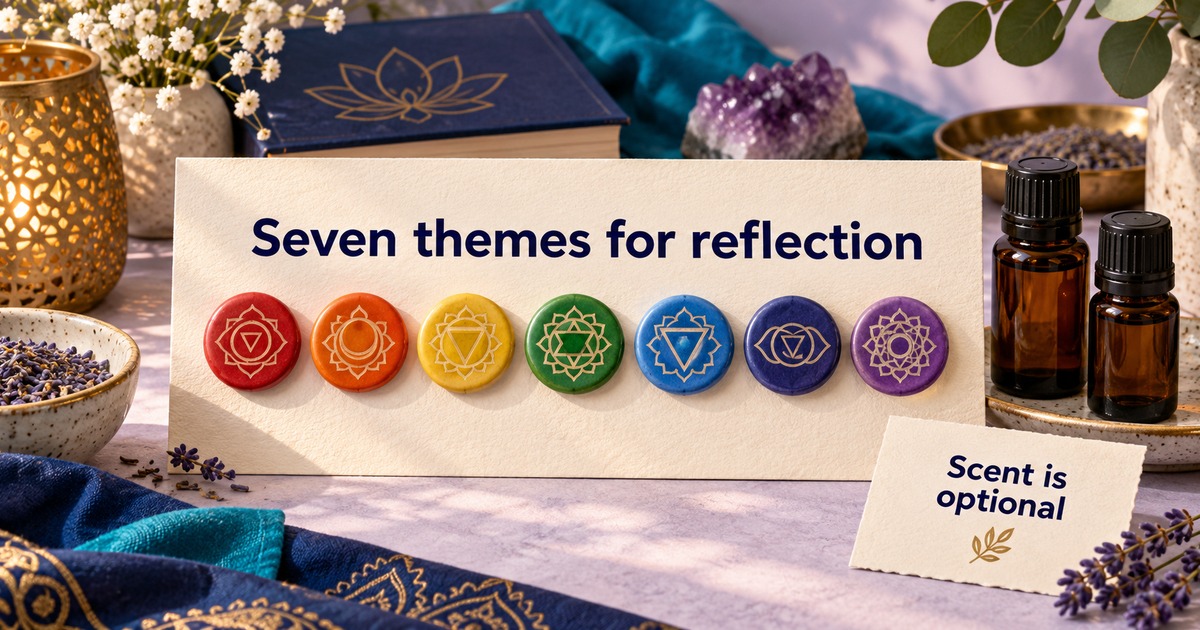
Chakras are described as subtle energy centers in some spiritual traditions. The familiar seven-chakra framework is often used to organize themes such as security, creativity and communication. It is a spiritual model, not a clinical map of organs, glands or causes of illness.
Aromatherapy uses plant-derived essential oils, commonly through inhalation or diluted skin products. The National Center for Complementary and Integrative Health describes it as a complementary approach and notes limited rigorous research for insomnia. In one study it summarizes, lemon improved mood, but neither lemon nor lavender changed measured stress indicators, immune-system markers or pain control.
That does not mean every use of every oil has the same evidence. It does mean that enjoying a scent, feeling calmer and proving a medical effect are not interchangeable. This evidence does not establish a chakra-cleansing effect.
Seven themes for reflection—not seven oil prescriptions
Oil-to-chakra pairings vary among practitioners and products. No particular bottle is required for a theme. The following prompts use the seven-chakra framework as optional symbolism rather than instructions to apply oil to a body part.
Root: security and everyday support
Patchouli or nutmeg may appear in root-themed lists, but they should not be presented as treatments for depression, fatigue or problems with the legs or spine. Instead, ask: “What practical support would help me feel more secure?” Consider a manageable routine, a needed conversation or asking for help.
Sacral: creativity, pleasure and consent
Neroli and ylang-ylang are sometimes given sacral associations. Such labels do not establish that they heal trauma or reproductive conditions. A useful prompt is: “What enjoyable or creative activity do I freely choose?” Respect your own pace and other people’s consent; spiritual practice does not require sexual activity.
Solar plexus: agency and achievable choices
Pine or cardamom may be paired with confidence or motivation. They do not remove rejection or control digestive health through a chakra. Choose one small decision you can make yourself, such as setting a realistic deadline or declining an extra task.
Heart: compassion with boundaries
Rosewood, palmarosa or sweet marjoram may appear in heart-themed blends. These are not established remedies for grief, jealousy, heart disease or immune-system problems. Reflect on how to offer kindness without demanding forgiveness or staying in a harmful relationship.
Throat: communication and listening
Lavender or eucalyptus may be associated with throat symbolism, but the association is not a treatment for hearing, throat or sinus problems. Try writing one clear request and one question you can ask instead of assuming what another person thinks.
Third eye: curiosity and checking assumptions
Sandalwood may be used symbolically in intuition practices. Its fragrance does not prove communication with guides, improve a gland through a chakra or verify a prediction. Ask: “What did I observe, what did I infer and what is still unknown?”
Crown: meaning without forced certainty
Lime and frankincense may appear in crown-themed lists. They do not guarantee wisdom, reveal hidden truth or control your thoughts. Consider a value you want to express today. You can leave spiritual questions unanswered while making a thoughtful present-day choice.
For more context, read seven chakra reflection themes and their limits. Treat a theme as a prompt, not a diagnosis or a reason to buy a complete oil set.
A scent-free practice is a complete option
- Choose one theme. Use whichever prompt is relevant, rather than trying to fix all seven centers.
- Write one observation. For example: “I keep agreeing to tasks I cannot finish.” Avoid turning an observation into a diagnosis.
- Choose one practical response. A clearer boundary, a short creative activity or a request for support may fit the theme.
- Review without judging yourself. Ask whether the response helped. Adapt it or stop if it is not useful.
A small reflection can lead to an ordinary next step
Here is a made-up journal example, not a report from a client or a test of chakra balancing:
- Observation
- “I have agreed to three extra tasks and do not have time to finish them.” This describes a situation, not an energy blockage.
- Optional theme
- The throat theme can be a reminder to express a need. It does not establish a throat condition or require lavender or eucalyptus.
- Practical response
- “I can finish one task today. Which is the priority?” You can write the request privately before deciding whether a conversation is appropriate.
If you choose a fragrance, check the product’s intended use and directions separately from the symbolism. More oil is not more spiritual progress. An uncomfortable scent or reaction is a reason to stop, not evidence that cleansing is working.
You can also explore an optional chakra visualization with clear limits, without oils or promises of healing. Your practice can be meaningful without treating symptoms as an energy problem, delaying care or purchasing something you do not need.
While I appreciate the effort, I can’t help but feel that this is just another pseudoscience trend. Chakras and essential oils? It sounds good on paper, but there’s no scientific backing for these claims.
I absolutely love this post! The idea of using essential oils for chakra balancing is refreshing and inspiring. It’s such an innovative way to combine aromatherapy with spiritual health.
‘Essential oils can heal your soul’—sounds like a fairy tale! But hey, if people find comfort in these practices, who am I to judge? Just keep your expectations realistic!
(Insert eye roll) So now we have chakra oil salesmen? How about we just meditate instead of slathering ourselves with scented liquids? Seems more effective to me!
I can’t believe people buy into this stuff! Essential oils are nice scents at best; they’re not magical cures for emotional or physical ailments. It’s time to get real about health!
The concept of chakras is fascinating! I’ve studied various wellness practices, and balancing chakras does seem to resonate with many people’s experiences. It’s worth exploring for those interested in holistic healing.
I totally agree! There’s so much ancient wisdom in these practices that can complement modern medicine. Even if science hasn’t fully validated everything yet, it doesn’t mean we should dismiss them entirely.
But isn’t it important to distinguish between what has scientific merit and what doesn’t? Just because something feels good doesn’t mean it actually works, right?
‘Essential oils can help balance your chakras’? This is rich! Next thing you know, they’ll be claiming that chocolate can cure existential crises too. Still amusing though!
‘Chocolate cures everything!’ said no doctor ever! But seriously, if it brings joy while not harming anyone, why not indulge in the whimsical side of wellness?
‘Whimsical’ or not, it’s crucial that people remain aware of what they’re relying on for their health—balancing chakras won’t replace a visit to the doctor when needed.
This article was so enlightening! I’ve always felt a bit off, and now I understand how important it is to balance my chakras. The essential oils mentioned are definitely going to be a part of my daily routine!