

An inward journey does not require a retreat, a perfect meditation practice or a dramatic discovery. It can simply mean pausing to notice what you are feeling, what matters to you and what support you need. A private journal, a quiet moment or a conversation with someone you trust may offer a place to begin.
The six situations below are prompts, not diagnostic signs or proof that you urgently need to turn inward. Reflection cannot remove every practical obstacle or replace healthcare. You can choose one question, leave the others alone and stop whenever the exercise feels unhelpful.
1. Your outlook has become harsher
If everything seems to invite criticism, start with one situation rather than labeling your whole personality “negative.” Ask: “What actually happened? What am I assuming? What need or concern deserves attention?” Perhaps a delayed reply feels like rejection, but you do not yet know why the person has not answered.
You do not have to manufacture a sunny outlook. A fairer sentence might be, “I feel disappointed, and I can ask for clarification when appropriate.” Our guide to working compassionately with your inner voice offers practical examples of replacing a harsh verdict with a realistic next step.
2. A past experience keeps occupying your attention
You can acknowledge that something still hurts without forcing yourself to revisit every detail, recover a hidden memory or find a lesson in it. Ask a present-focused question: “What would help me feel supported today?” The answer might be a boundary, practical advice, company or a conversation with a qualified professional.
If reflection brings up overwhelming memories or distress, stop. Notice where you are, look around the room or contact someone you trust if that feels helpful. You are not required to forgive someone, confront them or turn a painful experience into personal growth. An article is not a substitute for trauma-informed care.
3. Your motivation has faded
Before demanding more determination, consider whether the goal still fits your life. Have your interests changed? Is the next step unclear? Are money, time, health, access or caring responsibilities making it difficult? These are real constraints, not evidence that you are failing to think positively.
Try choosing among three options: continue with a smaller step, pause while you seek support, or change the goal. For a course you have been considering, the next step could be checking its schedule and cost rather than immediately enrolling. Write what information you need before deciding. Changing direction can be a thoughtful choice.
4. An important need is not being met
“I feel unfulfilled” can cover many different concerns. Make it more specific: “I want more predictable time off,” “I miss companionship,” or “I need clearer expectations.” Naming the need can help you decide whether to make a request, adjust a routine or seek outside assistance.
When a conversation feels safe, practice a concrete request: “Could we agree on a time to discuss the workload and what can realistically be finished?” Ask whether the other person has time to talk and leave room for negotiation. They may not be able to meet every request. If you fear threats or retaliation, prioritize safety and appropriate support rather than treating confrontation as a required reflection exercise.
5. You are adjusting to a major life change
A breakup, bereavement, move or change in family life can leave ordinary routines feeling unfamiliar. You need not decide what the change means for the rest of your life today. Ask: “What has changed? What remains important? What would make this week a little more manageable?”
The NHS explains that grief affects people differently, including after losses other than a death. There is no single right way to feel. A practical request, such as help with an errand or someone to listen, may be more useful than pressure to discover new opportunities. You do not owe anyone a transformation story.
6. You feel stuck without an obvious reason
You do not have to uncover a hidden root cause to take care of yourself. Try a short check-in with ordinary details: “What has been difficult lately? What am I putting off? What is one thing I could ask for?” If nothing clear emerges, that is an acceptable result.
Quiet reflection or meditation may appeal to you, but it is optional. NCCIH notes limits in meditation research and possible negative experiences; it advises against replacing or postponing conventional care. Keep your eyes open if you prefer, breathe normally and stop if a practice increases distress. Comfortable everyday movement or a supportive conversation can be alternatives; no special spiritual experience is required.
Finish with one small action, not a verdict
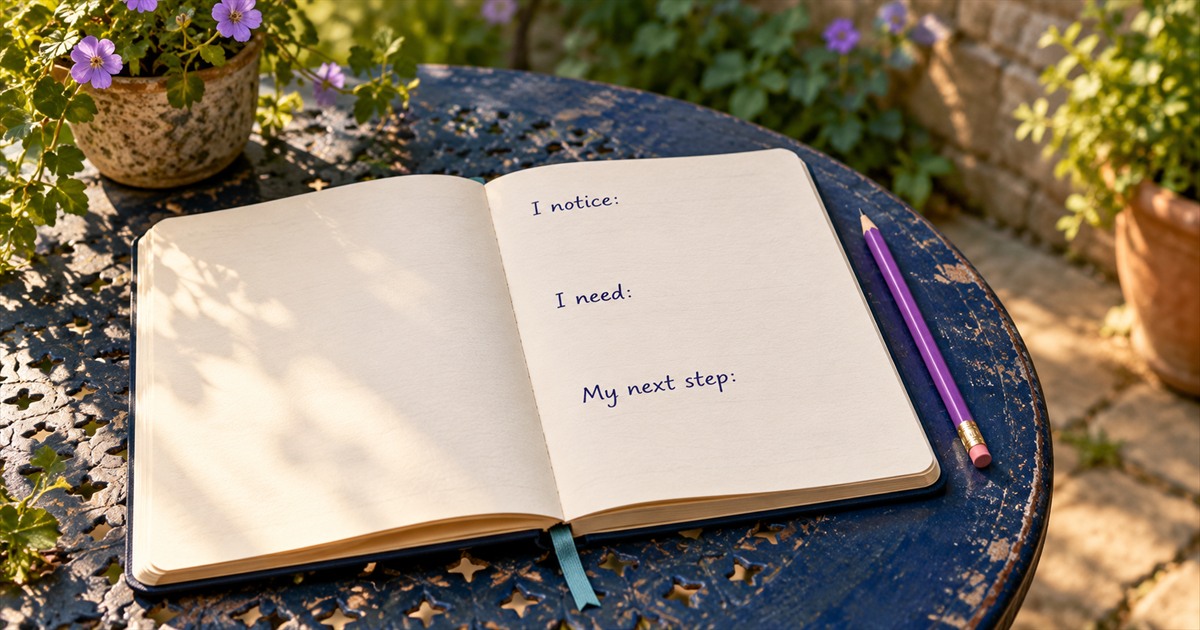
Use three brief lines: I notice: I keep postponing the course decision. I need: reliable information about time and cost. My next step: check the published schedule tomorrow. Afterwards, decide whether the information helps or whether you need a different plan. Keep private notes somewhere you feel comfortable, and share only what you choose.
Spiritual reflection can be personally meaningful, but it cannot diagnose the cause of distress or guarantee clarity. If low mood, anxiety or difficulty coping persists, worsens or disrupts daily life, contact a qualified healthcare professional. The NHS grief guidance also recommends seeking help when self-help is not working. You can ask for support without first completing an inward journey.
‘Take an inward journey’? Really? Because when I feel stuck, what I need is to go on an imaginary adventure inside my own head instead of dealing with reality!
This article is a breath of fresh air! It’s so important to take time for ourselves amidst the chaos of life. I love the suggestions for inward journeys; they really resonate with me. Thank you for sharing!
While I appreciate the sentiment, I’m not sure inward journeys are the solution for everyone. Sometimes, practical action is needed instead of just introspection.
I completely agree! Self-reflection can really transform one’s perspective. It’s fascinating how much clarity can come from just taking a moment to pause and reflect.
I read this article while sipping coffee, and I couldn’t help but laugh at the ‘six signs.’ They could just say ‘if you’re human,’ right? But hey, we all need reminders now and then!
I find this whole idea a bit ridiculous. Just because you meditate or journal doesn’t mean your problems will vanish. Life is complicated, and introspection isn’t a cure-all!
The insights shared in this post are grounded in psychological principles. It aligns with cognitive behavioral techniques that encourage understanding and reframing negative thoughts to promote mental well-being.
‘Understanding feelings’ is great until your feelings are screaming at you like toddlers in a candy store—good luck finding calm then!
‘Understanding your feelings’ sounds fancy, but it feels like fancy talk for ‘just think positive.’ Maybe we need some humor to lighten up these deep thoughts!
‘You’ve Lost Your Motivation’ really hit home! Sometimes life feels like an uphill battle, but I’m inspired by this reminder to look inward and rediscover my drive.
‘You’re Unfulfilled’—how true! It’s almost like society expects us to be satisfied with mediocrity while ignoring our true desires. This article should be required reading!
I didn’t know it was okay to feel lost sometimes! This post encourages us to look within rather than outward for solutions—a perspective shift that could be quite enlightening.