

Can psychics predict the future? Some readers say they receive impressions about events that have not happened yet, but a confident prediction is not a guarantee. A reading may offer a spiritual perspective or a starting point for reflection; it should not be treated as confirmed knowledge of what will happen.
When you are facing uncertainty about love, work or family, a definite answer can sound reassuring. The important distinction is between a message that feels meaningful and a claim you can actually check. You can explore a reading without handing over your decisions, ignoring practical evidence or accepting responsibility for a prediction that fails.
What do psychics mean by predicting the future?
Readers describe their methods differently. Some attribute impressions to intuition, visions or spiritual communication. Others interpret tarot cards, astrology or other symbolic systems. These descriptions explain the reader’s beliefs and approach; they do not, by themselves, establish that the reader can obtain reliable information about future events.
A session might contain several kinds of statements:
A spiritual interpretation
“This card suggests a period of reflection.” You can consider whether the theme is useful without treating it as a fact.
A prediction
“You will receive a job offer before the end of next month.” This claims a particular event will occur within a defined period.
Ordinary advice or forecasting
“Applying for more suitable vacancies may improve your opportunities.” This links an action to a plausible possibility, rather than claiming special access to the future.
Ask which kind of statement the reader intends. A helpful conversation about your priorities and a correct prediction are different things.
Does a convincing reading establish accuracy?
No. Confidence, detailed language and a strong emotional reaction are not enough to establish that a prediction is reliable. Even a statement that turns out to be correct needs context: how specific was it, what information was already available, and how many other statements did not fit?
Reviews can describe someone’s experience with a service, but they do not establish an accuracy rate. The UK Committee of Advertising Practice’s guidance for spiritual and psychic services distinguishes genuine testimonials from evidence supporting claims about accuracy or guaranteed results. That is a useful distinction when evaluating promotional language, wherever you are reading it.
If a service advertises a percentage such as “99% accurate,” ask what was measured and how. A collection of favorable stories is not the same as a clearly defined, independently checked record of predictions.
Why vague timing needs careful questions
A reader might mention a number, a season or “soon.” Those expressions leave considerable room for interpretation. For example, the number eight could be described as eight days, eight weeks or August. If the meaning changes after each deadline passes, you no longer have the same prediction to evaluate.
Before accepting a timing claim, ask:
- What specific event are you predicting?
- What does the time reference mean now, before the outcome is known?
- Is there a defined start and end date?
- What would count as the prediction not happening?
It is acceptable for a reader to say they cannot give a date. Treat that as uncertainty, not as permission to keep extending a promise indefinitely. “The timeline changed” may be a spiritual explanation the reader believes, but it does not demonstrate that the original prediction was accurate.
Do not put applications, necessary conversations or other practical plans on hold while waiting for an undefined event.
Do psychics read minds or access your subconscious?
You should not assume that a reader can directly access your private thoughts, memories or another person’s intentions. Some readers describe their work that way, but a compelling impression is not proof of mind-reading.
A statement may feel personal because you recognize part of your own experience in it. Questions, information you share and details already available about you can also shape a conversation. That does not automatically make a reader dishonest; it does mean you should distinguish information supplied during the session from information supposedly obtained independently.
You can decline questions, keep sensitive details private and ask how a conclusion was reached. A claim that a partner is cheating, an employer is planning to dismiss you or someone secretly loves you should not replace verifiable information or respectful communication. It is not a sound basis for accusations.
Can your choices change what happens next?
Your actions can affect many outcomes, but you do not control everything. Other people make their own choices, and circumstances can change for reasons unrelated to a reading. You cannot guarantee a relationship, a job or another person’s behavior through belief alone.
If a reader describes a possible direction, consider it alongside the facts you already have. Ask what action you would choose even if you had never heard that prediction. An application, a budget review or a conversation can be worthwhile because it addresses a real need, not because a psychic has promised a result.
A failed prediction is not proof that you lacked faith, had “negative energy” or blocked your destiny. Nor does a frightening prediction mean you must accept mistreatment or stay in an unsafe situation. Spiritual beliefs should leave room for consent, boundaries and independent choices.
How to keep a fair record of predictions
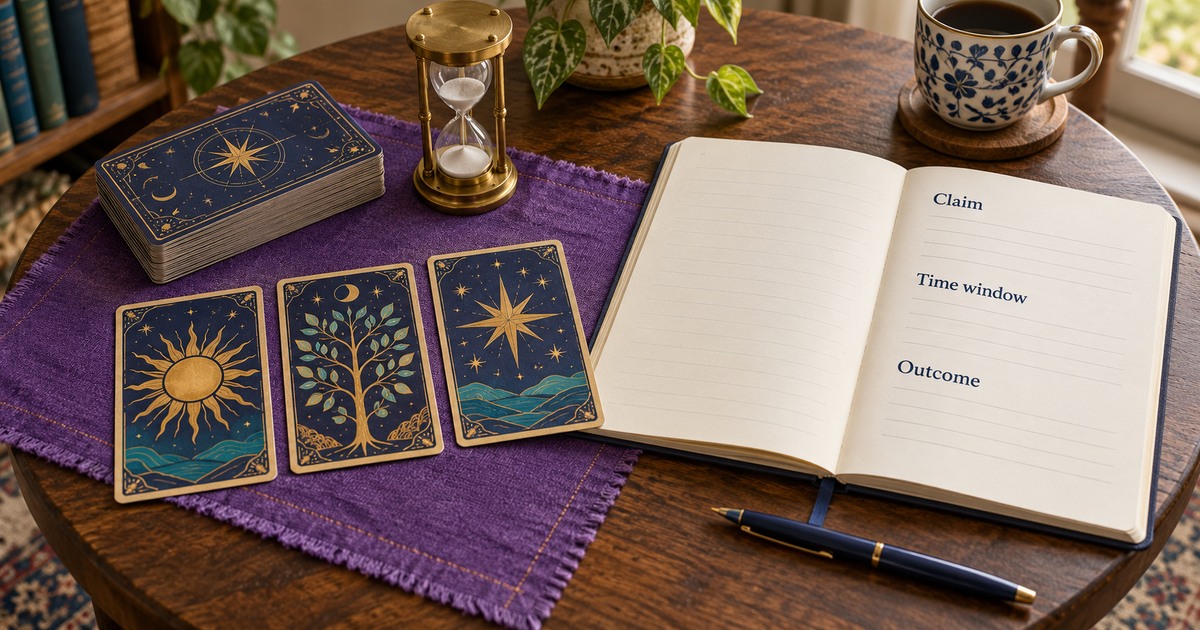
If you want to assess what was said, write down the exact claim and its date while the details are fresh. Separate the reader’s words from your interpretation. If you want to record a session, obtain permission and check the service’s rules first.
- Keep the original wording. “A new opportunity” is not equivalent to “a written offer from this employer by Friday.”
- Note the agreed time window. Do not silently change it after the outcome.
- Include misses and unclear statements. Remembering only apparent successes gives an incomplete picture.
- Check against real events. Label anything too vague to evaluate as uncertain, rather than counting it as a success.
This is a way to keep your own experience in perspective, not a scientific demonstration of psychic ability. You can decide a session was enjoyable or thought-provoking while remaining unconvinced about its predictions.
Questions that support useful decisions
Instead of asking for a guaranteed outcome, you might ask, “What options could I reflect on?” or “What am I overlooking about my priorities?” Then evaluate the suggestions yourself. For topic-specific prompts, see what to ask a psychic about work, relationships, family and the future.
Before booking, ask about the reader’s approach, session length, total price, what happens if time runs over, and any cancellation or refund terms. These policies vary; do not assume a guarantee exists. Our guide to preparing for a psychic reading can help you set questions and boundaries.
For medical, mental health, legal or financial decisions, use an appropriately qualified professional. A reading cannot diagnose an illness, establish a legal outcome or guarantee an investment return. Keep consequential decisions grounded in relevant evidence and qualified advice.
When to step back from a service
You do not need certainty about the distant future to make a sensible next choice. A reading can remain an optional spiritual conversation while your plans, budget, safety and decisions stay yours.
‘Psychic insight or just lucky guessing?’ Who needs a crystal ball when you have Google? It’s all just a game of chance at the end of the day—might as well toss dice instead!
The discussion around free will versus determinism is fascinating and has puzzled thinkers for centuries. This article touches on some key philosophical ideas, but I would love to see deeper exploration of how these concepts intersect with modern psychology.
Absolutely! I think it’s essential to consider how our belief systems affect our decision-making processes. Maybe combining insights from both psychics and personal reflection could yield a more balanced approach.
I absolutely loved this article! It beautifully highlights the nuanced role of psychics in our lives. The idea that we can shape our future with guidance is so empowering! Truly a refreshing perspective on an often misunderstood topic.
This sounds like a bunch of nonsense to me. Psychics claiming they can predict the future are just playing mind games with vulnerable individuals. People need to wake up and rely on rational thinking instead of mystical beliefs.
‘Can I create my destiny?’ This question is profound! It challenges us to consider how much control we truly have over our lives. While psychics offer insight, it’s ultimately up to us to act upon it and shape our futures.
Honestly, this article misses the mark. Relying on psychics for guidance seems misguided to me. Instead of looking outward, people should focus on their own decisions and actions. It’s time we stop seeking answers from others.
‘Psychics can’t provide timelines? Well, that’s convenient!’ Seriously though, if they can’t give you a clear answer, how can anyone justify spending money on such readings? Just seems like a fancy way to take your cash!
‘Mystical mumbo jumbo’? I prefer my answers served with a side of fries, thank you very much! At least that way, if I don’t get clarity, I’ll at least get some tasty food!
‘The future is fluid’? This resonates deeply! Life’s unpredictability means we must navigate it wisely—psychic readings can serve as useful tools for self-reflection and growth when approached with an open mind.