

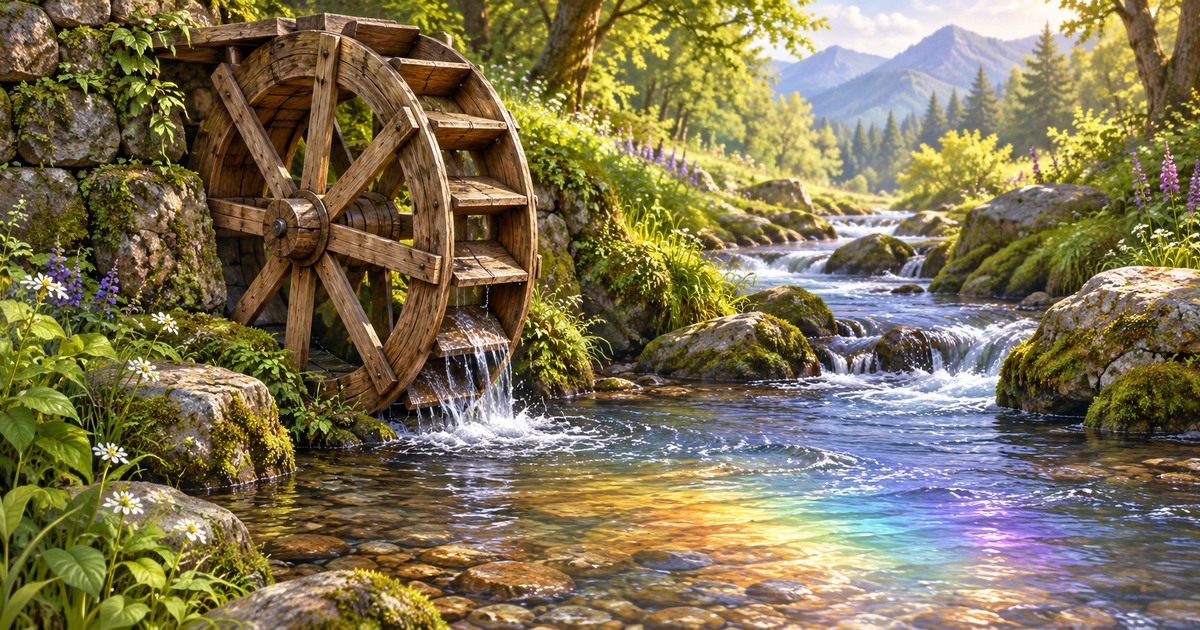
A water wheel chakra cleansing is an imagined exercise: you picture flowing water turning a wheel while moving your attention through a seven-chakra sequence. If that imagery appeals to you, it can provide a focus for a quiet pause. You do not need a real wheel, actual water or any special equipment.
What are chakras in this exercise?
Chakras are described as subtle energy centers in spiritual traditions and contemporary practices. They are not medical diagnoses or a way to establish the cause of symptoms. Different teachings use different interpretations; this exercise uses a familiar seven-point model as a symbolic framework.
You can connect each point with a theme for reflection without assuming it controls that part of your life. For instance, using the heart as a reminder of compassion does not mean relationship difficulties prove a blocked heart chakra.
For a broader introduction, see what chakra meditation means and how to approach it. You can also skip the chakra language altogether and imagine a gentle stream as your focus.
Why imagine a water wheel?
The wheel gives the imagery a repeating movement: water flows, the wheel turns, and attention returns to the scene. You might picture a small wooden wheel beside a stream, rather than a forceful current. There is no correct design, speed or direction.
The image can stand for continuity or a fresh start. It does not have to carry a religious meaning, and you do not need to adopt beliefs from another tradition to use a simple visualization. If water imagery is unpleasant for you, choose a slowly turning windmill, a leaf moving in a breeze or a neutral object instead.
This is not an instruction to enter water, stand under a waterfall or perform a physical cleansing ritual. The entire exercise can happen while you sit comfortably indoors.
A seven-point color guide
The following colors, locations and themes are prompts for this version of the exercise, not a universal chart or an anatomical map. You do not need to touch these areas or produce sensations in them.
- Root — red, base of the spine: reflect on support, steadiness or a practical need.
- Sacral — orange, lower abdomen: reflect on creativity, enjoyment or personal boundaries.
- Solar plexus — yellow, upper abdomen: reflect on confidence and choices you can make.
- Heart — green, center of the chest: reflect on compassion, including kindness toward yourself.
- Throat — blue, throat area: reflect on communication or something you want to express.
- Third eye — indigo, between the eyebrows: reflect on perspective or a question you want to consider.
- Crown — violet, top of the head: reflect on meaning, connection or your broader values.
These themes need not be resolved during a session. You can simply notice one, then move on. None of the points requires you to revisit painful memories, excuse another person’s behavior or achieve a special spiritual state.
How to try the water wheel visualization
Begin with a short period that feels manageable, perhaps three to five minutes. That is a suggested starting point, not a therapeutic dose or a requirement. A chair, couch or supported seated position is fine; sitting cross-legged is optional. No candles, incense, colored liquids or purchased tools are needed.
- Notice your surroundings. Feel the chair or floor supporting you. Keep your eyes open, soften your gaze or close them only if that feels comfortable. Let your breathing remain easy rather than forcing it.
- Introduce the image. Imagine a small water wheel turning steadily beside a stream. A faint idea, a word or a sense of movement is enough; a vivid mental picture is not required.
- Begin at the root. If you want to use the chakra sequence, imagine the water as red while thinking of steadiness or support. Do not try to make water physically enter your body.
- Move through the colors. Continue through orange, yellow, green, blue, indigo and violet. Spend a comfortable moment on each. You can skip a point or finish early; you do not have to wait for peace before moving on.
- Let the picture settle. If you like, imagine the colors blending into a rainbow beside the wheel. Alternatively, let the scene fade. Neither ending proves that cleansing has occurred.
- Return to the room. Notice what you can see and hear, move comfortably, and take your time before standing. Decide whether you want to continue your day, rest or attend to a practical need.
If you become distracted, you can return to the image once or simply end the exercise. There is no failed session to repair and no reason to repeat it until you feel a particular result.
What if you cannot visualize or feel uncomfortable?
You do not have to see pictures in your mind. Choose a form of attention that feels workable, or leave the exercise out altogether.
Use words
Read the color names quietly or use the phrase “water flows, wheel turns.” You do not have to turn the words into a mental picture.
Use imagined sound
Think of the sound of a gentle stream instead of its appearance. If that is not comfortable or easy to imagine, there is no need to keep trying.
Use an external focus
With your eyes open, notice an ordinary object’s color and shape. You can leave out the water, chakra language and inward focus.
If inward attention makes you anxious, distressed or disconnected from the room, stop. Open your eyes if they were closed, look around and orient yourself to your surroundings. An external focus may suit you better; our guide to grounding versus spiritual escapism offers ways to keep reflection connected with daily life.
The National Center for Complementary and Integrative Health notes that meditation is not risk-free and that some people report negative experiences. Its guidance also cautions against using meditation to replace or postpone conventional care. You are allowed to stop a practice that does not suit you.
What should you expect afterward?
You might feel calmer, unchanged, bored or still preoccupied. None of those responses establishes whether an invisible blockage was present or removed. General meditation findings do not establish that this specific water-wheel exercise cleanses chakras.
Instead of checking whether you feel “fully cleansed,” ask a practical question: “What do I need next?” The answer might be a break, a meal, sleep, a boundary or a conversation. You can write down one small action without turning it into a promise that visualization will solve the issue.
Repeated imagery is not a substitute for addressing an ongoing problem. If someone has harmed you, imagining flowing water does not require forgiveness, contact or staying in that situation.
When tiredness needs more than a spiritual exercise
Do not use a chakra explanation to diagnose fatigue or other physical symptoms. The NHS guidance on tiredness and fatigue advises medical assessment when tiredness has lasted a few weeks without a clear reason, affects daily life or comes with other symptoms. A health professional can help investigate the cause.
You can keep an optional spiritual practice alongside appropriate care, rather than choosing one in place of the other. The water wheel is an image you can adapt or leave behind—not a treatment, a test of faith or a requirement for moving forward.
“Visualizing water wheels to cleanse chakras? Really? This feels like another trend built on half-baked ideas with no real science behind it. Let’s stick to proven methods instead of these whimsical exercises.”
“So let me get this straight: my chakras are blocked, and I’m supposed to visualize a giant water wheel? What’s next, using fairy dust? If only life were as simple as imagining my problems away!”
Seriously? A water wheel for chakra cleansing? This sounds like pseudoscience wrapped in a pretty bow. Just because it sounds nice doesn’t mean it’s effective. We need evidence, not just flowery metaphors.
Exactly! It’s all wishful thinking. If my chakras were really blocked, I’d rather see a doctor than imagine some magical water wheel. We need grounded solutions, not fairytales.
I appreciate the intention behind the article, but we must remember that wellness trends can often be misleading. It’s important to approach such methods with a critical mind.
“Wow, who knew that all my problems could be solved by picturing a water wheel? Next time I’m late for work, I’ll just imagine my boss getting relaxed by the power of visualization!”
This article provides a fascinating overview of chakras and their significance in our lives. The step-by-step guide on using visualization techniques is also quite informative, making it accessible to beginners.
I absolutely loved this article! The way it explains chakras and the water wheel visualization is both refreshing and enlightening. It’s a simple yet powerful tool that I can’t wait to try out for myself!
“I found this method intriguing! Using colors associated with each chakra while visualizing can be very therapeutic and calming. Sometimes we all need gentle reminders to care for our energy levels.”