

If a conversation leaves you longing for quiet or feeling that you have nothing left to give, you can take that response seriously. “Energy vampire” is a popular metaphor for draining interactions—not a medical diagnosis, a personality test or proof that someone is literally taking your energy. Start with the pattern you can describe, rather than a verdict about the person.
You can take your discomfort seriously without claiming to know someone’s motives. Look at repeated behavior, the demands being placed on you and whether your limits are respected.
What draining patterns can look like
One difficult conversation is not enough to define a person. People may need extra support during grief, illness or a stressful period. A more useful concern is a recurring imbalance that leaves little room for your needs.
- One-sided conversations: You regularly listen for a long time, but attempts to discuss your own concerns are brushed aside.
- Repeated urgency: Nonurgent requests are treated as emergencies, and you feel expected to drop everything.
- Pressure after a no: A reasonable limit is met with repeated demands, guilt or insults.
- Unwanted responsibility: You are repeatedly asked to settle arguments, make decisions or provide money you cannot afford.
These observations describe interactions, not proof of a diagnosis or deliberate malice. Being attractive, charming, successful, quiet or emotional does not identify an “energy vampire.” Focus on what happens when you ask for reciprocity or set a reasonable limit.

Empathy does not make you responsible for everyone
If you identify as an empath, you may find it helpful to describe yourself as attentive to feelings or easily overwhelmed by demanding conversations. That does not establish that you absorb another person’s pain into your body or have an energy field that attracts predators.
Compassion is not the cause of someone else’s harmful behavior. You can care about a friend without being their only source of support, available at every hour or responsible for fixing every problem. Our guide to empath traits distinguishes personal reflection from assumptions about hidden feelings.
Ask what help is wanted before offering it: “Would you like me to listen, help with one practical task or give you space?” You are allowed to offer less than the person requests.
Check the pattern without turning intuition into proof
Feeling uneasy can be a reason to pause. It is not a reliable verdict about someone’s intentions. Separate what you observed from what you inferred: “They sent five messages after I said I was unavailable” is different from “They want to steal my energy.”
Consider the context, your own workload and whether the situation changes after a clear request. A person who apologizes and consistently adjusts their behavior presents a different situation from someone who repeatedly ignores your limits. You do not have to prove a supernatural explanation before reducing contact or asking for support.
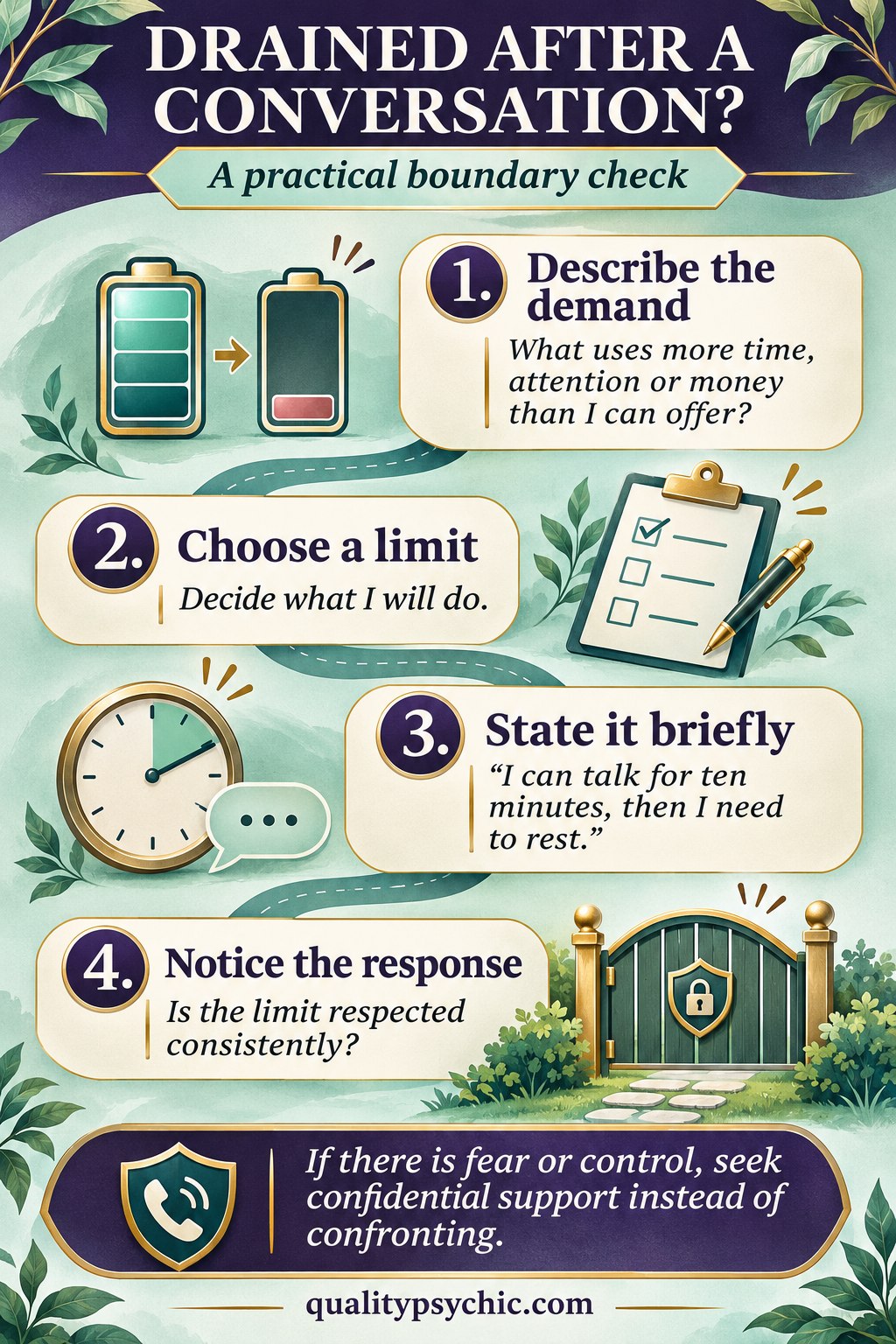
A four-step boundary check
For ordinary, nonthreatening disagreements, try a small limit you can realistically keep:
- Name the demand. What specific interaction is using more time, attention or money than you can offer?
- Choose your limit. Decide what you will do, not how you will force the other person to behave.
- State it briefly. Use a calm sentence if it is safe to communicate directly.
- Review the response. Notice whether the limit is respected and what practical adjustment or support you need.
These made-up phrases are options for ordinary, nonthreatening situations, not instructions to confront someone who frightens you. Adapt them to what you can honestly offer:
- Time for a conversation
- “I can talk for ten minutes, then I need to rest.”
- Nonurgent messages
- “I will reply to nonurgent messages tomorrow.”
- A request for money
- “I cannot lend money.” You do not need to offer an amount you cannot afford.
- When insults begin
- If it is safe to end the exchange: “I am ending this conversation; we can revisit it when we can speak respectfully.”
If you share a workplace, household or caring responsibility, distance may require planning rather than an abrupt cutoff. Consider a trusted person, an appropriate workplace channel or outside support. Our compatibility guide explores everyday expectations beyond a spiritual label.
What relationship energy can tell you to explore
In spiritual conversation, “relationship energy” often names the atmosphere between people: the ease of being yourself, a sense of warmth or the tension that follows an exchange. You may understand that through intuition, prayer or your personal beliefs. Give the feeling a concrete question: is there room for both of us in this relationship?
A supportive connection does not require constant cheerfulness. Partners and friends can be sad, frustrated or in need of help while still respecting each other. Equally, an exciting or spiritually intense connection can contain pressure that needs attention. Feeling uplifted or depleted is a starting point for reflection, not a measurement of someone’s spiritual worth.
Look for the pattern across several ordinary interactions. Can you disagree without punishment? Can each person receive care as well as offer it? Do promises become consistent actions? A difficult week followed by honest repair is different from repeated guilt, boundary crossing and demands that you abandon your own needs. You do not need to keep a relationship merely because someone calls it karmic.
If you keep choosing a familiar pattern, approach yourself with curiosity rather than blame. Ask what initially draws you in, when you start overriding your limits and what outside perspective would help. Another person’s harmful choices are not evidence that you attracted mistreatment through a low vibration.
Free interaction review worksheet
Use these six prompts privately after an ordinary interaction. Keep any notes somewhere safe; you can answer mentally if recording them would compromise your privacy.
- Before: How rested, stressed or available was I already?
- What happened: What words or actions can I describe without guessing motives?
- After: What emotion, bodily feeling or practical concern did I notice?
- Reciprocity: Was there space for both people’s needs?
- One limit: What time, topic, task or contact boundary would help?
- Review: Was the limit respected? What support or adjustment do I need?
Example: “I was tired before the call. I offered ten minutes; the caller continued asking after I said I needed to stop. Next time I can offer a scheduled call.” That gives you something observable to address without deciding that the person has a permanently negative energy.
Do not explain persistent fatigue as energy theft
Make room for ordinary rest and activities you enjoy, but do not treat them as a substitute for assessment when needed. Optional prayer, journaling or a brief grounding practice can be personally meaningful; none is proof of an invisible attack or a guaranteed shield. Our grounding guide offers ways to pause without blaming yourself for distress.
When the issue is control, fear or abuse
The National Domestic Violence Hotline distinguishes healthy boundaries from controlling or abusive behavior. Threats, coercion, isolation, monitoring or control over money deserve more than the label “draining.” Harm is not your fault because you are compassionate.
Do I need to call someone an energy vampire?
No. You can say “This conversation is too much for me,” “I need more balance” or “I do not feel safe” without assigning a permanent label. The goal is a practical response to the behavior—not winning an argument about another person’s nature. Keep your compassion, and leave room for your own needs.
Frequently asked questions
1. Can another person’s energy affect how I feel?
An interaction can influence your mood and attention. You may also attach spiritual meaning to it. That feeling alone cannot establish a literal transfer of energy or someone’s intentions.
2. What does energy vampire mean here?
It is a metaphor for repeatedly draining interactions. It is not a diagnosis, a fixed personality category or evidence of an invisible attack.
3. Is one exhausting conversation a warning sign?
Consider the context and the pattern. A friend having a hard day is different from a recurring expectation that your needs never matter.
4. Does supporting someone through grief make the relationship unhealthy?
No. People may need more help during grief or illness. Discuss what you can offer and avoid treating distress itself as a character flaw.
5. What is reciprocity in a relationship?
Both people have a meaningful voice and room to receive care. Their contributions need not be identical in every conversation or during every life stage.
6. Can I trust my uneasy feeling?
Use it as a reason to pause and look at the circumstances. Distinguish the feeling from conclusions about hidden motives, and seek a trusted perspective when useful.
7. How can I set a small boundary?
Choose something you control, such as the time you can offer or when you will reply. State it briefly when direct communication is safe.
8. Do I need to justify every no?
You can communicate a clear limit without providing private details or negotiating past what you can afford to give.
9. What if someone keeps asking after I decline?
Notice the repeated behavior and decide how you will respond. You may end an ordinary conversation, change your availability or seek support. Consider safety before confronting a threatening person.
10. Does identifying as an empath make me responsible for others?
No. Being sensitive or compassionate does not oblige you to be constantly available, absorb mistreatment or become someone’s only support.
11. Should I avoid anyone who seems negative?
No. Sadness, frustration and disagreement are normal experiences. Focus on respect, accountability and recurring behavior rather than requiring constant positivity.
12. Can a spiritual practice help me reset?
Prayer, grounding or reflection may feel meaningful. Use it alongside practical limits and support rather than as proof that someone attacked your energy.
13. What if I feel tired all the time?
Do not assume that another person is the cause. Persistent or unexplained fatigue can need medical advice, particularly when it affects daily life or has other symptoms.
14. Must I keep a karmic or spiritually intense relationship?
No spiritual label removes your freedom to choose contact, boundaries or support. Intensity is not a substitute for respectful behavior.
15. What if setting a boundary could put me at risk?
Seek confidential, individualized safety support instead of testing a limit or announcing plans. Use a safer device if yours may be monitored and local emergency help for immediate danger.
‘Protect yourself from energy vampires.’ This is hilarious! Are we going to start wearing protective gear now? I mean, who knew relationships could require such armor?
This piece provides a great overview of the concept of energy vampires. It highlights how empaths can be particularly vulnerable, which I found fascinating. It’s essential to understand these dynamics in relationships.
But can we really label people as ‘energy vampires’? Isn’t it overly simplistic? People have complexities that go beyond draining or nurturing energies.
I agree! The relationship dynamics are so intricate. Understanding these traits can really help us navigate our interactions better.
“Energy vampires”—sounds like something from a B-movie, right? I’m just saying, if someone drains your energy, maybe it’s time to take a good look in the mirror instead of pointing fingers at others!
*laughs* So we’re calling people ‘energy vampires’ now? What’s next? ‘Emotion leeches’? Honestly, if someone makes you tired, maybe just take a nap instead of writing articles about them.
‘Wolves in sheep’s clothing’? Really? This sounds like something out of a bad soap opera! Next thing you know, we’ll have ‘relationship police’ enforcing boundaries everywhere!
Honestly, this article is just another way to blame people for our own problems. Not everyone who drains your energy is an energy vampire; sometimes we just need to take responsibility for our feelings.
I absolutely loved this article! It’s refreshing to see a clear explanation of energy vampires. I’ve been able to identify a few in my life now, and I feel empowered to set boundaries. Thank you for sharing!
“Listen to your gut.” Classic advice! But let’s face it—some of us ignore our instincts because we want love or friendship. Maybe the real lesson is learning when to walk away from unhealthy ties.