

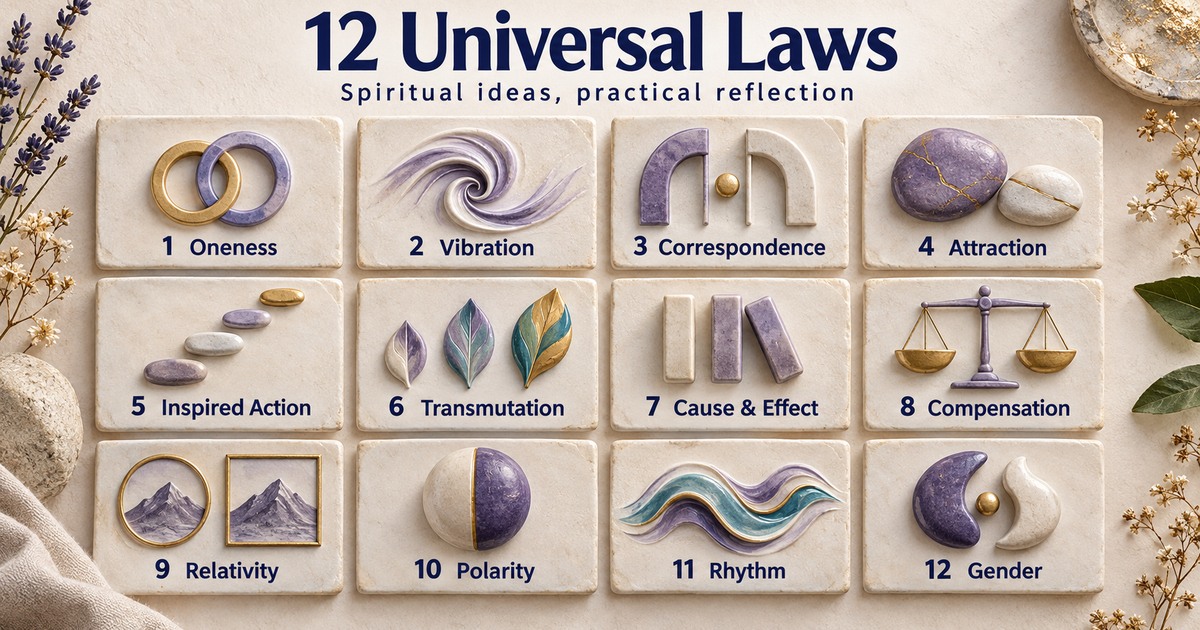
The “12 universal laws” are spiritual self-help concepts about connection, attention, action and change. People may find them meaningful as a way to reflect on life. They are not a set of proven rules that guarantee love, money, health or a particular future.
You do not have to accept every concept or follow twelve practices at once. The useful question is what an idea helps you notice or do—not whether you have become positive enough to deserve a good outcome.
View the illustrated twelve-term index at full size. The cover’s rings, waves, stones and other symbols are artistic shorthand. Read each named concept and its limits below; none of these pictures demonstrates a physical force or promises a result.
How to read these spiritual “laws”
In this context, “law” names a belief or metaphor, not a scientific finding. Words such as vibration, energy and relativity are being used spiritually here; this list should not be treated as a physics explanation. Nor should it be presented as a single teaching shared by every spiritual tradition.
Interpretation
A spiritual meaning you find helpful. You can keep it, question it or choose different language without failing a test.
Action
A choice you can make in your circumstances: ask, prepare, rest, invite, set a limit or seek appropriate help.
Outcome
What happens afterward. Other people, resources and events also matter; an unwanted result does not measure your spiritual worth.
A reflection can support a practical decision without proving that the universe caused what happened. You do not need to turn a meaningful metaphor into a rule for everyone else.
The twelve concepts, one at a time
Choose a name to jump to its meaning, a reflection question and an important limit. The shorter cover labels “Oneness” and “Transmutation” refer to Divine Oneness and Perpetual Transmutation of Energy in this list.
- Oneness
- Vibration
- Correspondence
- Attraction
- Inspired Action
- Transmutation
- Cause & Effect
- Compensation
- Relativity
- Polarity
- Rhythm
- Gender
1. Law of Divine Oneness: connection without losing boundaries
This spiritual idea describes life as interconnected. A grounded interpretation is to consider how your choices affect other people and your surroundings. That can mean listening carefully, considering shared responsibilities or offering help you can reasonably give.
Try asking: “Who else is affected by this choice?” Connection does not mean you owe everyone access to your time, body or private information. Compassion and a clear no can coexist.
2. Law of Vibration: notice your state, not a spiritual score
Within this belief, people describe emotions or experiences as having different vibrations. Treat that language as symbolic, not a measurement of your worth, health or likelihood of success.
Try asking: “Am I tired, tense, comfortable or needing support?” Choose an ordinary response that fits, such as taking a break or asking for help. Sadness and anger are not proof that you are attracting punishment. You do not need to buy a product to raise a supposed frequency.
3. Law of Correspondence: look for patterns without blaming yourself
This concept is often expressed as a relationship between inner and outer life. You might use it to explore whether a belief is influencing a habit: expecting rejection, for example, might make you reluctant to start a conversation.
Try asking: “What part of my response could I change?” Your thoughts are not the whole cause of your circumstances. Other people’s choices, resources and events matter; a harmful situation is not evidence that your inner life created it.
4. Law of Attraction: intention is not a guarantee
The spiritual claim is that similar thoughts or energies attract similar experiences. A practical alternative is to use a clear intention to identify what matters and plan toward it, without assuming belief alone delivers the result.
Try asking: “What would move this goal forward, and what is outside my control?” Wanting a relationship does not override another person’s consent. Worry does not make you undeserving of love or opportunity. Our guide to manifestation and practical action explores this distinction.
5. Law of Inspired Action: take a manageable next step
This concept pairs intention with action. You can interpret inspiration as a starting point for a choice, rather than an instruction you must obey or a sign that an opportunity is safe.
Try asking: “What is one small, realistic step?” If you want a different job, that might mean updating one section of your résumé or checking a role’s requirements. You can act before feeling completely confident, while still checking the details.
6. Law of Perpetual Transmutation of Energy: allow room for change
Spiritually, this idea describes energy as continually changing. As a metaphor, it can remind you that a feeling or situation need not define your whole life. It does not show that your thoughts alter physical energy or cure an illness.
Try asking: “Could I respond differently this time?” You might pause before replying to a tense message or revisit a plan with new information. Do not label someone a negative-energy person simply because they are grieving or struggling.
7. Law of Cause and Effect: consider consequences, not cosmic punishment
This concept encourages attention to how actions may affect what follows. An apology, preparation or missed deadline can have practical consequences. That is different from assuming every event is the universe rewarding or punishing someone.
Try asking: “What consequences can I reasonably anticipate?” Act responsibly, but leave room for uncertainty. Illness, violence and financial hardship are not evidence that a person thought incorrectly or deserved what happened.
8. Law of Compensation: contribute without expecting a guaranteed return
This spiritual idea links what someone gives with what they receive. A useful reflection is whether effort, generosity and fair exchange are present. It is not a promise that money, affection or recognition will return in equal measure.
Try asking: “Is this exchange fair and sustainable?” Agree on practical terms when needed. Giving more will not necessarily make an unequal relationship mutual, and borrowing or spending beyond your means is not a test of faith.
9. Law of Relativity: perspective without dismissing harm
Here, relativity means considering different viewpoints and contexts. It can help you ask what information you are missing or whether comparison with someone else is useful.
Try asking: “What would a fairer comparison include?” Someone else’s harder experience does not erase yours. Taking another perspective does not require treating abuse, discrimination or a broken agreement as harmless.
10. Law of Polarity: more than two rigid options
This idea uses opposites, such as fear and courage, to explore contrast. You can use it to notice complexity: you might be disappointed and grateful, or feel afraid while making a careful choice.
Try asking: “What else can be true alongside this feeling?” You do not have to turn every painful experience into a blessing or force a positive mantra. Some situations need repair, support or a boundary.
11. Law of Rhythm: adjust to change without predicting a cycle
This concept views life through rhythms and changing phases. A practical interpretation is to notice your current demands and capacity rather than expect constant productivity.
Try asking: “What is a realistic pace for now?” Allow time for rest or a different plan. A difficult period is not guaranteed to end on a spiritual timetable; persistent symptoms or major problems deserve appropriate help rather than waiting for a cycle to change.
12. Law of Gender: symbolic balance, not rules for people
Some spiritual versions use “masculine” and “feminine” energy to describe contrasting qualities. These are symbolic labels, not requirements tied to someone’s sex or gender identity. Kindness, initiative, patience and assertiveness are available to anyone.
Try asking: “Does this situation need listening, action or both?” You can use those ordinary words if the gendered language does not fit your beliefs. There is no need to make yourself conform to a binary spiritual role.
Turn one idea into an ordinary plan
You do not need twelve simultaneous practices. Choose one concept that fits a current, low-stakes goal and try these four prompts:
- Name the goal. Describe an ordinary change that matters to you, not a result you must achieve to prove a belief.
- Choose one action. Make it specific enough to carry out. An intention can guide the choice, but it does not complete the task.
- Name a constraint. Include time, money, access or another person’s consent. A limit is something to plan around, not evidence of spiritual failure.
- Review and adjust. Pick a realistic time to see what happened. Keep the facts separate from your interpretation, and allow “I do not know yet” when the outcome is unclear.
A friendship example, not a manifestation test
This is a made-up situation, not a client account. Imagine wanting to reconnect with a friend:
- Goal
- “I would like to make time for this friendship.” That names something important to you without claiming to control the other person.
- Action
- Send one invitation to a short walk, with a proposed day and an easy way for them to decline or suggest another time.
- Constraint
- Their availability and interest are their own. Your schedule, travel and energy also affect what is feasible.
- Review
- If they cannot come, consider another plan if you both want one. If there is no reply, leave room for an unknown reason rather than treating silence as a message about your vibration.
One invitation cannot tell you whether a universal law is true or whether a friendship will last. It can tell you whether that particular plan works for both of you. You can respect the answer without turning it into a judgment of your worth.
The NHS guidance on reframing thoughts encourages examining evidence and considering other explanations. It makes room for a neutral view and for thoughts you cannot change. You do not need to replace uncertainty with forced optimism.
Keep your choices, money and care protected
Do not use these concepts to diagnose symptoms, replace qualified medical, legal or financial advice, or explain away someone’s harmful behavior. Reflection should leave you more able to respond to reality, not less. Our guide to grounding versus spiritual escapism offers another way to examine that difference.
If you discuss these ideas in an optional reading
Bring a question about your own choices, such as “Which part of this goal can I act on?” A reader’s interpretation is not evidence about another person’s private thoughts, a medical assessment or a financial forecast. Decide what to keep private and agree on fees and a spending limit before starting. You can disagree, stop or choose not to book.
You can enjoy spiritual language without treating it as a contract with the universe. Keep what helps you act with care, question what creates guilt or pressure and let real-world information change your plan.
‘Law of Compensation’ seems straightforward but isn’t this just common sense? You reap what you sow—this isn’t some divine revelation; it’s basic human interaction we learn as kids!
‘Just think positively!’ They say. Meanwhile, I’m over here trying to pay my bills on time while visualizing wealth! Maybe I should visualize winning the lottery next week instead.
I absolutely love this article! The way it breaks down the universal laws makes them so accessible. It’s like a spiritual roadmap for living a happier life. Thank you for sharing such uplifting content!
“Law of Polarity” is such an intriguing concept! It’s fascinating how everything in life has its opposite. Understanding this might truly help us find balance in our emotions and reactions.
*Looks at Law of Attraction* So if I think really hard about pizza, does that mean it will magically appear? Asking for a friend! This is all fun and games until you realize you still have to pay for dinner!
Honestly, this all sounds like vague nonsense to me. How can anyone seriously believe that thoughts can influence the universe? This article is just another way to sell self-help fluff without any real substance.
While I appreciate the effort put into explaining these concepts, it’s essential to recognize that many of these ideas lack empirical evidence. Spirituality can be meaningful, but it should also be approached with a critical mind.
But isn’t spirituality about personal interpretation? Just because something isn’t scientifically proven doesn’t mean it lacks value! People find meaning in different ways.
That’s true, but we must differentiate between belief and fact. It’s great if these laws help someone feel better, but we shouldn’t confuse personal feelings with objective reality.
*sips tea* Who knew there were so many laws governing my feelings about Mondays? If only they had a law against Mondays entirely; now that would attract some serious positivity into my life!