

Feeling unsettled at home can be frightening, especially if you interpret an experience as an unwanted spirit. You deserve to feel heard and to get useful help. A noise, a vivid dream or a sense of presence, however, does not by itself establish that a spirit is there or that stronger magic is needed.
Cleansing, warding and banishing are terms used in spiritual practice. They can describe meaningful symbolic rituals, but they are not reliable tests for a haunting or guarantees of protection. Start with practical safety and support; optional spiritual reflection can come afterward.
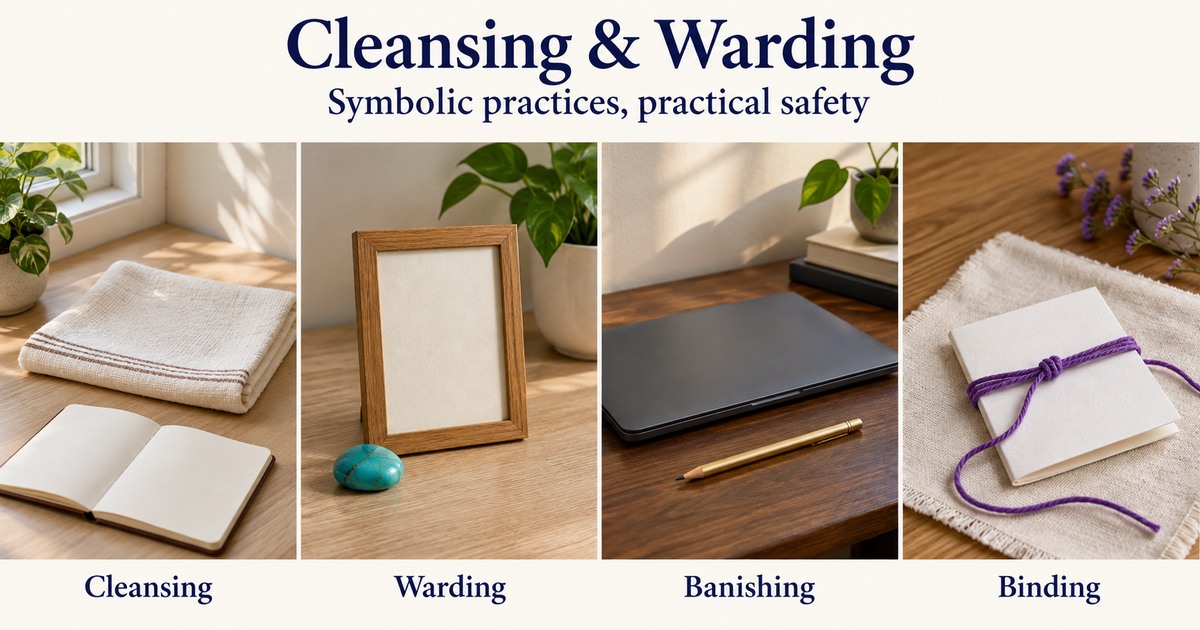
View the full-size four-practice comparison. Its cloth and notebook suggest a fresh start, the frame a boundary, the closed laptop an ended media routine, and the corded paper a chosen limit. These are illustrative objects, not required tools or evidence of supernatural effects. Background plants are decoration, not ritual ingredients.
Check immediate safety before considering a ritual
If there is a fire, an intruder or an immediate threat, move to safety and contact emergency services. Do not confront a person or stay in danger to finish a spell.
The CDC explains that carbon monoxide is odorless and colorless; symptoms can include headache, dizziness, vomiting, chest pain and confusion. These symptoms are not proof of a haunting. Suspected exposure needs urgent real-world action, not cleansing or reassurance that your energy is protected.
For non-emergency concerns about unfamiliar household noises or appliances, ask a landlord or qualified professional to check the relevant issue. Do not disable smoke or carbon monoxide alarms because a ritual seems to have helped. Do not dismantle or test a potentially unsafe appliance yourself to investigate a spiritual explanation.
Separate what happened from what it might mean
It can help to describe an experience plainly before interpreting it. An explanation can feel convincing without being established. Here is a made-up example that assumes there is no sounding alarm or immediate danger, not a client account:
- Observation
- “I heard three knocks near the window.” This describes a sound and location without claiming a cause.
- Interpretation
- “An angry spirit is warning me.” That is an added explanation, not something the sound itself confirms.
- Proportionate next step
- Ask for company if that would help, note the time once, and arrange an appropriate household check if the concern continues. You do not need to provoke a presence, keep testing rooms or stay awake collecting signs.
You can ask what information is missing, including whether someone independently noticed the same event. Their account may add information; agreement alone still does not establish a spirit. You can receive support before deciding what caused the experience.
If it happens around sleep, consider that context. The NHS describes sleep paralysis as being unable to move or speak while waking or falling asleep; it can include feeling that someone is in the room. This is one possible explanation, not a diagnosis of every experience. Seek healthcare advice if episodes often leave you frightened to sleep or exhausted.
What cleansing, warding, banishing and binding mean
These meanings vary between practitioners and traditions. Use the distinctions to understand the language, not to choose a stronger response to an unconfirmed threat.
Cleansing: a symbolic fresh start
In spiritual language, cleansing can mean clearing unwanted energy or resetting a space. You might interpret it as a personal moment to tidy, reflect or put an upsetting day behind you. A cleaner or calmer room does not demonstrate that an entity has been removed.
Ordinary cleaning should use suitable products as directed. There is no need to boil roots, spread salt mixtures through the house or spray homemade ritual preparations on carpets and belongings. Spiritual purpose does not make an unknown substance suitable for household use.
Warding: a symbol of a boundary
Warding refers to symbolic protection or a boundary in some practices. It does not inherently require a wand, a knife or walking around every baseboard. A written reminder or an ordinary object can represent a personal intention if that fits your beliefs.
Keep practical protection separate: locks, alarms, safe access and help from appropriate people still matter. A ward cannot establish that a home is safe or override another resident’s consent to what happens in a shared space.
Banishing: choosing what you want to leave behind
Some practitioners use banishing language for ending an unwanted influence. As a reflective practice, you can focus on your own choices: ending an upsetting media routine, changing a habit or setting a boundary with someone.
That is not evidence that a spell forces a spirit or person to leave. If someone is harassing or threatening you, seek practical support rather than trying to control them through a ritual. Do not take their belongings, confront them or burn items connected to them.
Binding: do not confuse a symbol with control
Binding language may describe restraint or limitation within a spiritual belief. It should not be used to promise control over another person’s thoughts, feelings or actions.
Instead of imagining someone physically restrained, name a boundary you can actually choose: “I will not reply to threatening messages alone,” or “I will ask for help with safe next steps.” A symbolic jar or knotted cord is not a substitute for protection, consent or accountability.
An optional non-burning reflection
If a brief ritual feels comforting and there is no immediate safety issue, keep it simple and centered on your own choices. Nothing needs to be burned, swallowed, sprayed or applied to skin. You can also skip a ritual entirely.
- Name the need. Write “I want a calmer place to rest” rather than diagnosing a spirit or naming someone as spiritually dangerous.
- Choose an ordinary symbol. Use a note, a drawing or a battery-operated light, with the agreement of anyone sharing the space.
- Pair it with one practical action. Turn off frightening content, clear a safe path, contact a trusted person or arrange an appropriate check of a household concern.
- Finish and return to your day. Put the note away or switch off the light. You do not need to repeat the ritual until it feels perfect. If it makes you more distressed, stop and seek support.
A bedtime boundary, not a test for spirits
Imagine feeling uneasy after watching frightening videos before bed. This is another illustrative situation, not a client account. You could put the device aside, write “No more frightening videos tonight” and contact a friend for a brief conversation. The next step belongs to your routine; it does not require making claims about the house.
Feeling more settled afterward would not prove a spirit was present or removed. Still feeling unsettled would not mean you need a more powerful ritual. If the fear keeps affecting sleep or daily life, seek qualified support.
Our guide to tool-led and tool-free rituals explains how to choose a symbolic practice without making purchases or tools a requirement.
Avoid turning fear into a fire or household hazard
Do not assemble lines of burning matches, hold burning paper in tweezers, burn someone’s belongings or coat candles with oil, pepper or other ingredients. Do not place a lit candle directly on paper or leave it to burn down as a test of success.
The U.S. Fire Administration recommends flameless candles. If you use an ordinary lit candle, use a stable holder and keep it at least 12 inches from anything that can burn. Extinguish it before leaving the room or going to bed. Do not use lit candles in bedrooms, bathrooms or sleeping areas. A symbolic intention does not change these precautions.
Keep ritual materials away from children and pets, respect other people’s belongings and leave exits clear. A frightening experience is not a reason to escalate to sharper tools, stronger mixtures or more fire.
When to seek support rather than stronger magic
If you hear unexplained voices or see things others do not, seek prompt medical assessment rather than assuming spirits are responsible. The NHS guidance on hallucinations describes multiple possible causes and recommends medical help. You can tell a professional what you experienced and what it means to you without treating a spiritual explanation as a diagnosis.
If fear is disrupting sleep, work or daily life, speak with a healthcare or mental-health professional. You can also ask a trusted person for company. Our guide to grounding, sleep and boundaries offers practical ways to approach spiritual-protection language without treating it as a shield against real danger.
Be cautious about paid removal promises
Pause if someone claims they alone can remove a spirit, says your home is unsafe unless you pay or threatens consequences if you stop buying spells. A lack of improvement does not mean you need heavier magic or that you have failed spiritually.
If you choose an optional reading for reflection, decide what to keep private and agree on fees and a spending limit in advance. A question such as “What ordinary support or boundary could help me feel more settled?” keeps the focus on your choices. A reader’s interpretation is not a safety inspection or medical assessment, and you can stop or decline a booking.
The FTC’s scam-prevention guidance warns about pressure to act immediately and demands for unusual payment methods. Step back and talk with someone you trust. Do not send money because someone has frightened you into believing there is no time to check.
You do not have to settle every question about spirits to take care of yourself. Practical safety, respectful boundaries, qualified care and optional low-risk reflection can coexist without a promise that a ritual controls the unseen.
‘Make Magic’? I love how whimsical that sounds! While I don’t personally believe in this stuff, it’s fun to read about the various techniques people believe can help them cope with their fears or uncertainties.
‘Honey Lock Spell’? Now that caught my attention! A bit odd yet oddly charming; I mean, who wouldn’t want sweet honey involved in getting rid of negativity? If anything, it sounds deliciously intriguing!
This post is ridiculous. Magic to get rid of spirits? Seriously? If you have problems, maybe it’s time to call a therapist instead of trying these outdated rituals. It’s all just superstition.
I agree with Sam. This type of thinking can lead people down a dangerous path instead of facing reality and dealing with their issues through rational means.
Come on, Sam! You can’t just dismiss other people’s beliefs. Maybe it’s not your cup of tea, but who knows? Some people find comfort in these practices.
*chuckles* Who knew banishing spirits required so many ingredients? Sounds like preparing for a witch’s cooking show! If only life were as simple as mopping with salt water to clear out bad vibes.
This is fascinating! I didn’t know about the various types of magic like cleansing and warding before reading this article. It’s intriguing how different cultures approach spiritual issues, even if I’m not fully convinced by the concepts.
‘Heavy magic’? Really? This sounds like something out of a fantasy novel rather than practical advice for real-life situations. We should focus on tangible solutions instead of resorting to these theatrical measures.
I found this article incredibly insightful! The detailed instructions for cleansing and warding are especially helpful. I’ve struggled with a spirit in my home, and I’m excited to try these methods. Thank you for sharing!
‘Just sprinkle some salt and light a black candle!’ Wow, that sounds like a foolproof plan to deal with real-life problems! Next time I’m stressed out about work, I’ll just throw some magic around—because that always works!