

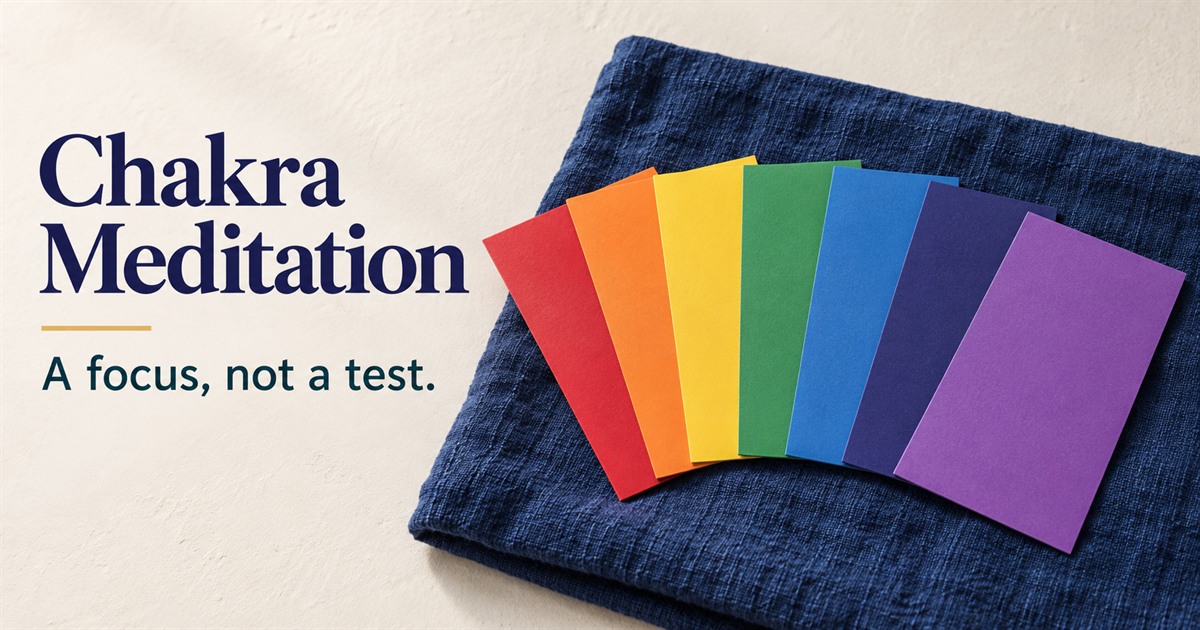
Chakra meditation offers a way to give your spiritual attention a gentle focus. You might choose one color, one area of the body or one question that matters today. You do not have to chase a dramatic sensation to make the moment meaningful.
Chakra meditation directs attention toward points believed to be centers of spiritual energy. In a commonly used seven-point model, a guide may lead you from the base of the body toward the crown, using colors, words or imagery. The practice can be personally meaningful without becoming a medical test or a promise of psychic abilities.
What does “balancing your chakras” mean?
Within chakra-based spirituality, balance may express a wish for steadiness, connection or a more honest relationship with yourself. Before a session, decide what that language means to you. “I want space to think about a difficult conversation” is a clearer intention than “I must fix every part of my energy.”
A spiritual interpretation is not evidence that a body part is diseased, a hidden memory must be recovered or someone else is sending you harmful energy. Nor does a distracted session show that you are spiritually closed. A thought can wander without becoming a message you must decode.
If you are drawn to the language of blocked chakras, our guide to chakra imbalance and reflection themes explains why personal meaning and symptom assessment need to stay separate.
Keep the aim small: choose a focus, notice what you want to reflect on and leave room for an ordinary next step. You do not need to open all seven chakras, purchase special objects or finish a spiritual checklist.
A seven-point guide you can use for reflection
Cleveland Clinic’s explanation with yoga therapist Renee Warren describes seven believed energy points, with associated locations and colors, while noting that chakras are not recognized by Western science. The cues below follow that commonly used model.
The questions are optional prompts offered here, not fixed personality descriptions or traditional diagnostic rules. You can use one, adapt it to your beliefs or leave it aside. The order shows the model’s base-to-crown arrangement; it is not a required route through a session.
- 1. RootNear the tailbone · Red
- “What ordinary support would make today feel more manageable?” You might name a dependable person, a familiar routine or one task you can simplify.
- 2. SacralBetween tailbone and navel · Orange
- “What would I like to make room for?” Consider a small creative choice or an enjoyable activity, without requiring yourself to feel inspired.
- 3. Solar plexusNavel area · Yellow
- “Which choice is actually mine to make?” Name one decision within your control rather than trying to control another person’s response.
- 4. HeartCenter of the chest · Green
- “How could I express care without abandoning a boundary?” A kind message is one option; keeping a respectful distance can be another.
- 5. ThroatThroat area · Blue
- “What would I like to say clearly?” You could write one honest sentence privately before deciding whether a conversation is appropriate.
- 6. Third eyeBetween the eyebrows · Indigo
- “What do I notice, and what am I assuming?” Let an intuitive impression remain an impression while you check the facts available to you.
- 7. CrownTop of the head · Purple
- “What gives this day meaning?” Your answer might involve faith, community, nature or a personal value. It does not need to be a revelation.
The locations and colors are visualization cues, not instructions to press on the body, test an organ or infer a diagnosis. You do not have to see a vivid inner picture. Simply reading a chosen word or question is another way to reflect.
A gentle starting point, without forcing an experience
This optional exercise is for personal reflection, not treatment or an awakening technique. Choose a time when you do not need your attention for driving or another safety-critical activity. There is no prescribed duration or breathing pattern to achieve.
- Settle in a position that suits you. A supported chair is fine; you do not need to sit cross-legged. You can keep your eyes open and change position or stop.
- Choose one cue. Pick a color, a word or a question from the guide. There is no need to work through every point or begin at the root.
- Leave your breathing ordinary. Do not add forceful breathing, breath-holding or strain to create a stronger effect. Let the cue be something to consider, not a demand for a bodily sensation.
- Let the reflection stay unfinished. If your attention wanders, you can return to your chosen words or simply end. You do not have to empty your mind, uncover memories or explain every thought.
- Return to the room and choose freely. Notice your surroundings, then decide whether to write a line, take an ordinary next step or leave the practice alone. Ending early is allowed.
From a symbol to an everyday choice
For example, you might choose the throat cue because a conversation is on your mind. After a brief reflection, you write: “I can help tomorrow, but I cannot take this on tonight.” You can decide later whether to say it.
The useful outcome in this illustration is a clearer sentence—not proof that an energy center opened or that the other person will respond as you hope.
If imagery feels awkward or unwelcome, you can choose a different approach. Our comparison of seven meditation styles explains options such as a simple sound anchor or spoken guidance. You do not need to make chakra practice fit you.
What to ask before a guided chakra session
A class title does not tell you what will happen. Ask for the actual format rather than assuming a chakra session, yoga class, Reiki appointment or Kundalini practice follows the same method.
- What will we do? Ask about duration, posture, audio, touch, movement and any breathing instructions. Find out whether you can keep your eyes open, sit in a chair or opt out of a part.
- What training and experience do you have? Ask about the specific practice being taught. A spiritual teaching credential is not the same as a healthcare license.
- How do you respond if I feel uncomfortable? Look for permission to pause or leave, not pressure to push through distress as a sign of progress.
- What are the cost and privacy arrangements? Check the total price, cancellation terms, recording policy and whether sharing personal experiences is optional before agreeing.
You can decline touch, personal disclosure, added purchases or a teacher’s interpretation of your life. A respectful session leaves room for your choice; it does not require accepting a diagnosis of a spiritual blockage.
What if you feel nothing, or notice a strong sensation?
Not seeing colors or feeling energy does not make you a failure. You may find the words meaningful, feel neutral or decide the practice is not for you. There is no completion test here.
At the other extreme, do not treat pain, nausea, involuntary movements, disturbing perceptions, disrupted sleep or worsening mood as proof that a chakra is opening. These are not established chakra-specific side effects, and a spiritual label cannot determine their cause. Stop and seek appropriate assessment for new, concerning or persistent symptoms.
You do not need to keep repeating a session to obtain a “better” sign. If reflection turns into an endless search for reassurance, our grounding and spiritual escapism guide offers ways to reconnect spiritual reflection with daily choices and support.
Safety, healthcare and a practice you can leave
The National Center for Complementary and Integrative Health notes that meditation can involve negative experiences and that safety research is limited. It advises against replacing conventional care or delaying assessment, and recommends asking about an instructor’s training and experience.
If you have health concerns, have found meditation upsetting before or are considering unusual physical or breathing demands, discuss the specific practice with a qualified healthcare professional. A psychic reading cannot provide medical clearance. Do not change prescribed treatment on a spiritual teacher’s advice.
You can keep a spiritual outlook while receiving care. Our guide to spirituality alongside healthcare explores that distinction without asking you to abandon your beliefs.
If you are struggling
The National Institute of Mental Health recommends professional help for severe or distressing symptoms lasting two weeks or more. You can seek help sooner if you are concerned; you do not have to wait for a spiritual explanation.
In the United States, call or text 988 for crisis support. Call 911 in a life-threatening emergency.
A chakra practice can remain an invitation to reflect, not a responsibility to fix yourself. Keep what is meaningful, leave what is uncomfortable and let ordinary care count.
It’s important to note that chakra meditation can have both benefits and risks. The side effects mentioned, like headaches or nausea, could be alarming for beginners. Always consult a professional before diving in!
*Laughs* I think I’ll stick to my cats for comfort rather than trying to meditate and possibly end up shivering on the floor! Imagine explaining that at the vet!
While some might argue that chakra meditation is beneficial, I contend that it can be misleading. People often overlook the scientific basis behind such practices and should focus more on traditional methods of self-care instead.
*Rolls eyes* This sounds like something out of a hippie convention! Balancing your chakras? Please! Next you’ll tell me there’s a crystal for every problem too. Reality check, people!
I absolutely loved this article on chakra meditation! It really opened my eyes to the power of energy within us. I can’t wait to try it out in my next yoga class. Such a positive experience awaits!
*Snickers* So let me get this straight: meditating can lead to hallucinations and crying? Sounds like a rollercoaster ride! Who knew getting your chakras balanced came with such entertainment value?
This whole chakra meditation thing seems like a bunch of nonsense to me. How can focusing on imaginary energy centers have any real effect? It’s just another fad that people will forget about soon enough.
‘Embrace your energy’—what does that even mean? This sounds like something you’d hear from someone trying too hard at a new-age retreat. Also, why are we talking about psychic abilities here?
Well, if embracing your energy makes you cry or laugh unexpectedly, I’m all in! Who needs Netflix when you can have a spontaneous emotional rollercoaster?
‘Embrace your energy’? Ha! Is that what we’re calling it now? Sounds more like an excuse for being overly emotional during yoga class.