

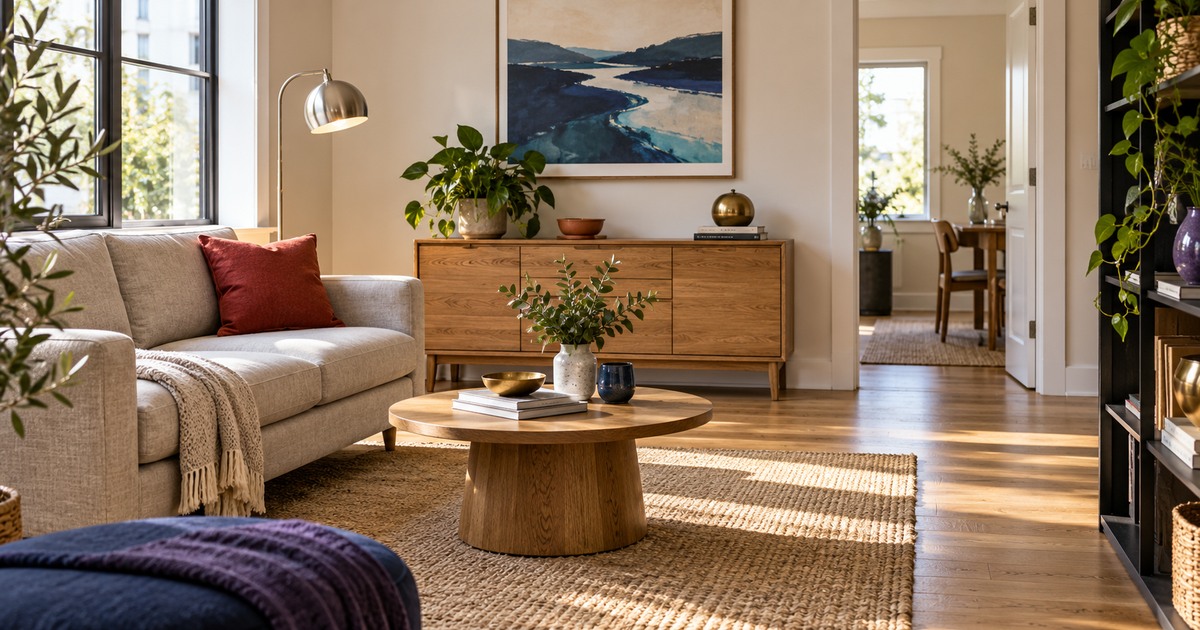
Feng shui is a Chinese tradition concerned with the placement and arrangement of buildings, landscapes and the spaces people use. Its name is commonly translated as “wind and water.” Today, people also use its ideas when arranging a home or workplace, with attention to balance, symbolism and the way a room feels.
It is more than a decorating trend, but its spiritual claims should not be treated as guarantees. Moving a chair, choosing a color or adding a crystal does not establish that wealth, romance or better health will follow. You can respect the tradition while judging a change by something observable: a clearer walkway, less glare, more useful storage or a space you enjoy spending time in.
Where feng shui comes from
Feng shui developed in China as a practice of selecting sites and orientations, not simply choosing accessories for an already furnished room. The Metropolitan Museum of Art’s resource on Chinese gardens describes its historical connection to locating structures and interpreting the landscape.
Qi, also written chi, is understood within this tradition as vital energy. References to its flow describe a traditional belief system; they are not measurements of electricity or proof that furniture controls future events. Different schools of feng shui interpret and apply these ideas differently.
The five elements: a symbolic design vocabulary
Wood, fire, earth, metal and water are the five elements used in feng shui. They can be represented through materials, colors, shapes or imagery rather than literal objects alone. The International Feng Shui Guild’s five-element guide explains these traditional associations. For a simple introduction:
- Wood
- associated with growth; green tones, upright shapes or plant imagery are common representations.
- Fire
- associated with active, expansive energy; red accents, lighting or triangular shapes can express it.
- Earth
- associated with grounding and steadiness; warm earth tones, square forms or ceramics are options.
- Metal
- associated with precision; white or gray tones, rounded forms or metal objects can represent it.
- Water
- associated with depth and reflection; dark blue or black tones, flowing forms or water-themed art are examples.
These are symbolic associations, not prescriptions for your personality or health. You do not need to buy five new objects or give each element exactly one-fifth of a room. Start with what you already own and like. A picture can suggest water without the upkeep of an aquarium; a red cushion can suggest fire without an open flame.
What a bagua map does—and why placement varies
A bagua is a mapping tool used within feng shui to connect areas of a space with traditional life themes. Common simplified versions show eight surrounding areas and a center, with themes such as relationships, career, creativity and prosperity. These labels are prompts within the tradition, not predictions or diagnoses.
The important distinction is how the map is oriented. Choose a method before deciding where a traditional theme belongs:
Entrance-based approaches
Commonly used in Western or BTB-style practice, these orient the map in relation to the entrance side of the space.
Starting reference: the entrance side—not an assumed compass direction.
Compass-based approaches
These use actual compass directions and may involve additional factors beyond a simple floor-plan overlay.
Starting reference: measured directions—not the entrance-based grid turned into a compass map.
The Guild’s bagua introduction discusses both methods. Do not assume your front door must face south, or combine an entrance-based grid with compass directions as though they were interchangeable. If following a specific school matters to you, use instructions from that school consistently and ask what method a consultant uses.
An irregular floor plan is not evidence that your life is broken. You do not need to renovate, remove a bathroom or buy an expensive “cure” because a diagram labels a corner as missing. Practical needs, accessible routes and building safety come first.
Start with one small, useful change
You can explore the ideas without mapping every room. Choose a place you use often and identify one real difficulty before deciding what to move:
- Name the issue. For example: “My desk is hard to use because papers cover the writing area.”
- Choose a small change. Give current paperwork a tray and file what you no longer need on the desk.
- Keep meaningful decoration optional. Add a familiar object or color only if it suits you and does not take away useful space.
- Check the result. Is the desk easier to use? If not, adjust it. You do not have to interpret an unsuccessful arrangement as bad energy.
A shared home also needs shared decisions. Ask before rearranging another person’s possessions, discarding keepsakes or changing a room they rely on. Keep adaptations affordable and reversible, especially in a rental.
Room-by-room ideas
Living room: comfort before symbolism
Arrange seating around how the room is actually used: conversation, reading, television, play or a combination. Check that people can reach seats and doors without stepping around a table or squeezing between furniture. Keep the seating you need rather than removing it solely to satisfy a rule.
If viewing the entrance feels comfortable, try placing a main seat where the doorway is visible. Do not block a route or struggle with heavy furniture just to achieve that position. A plant, landscape picture or natural texture can be a decorative choice, but it does not prove that the room has been cleared of negative energy.
Choose window coverings for the daylight, privacy and glare control you need. There is no requirement to add red, avoid black or conceal ordinary household objects for good fortune.
Bedroom: make the room work for you
Consider a bed position that leaves a convenient route to the door and suits the size of the room. Some feng shui guidance favors seeing the entrance from the bed; treat that as an optional preference, not a rule worth obstructing a doorway or making access difficult.
Choose lighting, storage and colors that you find comfortable. You do not need to divide decor into “masculine” and “feminine” objects, place everything in pairs or remove family photographs to deserve a relationship. Symbols can reflect your hopes without controlling another person’s choices.
Home office: function before a “power position”
Make room for the task you perform most often. Separate active papers from storage, position a light where it helps and check that you can use the desk comfortably. Facing a doorway may suit you, but it does not grant authority or guarantee career progress.
If a traditional career-area symbol is meaningful, pair it with an independent action: update your application materials, organize a project or schedule a conversation. Our guide to the seven laws of attraction and their limits also distinguishes spiritual intentions from practical steps and outcomes.
Keep fire and household safety separate from spiritual rules
Do not cover vents, obstruct exits or place decoration where it interferes with everyday movement. Ask for help with heavy furniture rather than trying to rearrange it alone. Any structural, electrical or other safety problem needs an appropriate practical solution, not an energetic explanation. Our guide to cleansing and warding beliefs and safety makes a similar distinction between optional symbolism and real-world hazards.
Do you need a feng shui consultant?
A consultant is optional, not a prerequisite for enjoying your space. If you choose one, ask which school they follow, what the fee includes, whether recommendations require purchases and how they will accommodate your budget, mobility needs and preferences. Agree on the scope before paying.
Be cautious about claims that one object will guarantee wealth, cure illness or keep a partner from leaving. No room arrangement replaces healthcare, financial planning or mutual consent. Feng shui can be a personally meaningful way to think about a space; its most manageable starting point is a change that makes that space safer, more usable or more welcoming to you.
This article opened my eyes to the significance of Feng Shui! I never realized how much our environment can impact our energy and well-being. The tips on incorporating elements like wood and water are especially helpful for me.
While I appreciate the enthusiasm, I can’t help but roll my eyes at the idea that arranging furniture can change my life. It’s just decor, folks. Let’s focus on real problems instead.
You’re missing the point, Steve! Feng Shui is about creating harmony in your life, not just rearranging furniture. It’s a holistic approach that can lead to greater well-being.
“Fire means passion?” Come on! Sounds like someone just made up these definitions during lunch break! Why not just say it makes things ‘nice’ instead? Seriously though, where’s the evidence?
*sigh* This reminds me of my grandmother’s house—always filled with plants and odd little knickknacks meant to ‘bring good energy.’ Can we please focus on more practical home decor advice?
“Practical” doesn’t mean dismissing tradition, Nina! Feng Shui has roots that go back centuries; there’s wisdom in those practices if you’re willing to look deeper.
I found this post quite informative, especially the breakdown of the five elements. It really gives a clear understanding of how each one contributes to different aspects of life. Thanks for sharing these insights!