

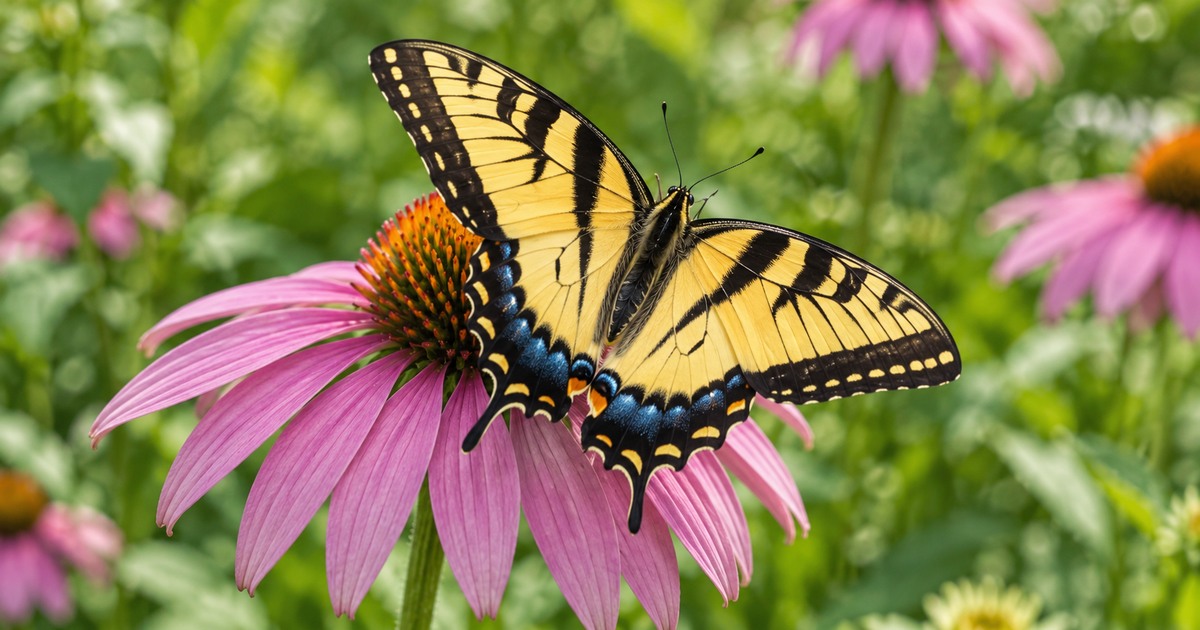
Nature, symbolism & personal meaning
A butterfly can be a small, vivid reminder of change, hope or someone you love. If an encounter feels spiritually meaningful, you can welcome that feeling without needing to turn it into a prediction.
The most useful question may be less “What must this butterfly mean?” and more “What did this moment bring to my attention?” Your memories, beliefs and present circumstances can shape the answer. There is no need to force an interpretation if you simply enjoyed seeing something beautiful.
Why a butterfly can symbolize change and renewal
A butterfly’s life offers a striking image of transformation. As the National Park Service explains, butterflies pass through four life stages: egg, caterpillar, pupa or chrysalis, and adult. The biology is real; the meaning you draw from it belongs to your own reflection.
You might connect the image with beginning again, making room for a different way of living or trusting that an unfinished chapter does not have to stay unfinished. Another person might think of lightness, freedom or the briefness of a lovely moment. Neither response needs to become a rule for everyone.
You do not have to reinvent yourself to honor the symbol. Perhaps your next change is a smaller promise, a clearer boundary or allowing yourself some rest. Human lives do not follow a butterfly’s timetable, and a difficult season is not a test you must pass before you deserve something good.
Butterfly colors: eight optional reflection prompts
These are creative prompts, not a universal spiritual color code, a species-identification chart or a prediction. Start with the colors you actually noticed, including mixed patterns. Use your own association if it feels more meaningful than ours.
- Orange — creative beginnings
- Ask: “What would I like to try without needing to be good at it yet?”
Possible step: Give one small idea a short, manageable trial. - Yellow — room for enjoyment
- Ask: “What simple pleasure have I been postponing?”
Possible step: Make space for something enjoyable without pretending a real problem has disappeared. - Blue — steadiness and trust
- Ask: “What helps me feel steady, and who has earned my trust through their actions?”
Possible step: Ask a dependable person for a specific kind of support. - White — a little more space
- Ask: “What could I simplify or set down for now?”
Possible step: Remove one unnecessary task. A color does not measure your purity or worth. - Brown or black — familiar support
- Ask: “What ordinary source of support am I overlooking?”
Possible step: Notice a helpful routine or a person you appreciate. Dark markings are not evidence of danger or loss. - Green — tending what matters
- Ask: “What needs consistent care rather than a dramatic leap?”
Possible step: Choose one realistic action you can repeat. This is not a promise of money or success. - Red — care and courage
- Ask: “What matters enough for me to express it respectfully?”
Possible step: Prepare one honest sentence, while respecting the other person’s boundaries. - Purple or mixed colors — curiosity
- Ask: “What am I curious about, and what can I leave unanswered?”
Possible step: Write down a question or look more closely at the actual markings, without forcing a category.
You do not have to complete all eight prompts. One useful question is enough. If you enjoy pairing nature imagery with everyday actions, explore our guide to flower symbolism and intuition.
What if butterflies keep appearing or one lands nearby?
Repeated encounters can feel especially personal. You can hold onto that feeling while staying curious about the setting. The Smithsonian’s butterfly guide describes their reliance on plants: caterpillars need host plants, and adults visit plants for nectar. A flowering patch may give you repeated chances to notice their ordinary activity.
- You keep seeing butterflies in the same place. Note the flowers, time, weather and markings. You may be seeing different individuals; repeated sightings alone cannot confirm a private message.
- A butterfly rests near you or lands on you. Stay calm and let it move on without chasing, trapping or handling it for a sign. The encounter can be memorable without proving that you were chosen for a particular destiny.
- You notice one during a difficult decision. Write down what it reminded you of, then return to the actual choice: what information, conversation or practical help do you need?
Keep an observation and an interpretation in separate sentences: “A butterfly visited these flowers three mornings” describes what you noticed. “It reminded me to be patient” describes the meaning you gave it. Both can be part of your story without becoming the same kind of claim.
When a butterfly reminds you of someone who died
Perhaps it appears near a favorite flower, on a significant day or while you are thinking about someone you miss. If your spiritual beliefs connect butterflies with loved ones, the moment may feel comforting. You do not have to persuade anyone else to share that interpretation.
You can honor the connection without needing proof. A sighting cannot establish contact with someone who died, but the love or memory it brings up can still matter. Not seeing a butterfly is not a sign that you have been forgotten or that your bond was less important.
You might write a memory, look at a photograph or do a small kindness that reflects something you valued about the person. Let that be enough if it feels right; there is no requirement to search for another sign or buy a reading to validate the moment.
If a similar connection arises in a dream, our guide to dreaming of someone you love explores personal feelings and spiritual meaning without treating an experience as proof of another person’s thoughts or presence.
A three-step practice: notice, connect, choose
Try this only if reflection adds something to the experience. You can also smile and carry on with your day.
-
Notice what actually happened
Describe the butterfly, place and moment in a sentence. Add how you felt, while leaving room for uncertainty about details you could not see.
-
Connect it with your own life
Ask what came to mind: a change, a person, a hope or simply a pause. Use “It reminded me of…” rather than deciding that the butterfly has issued an instruction.
-
Choose a proportionate response
Pick one action that is useful even if the encounter has no supernatural explanation. You might take a break, prepare a question, begin a small task or remember someone in a way that feels kind.
A hypothetical note about a new project
- What I noticed
- “An orange-and-black butterfly paused on a flower while I was thinking about an unfinished project.”
- What it brought up
- “I felt hopeful. To me, the moment suggested that a beginning can be small.”
- What I will do
- “Tomorrow, if I have the capacity, I’ll spend fifteen minutes listing the first three tasks. Then I can decide what is realistic.”
- What remains unknown
- “The sighting does not tell me whether the project will succeed or what anyone else will think of it.”
If the next step is harder than expected, adjust it rather than blaming your faith or willpower. Our article on manageable changes without self-blame offers more ways to work with your actual time and resources.
Enjoy the encounter without needing to decode it
Give the butterfly space. If you would like to identify it, use a regional field guide and note its markings and location, not just its overall color. A photograph taken without disturbing it may help you look more closely later.
For a practical way to welcome butterflies, Smithsonian Gardens recommends learning about local species and providing appropriate host plants for caterpillars as well as nectar plants for adults. Choose plants suited to your area rather than assuming every butterfly needs the same ones.
Let meaning be supportive, not demanding. An encounter does not need to settle your future to enrich your day. You can keep the sense of wonder and still make important choices using facts, consent and appropriate practical advice.
Seriously? This article makes butterflies sound like magical creatures with profound meanings. It’s just a bug! People need to stop reading too much into everything.
I absolutely loved this article! Butterflies have always fascinated me, and the way they symbolize change and rebirth resonates deeply. It’s so uplifting to think about how they can bring joy and meaning into our lives.
Yes! They represent so much more than just beauty in nature. I often feel inspired when I see one flutter by; it’s like a gentle nudge from the universe.
Totally agree, SunnySideUp! Butterflies are like little messengers from nature reminding us to embrace positivity and transformation. It’s amazing how something so small can have such a big impact on our emotions!
“Butterflies symbolize hope and change” – this is profound! Nature has its own language, and understanding it can lead us towards personal growth and enlightenment. Let’s pay attention to these signs in our lives.
*sigh* So if I see a blue butterfly, does that mean I’m going to get rich too? Honestly, if butterflies could talk, they’d probably just tell us to chill out!
‘Seeing butterflies means you’re going through change’? That’s quite a leap. What about people who just happen to see them without any personal transformation? Seems overly generalized, don’t you think?
The color symbolism of butterflies really adds an artistic flair to this post! Who knew that spotting one could potentially predict your emotional state or financial future? That’s quite the whimsical thought!
Next time I spot a butterfly, I’ll be sure to check my bank account first—just in case it’s an omen of wealth!
‘Your butterfly might be your spirit animal’… Really? Next thing we know, people will be saying their cat is their life coach! Let’s not get carried away here.
Haha! True that! The day my cat starts giving me advice is the day I reconsider my life choices.
But wouldn’t it be hilarious if cats actually were wise? They’d probably just tell us to nap more!
This is an interesting perspective on butterflies! I had no idea that different colors held specific meanings across cultures. It definitely adds depth to something we often take for granted in nature.