

If you are wondering whether you are a witch, start with what the word means to you. Are you interested in ritual, nature-centered spirituality, divination, folklore or a particular religious tradition? That interest can lead to learning and personal practice. It is not a test result proving that you have supernatural powers.
You do not need a dramatic sign, an unusual dream or a feeling of energy to begin reading about witchcraft. Nor do those experiences require you to adopt an identity. You can be curious, try a modest reflective activity or decide that the subject is not for you. If the label feels meaningful, let learning come before purchases or commitments.
Learn the tradition before adopting the label
Witchcraft and Wicca are related terms in some settings, but they are not interchangeable labels for everyone. Circle Sanctuary’s introduction to Wicca describes a diverse, decentralized religion within contemporary Paganism and nature spirituality. It also describes varied traditions, group practices and individual practitioners.
Ask which tradition a source is discussing rather than assuming it speaks for all witches. Beliefs, ethics, initiation requirements and rituals can differ. Some people practice alone; others learn within a group. Being solitary means practicing individually, not being cut off from friends, ordinary responsibilities or opportunities to learn.
Our guide to Wiccan readings and their limits separates a reader’s spiritual identity from the method they use. A person’s title does not establish reliable predictions or medical expertise.
Explore interests without treating them as proof
You may enjoy observing nature, learning tarot symbolism, listening to ritual music or keeping a journal. These interests are possibilities to explore, not diagnostic signs of being a witch. You do not need to match a personality checklist, dislike modern life or interpret every coincidence as a message to take your curiosity seriously.
If divination interests you, try describing the symbolism on one card and writing the questions it raises for you. Treat the result as reflection rather than verified information about another person’s thoughts, a future event or a health condition. An uncomfortable interpretation is not an instruction you must obey.
Some practitioners use moon phases, seasonal festivals or ritual circles as part of their spiritual lives. You can learn the meanings within a named tradition without claiming that a moon phase gives you guaranteed power. A circle or a reference to guardians is a ritual concept, not a physical shield against danger.
Begin with a small, optional practice
You can start without purchasing tools, making potions or joining a group. Choose something you can stop comfortably and that does not interfere with daily life:
- Pick one topic. Read about a specific tradition or symbolic practice rather than trying to master everything at once.
- Make a simple note. Separate what the source says from your own interpretation and any factual claim that needs checking.
- Try a low-risk reflection. Write a few lines, draw a symbol or notice something in nature. No flame, smoke or substance is required.
- Review the experience. Ask whether it was meaningful or useful, not whether it proved a hidden ability. Change it or stop if it increases fear or feels compulsory.
A made-up journal example: noticing an autumn leaf
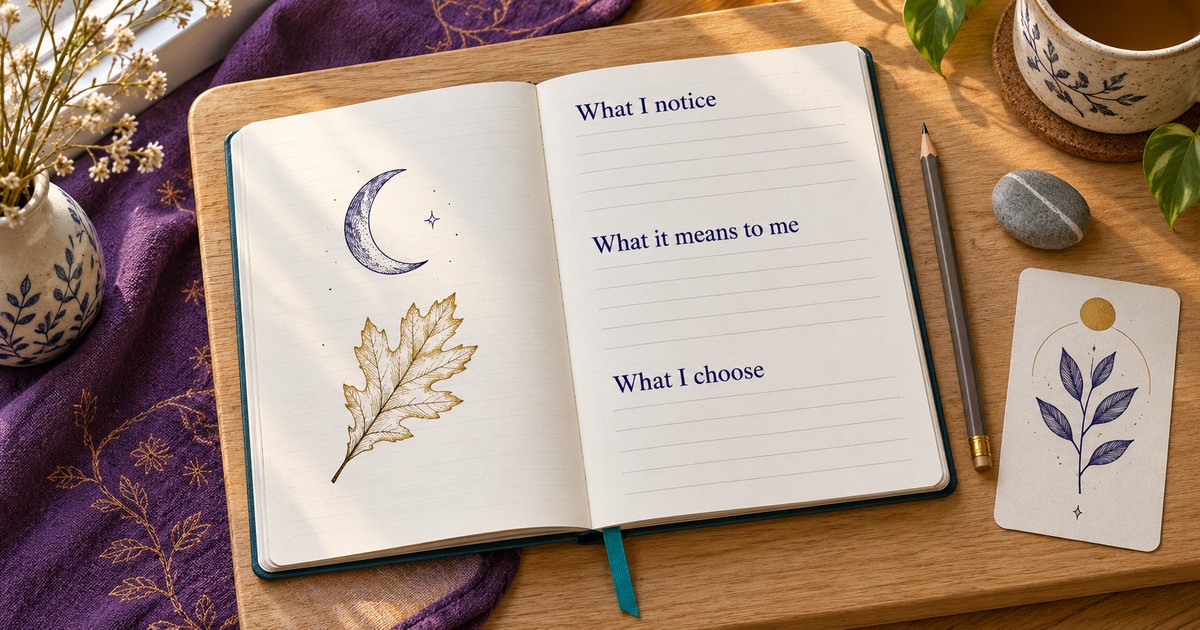
The three headings in the cover notebook can help keep observation, meaning and action separate:
- What I notice
- A leaf has changed color on a familiar tree. That is the observation; it does not tell me what will happen next in my life.
- What it means to me
- I choose to use seasonal change as a symbol for making room. Someone else could read the same leaf differently.
- What I choose
- I will clear one small shelf this weekend. The ordinary action is mine to adjust or skip; the leaf is not giving an order.
You could instead draw the moon, write about a plant or reflect on another symbol that matters to you. No particular symbol is required. That is a personal exercise, not a promise that a ritual will alter events. Our tool-free and tool-based practice guide offers ways to consider materials without assuming expensive objects are necessary.
Keep herbs and healing claims separate
Growing a plant or learning its folklore is different from swallowing a preparation, applying it to skin or treating an illness. Do not assume that a homemade potion is safe because it is natural or appears in a spiritual recipe. You can explore symbolism without consuming anything.
Poison Control explains that herbs and supplements can interact with medicines, changing their effects and causing harm. Discuss intended herbal products with a qualified health professional or pharmacist, including prescription and nonprescription medicines you use.
Choose communities with clear boundaries
Online groups can introduce different perspectives, but a shared spiritual label does not guarantee kindness or trustworthiness. Read group rules, notice how questions are handled and keep private information private. You can leave without accepting claims that you will be cursed or punished for doing so.
Before paying for teaching or attending a gathering, ask what is included, what it costs and what participation involves. Useful questions include:
- Cost and choice
- Can I see the total cost before deciding, and can I decline an activity without buying a remedy or proving my commitment?
- Privacy and contact
- What information is shared, and can I say no to touch, photographs or personal questions?
- Leaving or taking a break
- Can I stop participating without threats, curse claims or pressure to keep unsafe behavior secret?
You should be able to decline unwanted touch, secrecy demands or pressure to disclose intimate information. If you are under 18, involve a trusted parent or guardian before arranging contact with adult groups or teachers, and follow the group’s age requirements.
Read critically and decide at your own pace
One book you may encounter is The Modern Guide to Witchcraft: Your Complete Guide to Witches, Covens, and Spells by Skye Alexander. Its publisher identifies it as a guide to witchcraft practices. A publisher’s description of magic is not evidence that spells work or that a recipe is safe.
Use a library where possible, compare viewpoints and distinguish an author’s spiritual beliefs from historical, scientific or health claims. Check who wrote a source, which tradition it represents and whether its promises go beyond what it can support. You do not need to buy a book or prove an ability to take your interests seriously.
Ultimately, explore the label through the practices and commitments you choose, not through a stranger’s declaration about your hidden nature. Learning can be gradual, and changing your mind is allowed.
‘Witches love technology’? That’s a new one! Next thing you know, we’ll have witches on TikTok doing spells! As if social media wasn’t chaotic enough already. Can’t wait for the ‘WitchTok’ trend to take over!
This article provides a fascinating overview of witchcraft! It highlights important aspects like divination tools and the Wheel of the Year. For anyone interested in learning, it serves as a great starting point. I’ll definitely check out those recommended books!
I absolutely loved this article! It’s refreshing to see a positive perspective on witchcraft. The way technology is mentioned as a tool for connection among witches really resonates with me. I’m excited to explore more about this community!
‘Casting circles’ sounds like something I’d do on a lazy afternoon! Seriously though, I love how the article explains various practices in such an engaging way. It’s inspiring for someone like me who wants to dive deeper into witchcraft.
While I appreciate the effort put into this piece, I can’t help but feel it’s a bit misleading. Witchcraft is often romanticized, and the reality can be much different. We should approach such topics with more critical thinking.
‘Healing witches’? Really? While I’m all for exploring traditions, we must remain grounded in science. A balance between folklore and modern medicine is essential when discussing health practices that claim to be magical.
I find it amusing that the article presents witchcraft as this inviting and friendly practice. In reality, many people are skeptical about it due to historical stigmas. It’s worth discussing both sides rather than painting it in just one light.
‘Music for witches’? Does that mean we need special playlists? What’s next—witches having their own genre at music festivals? It’s funny how all this can turn into an entire cultural phenomenon!